Best Cloud Storage Services in 2026 — Top 14 Free and Paid Options Compared

Cloud storage has become as essential as electricity. Every photo you take, every document you create, and every project you collaborate on lives in the cloud. But with dozens of services competing for your money, choosing the right one matters more than ever.
The landscape in 2026 has shifted significantly. AI-powered search, end-to-end encryption, and lifetime pricing plans have become major differentiators. Google and Microsoft dominate through ecosystem lock-in, while privacy-focused alternatives like Sync.com and pCloud have carved out loyal followings. Free tiers range from a paltry 1 GB (Internxt) and 2 GB (Dropbox) to a generous 20 GB (MEGA).
We compared the 14 best cloud storage services based on free storage, pricing, security, platform compatibility, collaboration features, and overall value. Whether you need basic backup or enterprise-grade file sync, here are your best options.
Last updated: November 2026 by SaveDelete Editorial — prices and plans checked on each provider’s own website, and our separate best-cloud-storage guide merged into this one.
Quick Comparison: Best Cloud Storage Services 2026
Prices checked on each provider’s own site in November 2026. Introductory prices often renew higher, and some providers show prices by region, so confirm before you buy.
| Service | Free Storage | Paid Plans (from) | Encryption | Best For |
|---|---|---|---|---|
| Google Drive | 15 GB | $1.99/mo (100 GB, US) | At rest + transit | Android + Google ecosystem |
| iCloud+ | 5 GB | $0.99/mo (50 GB) | E2E (Advanced Data Protection) | Apple ecosystem |
| OneDrive | 5 GB | $1.99/mo (100 GB) | At rest + transit | Microsoft 365 users |
| Dropbox | 2 GB | $9.99/mo (2 TB) | At rest + transit | File sync + collaboration |
| pCloud | Up to 10 GB | $159 lifetime (500 GB) | Optional E2E (extra) | Lifetime plans |
| Sync.com | 5 GB | $9/mo (1 TB, billed yearly) | Zero-knowledge E2E | Privacy and security |
| MEGA | 20 GB | Billed in euros | Zero-knowledge E2E | Free encrypted storage |
| IDrive | 10 GB | $0.25/mo (100 GB) | Optional E2E | Backup + value |
| Backblaze B2 | — | $6.95/TB/mo | At rest + transit | Developers + bulk storage |
| Internxt | 1 GB | Annual or lifetime plans | Zero-knowledge E2E | Open-source privacy |
| Proton Drive | 5 GB | $2.49/mo (200 GB, 1-yr) | Zero-knowledge E2E | Swiss privacy |
| Box | 10 GB | Personal Pro (100 GB) | At rest + transit | Business collaboration |
| Icedrive | Free tier | Subscription or lifetime | Client-side (Twofish) | Encrypted lifetime storage |
| Koofr | 10 GB | From 2 EUR/mo (100 GB) | At rest + transit | Connecting several clouds |
Related: Microsoft 365 Family Storage Cut: What a Shared 2 TB Pool Means
How We Chose These Services
SaveDelete has covered cloud and security software since 2009. For this guide we compared each service on the factors that matter most, using each provider’s published plans, prices and security documentation:
- Free storage & pricing — how much you get free, and real cost per TB across monthly, annual, and lifetime plans.
- Security & encryption — at-rest/in-transit vs. true zero-knowledge end-to-end encryption, plus 2FA and compliance (HIPAA, GDPR).
- Platform support — Windows, macOS, Linux, Android, iOS, and web coverage.
- Sync & collaboration — sync speed, file versioning, sharing, and real-time document editing.
- Value & reliability — overall bang for the buck and the provider's track record.
Prices were current at the time of writing — always confirm on the vendor's site, since cloud plans change often.
1. Google Drive (Google One) — Best for Android and Google Users
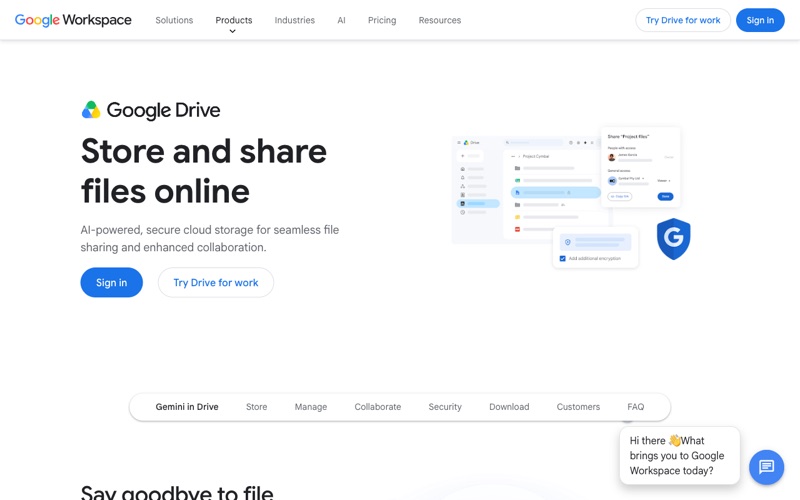
Google Drive remains the most popular cloud storage service in 2026, largely because every Gmail account comes with 15 GB of free storage shared across Drive, Gmail, and Google Photos. For most people, this is the cloud storage they use without even thinking about it.
Paid Google One plans start at $1.99 per month for 100 GB in the US. Larger plans add more storage, and the top Google AI Pro tier bundles Gemini AI features with several terabytes. Paid plans can be shared with up to five other people. Integration with Google Docs, Sheets, Slides, and the entire Google Workspace makes real-time collaboration seamless.
The main concern is privacy. Google scans your files to power its AI features and advertising (unless you are on a Workspace plan). If privacy is a priority, look at Sync.com or MEGA instead.
Pros: 15 GB free; seamless Google Docs/Workspace collaboration; excellent search and Gemini AI features.
Cons: Files are scanned for AI and ads on personal plans; storage is shared with Gmail and Photos.
Security: Encrypted in transit and at rest, but Google holds the keys (no zero-knowledge). 2FA supported.
2. iCloud+ — Best for Apple Ecosystem
iCloud+ is the obvious choice if you live in the Apple ecosystem. It syncs photos, documents, passwords, notes, and device backups across every iPhone, iPad, Mac, and Apple Watch you own. The 5 GB free tier is tight, but paid plans start at just $0.99 per month for 50 GB.
Apple's Advanced Data Protection enables end-to-end encryption for nearly all iCloud data categories, making it one of the most secure major cloud storage options when this feature is turned on. iCloud+ also includes Private Relay (a VPN-like service for Safari), Hide My Email, and custom email domain support.
The 2 TB plan at $9.99 per month can be shared with up to five family members. The biggest limitation is that iCloud's collaboration features are far behind Google and Microsoft — it is primarily a sync and backup service, not a productivity platform.
Pros: Effortless sync across Apple devices; cheap entry ($0.99 for 50 GB); includes Private Relay and Hide My Email.
Cons: Only 5 GB free; weak collaboration; clumsy on Windows and Android.
Security: End-to-end encryption for most data when Advanced Data Protection is enabled; 2FA standard.
3. Microsoft OneDrive — Best for Microsoft 365 Users
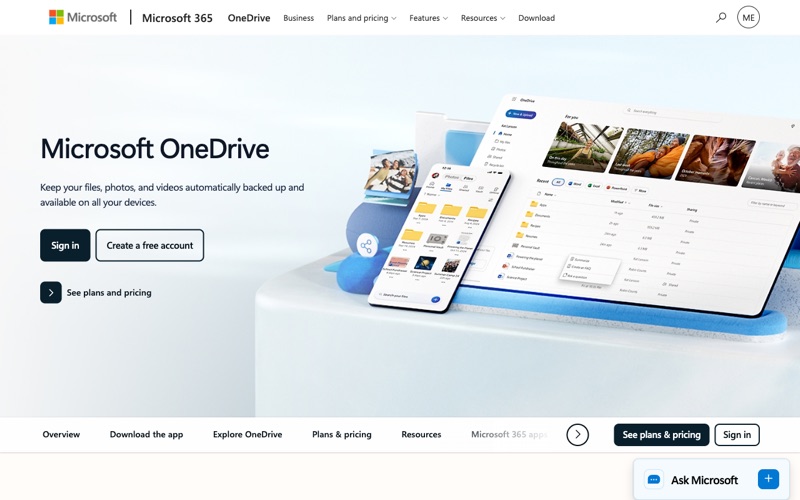
Microsoft OneDrive offers 5 GB free and integrates deeply with Windows, Microsoft 365, and Teams. Microsoft 365 Basic adds 100 GB for $1.99 per month ($19.99 a year). The real value comes with Microsoft 365 Personal, which includes 1 TB plus the full Office apps for $99.99 a year (Microsoft was offering it from $69.99 at the time of writing), or Microsoft 365 Family at $129.99 a year ($12.99 a month) for up to six people, who now share a 2 TB storage pool.
OneDrive's killer feature is its tight integration with Windows — it appears as a native folder in File Explorer with on-demand file access that downloads files only when you open them, saving local disk space. Real-time collaboration on Word, Excel, and PowerPoint documents works flawlessly.
The Personal Vault feature adds an extra layer of security with two-factor authentication for your most sensitive files. For businesses, OneDrive integrates with SharePoint and Teams for enterprise-grade document management.
Pros: 1 TB plus the full Office suite with Microsoft 365 Personal; native Windows File Explorer integration; Personal Vault.
Cons: Only 5 GB free standalone; best value requires a 365 subscription.
Security: Encrypted at rest and in transit; Personal Vault adds 2FA; no zero-knowledge by default.
4. Dropbox — Best File Sync Technology
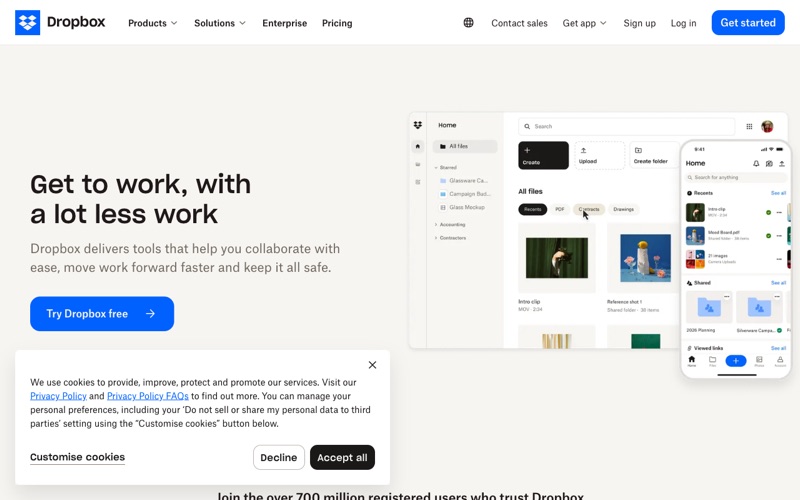
Dropbox pioneered modern cloud storage and still has the best file sync engine in the business. Delta sync means it only uploads the changed parts of a file rather than the entire file, making it significantly faster than competitors for large files that change frequently.
The free tier is a miserly 2 GB — the smallest on this list. Paid plans start at $9.99 per month for 2 TB (Plus); team plans start at $15 per user per month (Standard, from 3 TB shared) and $24 per user per month (Advanced). Dropbox has evolved into a collaboration platform with features like Dropbox Paper, integrated e-signatures, and video messaging via Capture.
Dropbox works on every platform — Windows, Mac, Linux, iOS, Android, and the web. The Smart Sync feature lets you see all your files in your file system without storing them locally. For creative professionals working with large design files, video projects, or CAD drawings, Dropbox's sync speed is unmatched.
Pros: Best-in-class block-level sync speed; works on every platform including Linux; strong collaboration (Paper, e-sign).
Cons: Stingy 2 GB free tier; pricier than rivals; no zero-knowledge encryption.
Security: AES-256 at rest, TLS in transit, 2FA — but Dropbox holds the keys.
5. pCloud — Best Lifetime Plans
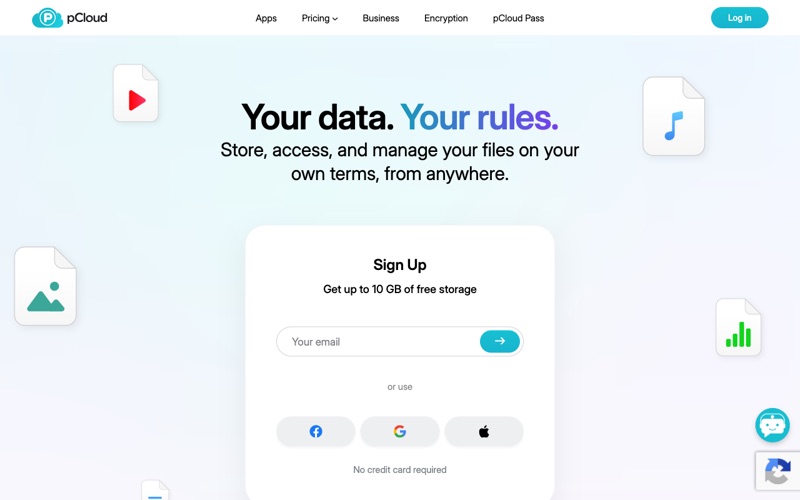
pCloud stands out with its lifetime pricing model. Lifetime plans cost $159 for 500 GB, $379 for 2 TB and $1,099 for 10 TB at pCloud’s current sale prices (listed at $279, $709 and $2,799), with no recurring fees. Over five years, that is dramatically cheaper than most subscriptions. Annual plans are also available.
The free tier offers up to 10 GB. Regular files are protected with TLS encryption during transfer and AES-256 encryption at rest. For true zero-knowledge encryption, you need pCloud Crypto as an optional add-on — this encrypts files on your device before upload using a key only you know.
pCloud's built-in media player streams music and video directly from your cloud storage without downloading. The platform works on Windows, Mac, Linux, iOS, and Android. Swiss data centers provide additional privacy protection under Switzerland's strict data laws.
Pros: One-time lifetime plans (pay once, keep forever); built-in media streaming; Swiss privacy jurisdiction.
Cons: True zero-knowledge (pCloud Crypto) costs extra; the lifetime upfront price is steep.
Security: TLS and AES-256; optional client-side zero-knowledge encryption via the pCloud Crypto add-on.
6. Sync.com — Best for Privacy
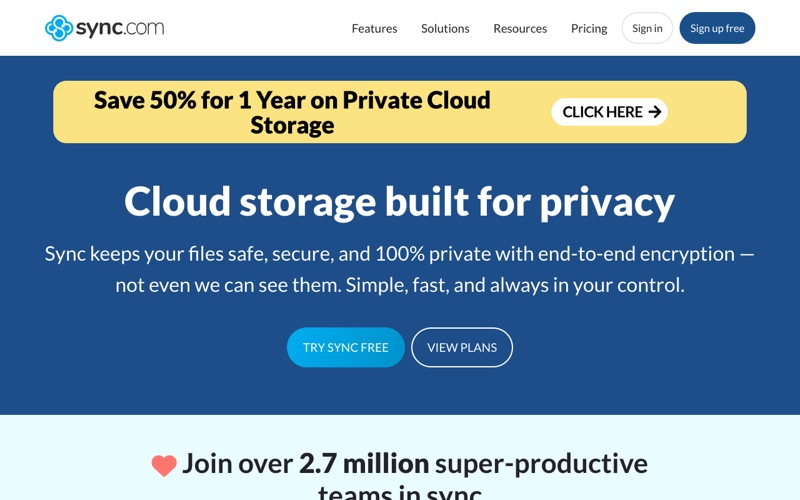
Sync.com is the gold standard for private cloud storage. Every plan — including the free 5 GB tier — includes zero-knowledge end-to-end encryption. This means Sync.com cannot read your files, even if compelled by law enforcement. They literally do not have the keys.
The service is HIPAA and GDPR compliant, making it suitable for healthcare, legal, and financial professionals who handle sensitive data. Personal plans start at $9 per month for 1 TB with annual billing (a first-year discount from $12), and a 5 TB plan costs $21 per month in its first year (from $28).
Sync.com's interface is clean but less polished than Google Drive or Dropbox. Collaboration features are more limited, and there are no built-in document editors. The trade-off is absolute privacy — if you value your data security above all else, Sync.com is the clear winner.
Pros: Zero-knowledge end-to-end encryption on every plan (including free); HIPAA and GDPR compliant; affordable 1 TB.
Cons: No built-in document editors; basic collaboration; interface less polished.
Security: Zero-knowledge end-to-end encryption — the provider literally cannot read your files. 2FA.
7. MEGA — Best Free Encrypted Storage
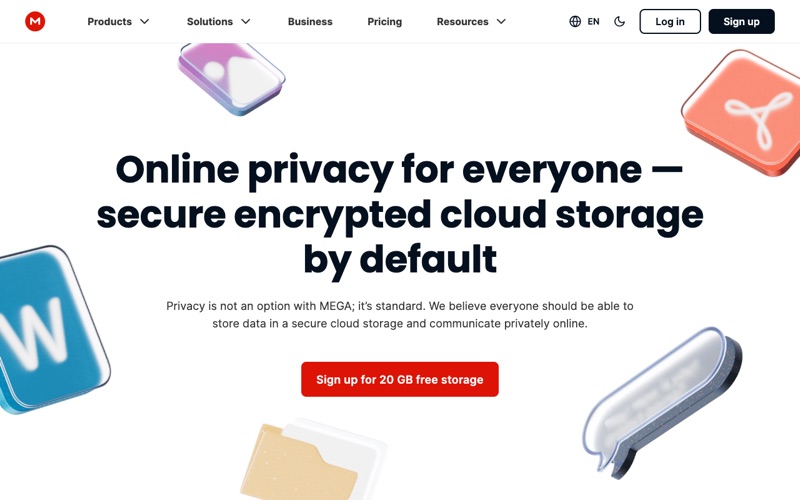
MEGA offers the most generous free tier with 20 GB of zero-knowledge encrypted storage at no cost. All data is encrypted on your device before it reaches MEGA's servers, making it one of the most private free options available.
Paid Pro plans scale up to 20 TB and are billed in euros; MEGA puts the cost of its yearly Pro III plan at about €1.25 per TB per month. MEGA also offers built-in encrypted chat and video conferencing, positioning itself as a privacy-focused alternative to Google Workspace.
MEGA was founded by Kim Dotcom (of Megaupload fame) and is based in New Zealand. The platform works across all major operating systems and browsers. File sharing is flexible with password-protected links and expiration dates.
Pros: Most generous free tier (20 GB); zero-knowledge encryption by default; built-in encrypted chat and calls.
Cons: Some free space is promotional/expiring; founder history makes some users wary; can be RAM-heavy.
Security: Zero-knowledge end-to-end encryption on all files; New Zealand jurisdiction; 2FA.
8. IDrive — Best Budget Backup Solution
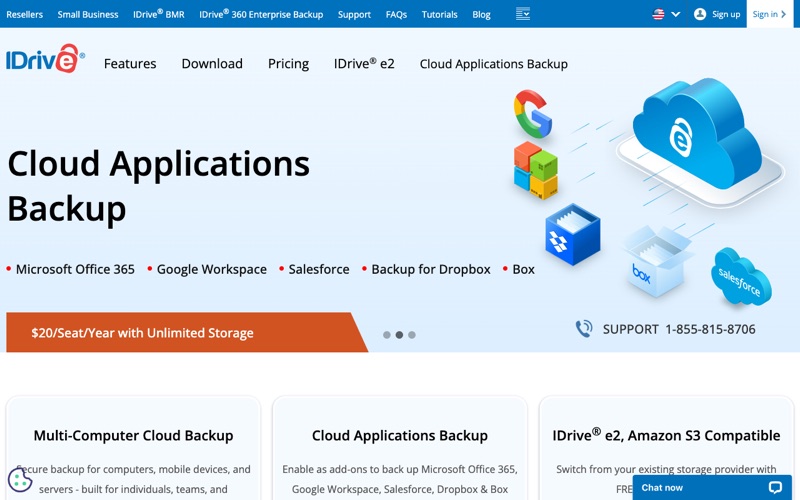
IDrive offers extraordinary value. The Mini plan costs just $0.25 per month for 100 GB, and IDrive Personal offers 5 TB for $6.99 per month in the first year (from $9.99), backing up multiple computers. IDrive’s discounts apply to the first year, after which standard pricing applies.
IDrive is primarily a backup service rather than a sync-and-share platform. It backs up your entire computer, external drives, NAS devices, and mobile devices to the cloud. Versioning keeps up to 30 previous versions of every file, and the IDrive Express service ships you a physical drive for faster initial backup or recovery.
Optional private encryption is available at no extra cost, though it must be enabled during initial setup. IDrive consistently wins "best value" in cloud backup comparisons.
Pros: Unbeatable value ($0.25/mo for 100 GB); backs up unlimited devices; 30 file versions plus physical-drive shipping.
Cons: Backup-first, not a smooth sync-and-share tool; private encryption must be set at signup; dated UI.
Security: AES-256 with an optional private (zero-knowledge) encryption key. 2FA.
9. Backblaze B2 — Best for Developers and Bulk Storage
Backblaze B2 is cloud storage infrastructure that starts at $6.95 per TB per month on pay-as-you-go pricing — a fraction of what consumer services charge per terabyte.
B2 is not a consumer file sync service. It is object storage with an S3-compatible API, designed for developers, photographers with massive archives, video editors, and anyone who needs cheap bulk storage. It integrates with tools like rclone, Cyberduck, and many NAS devices.
Backblaze also offers Personal Backup at $99 a year for unlimited backup of a computer, which is a different product from B2 but equally compelling for straightforward computer backup.
Pros: Dirt-cheap (from $6.95/TB/mo); S3-compatible API; no minimums; ideal for archives and NAS.
Cons: Not a consumer sync app; needs technical setup; no collaboration features.
Security: Encrypted at rest and in transit, with optional server-side and application-level encryption.
10. Internxt — Best Open-Source Privacy Alternative
Internxt is an open-source, zero-knowledge encrypted cloud storage service based in the EU. A 1 GB free tier lets you try it, and paid plans (1 TB, 2 TB and 5 TB) are sold yearly or as one-time lifetime purchases.
What makes Internxt unique is its commitment to transparency — the entire codebase is open source and has been independently audited. Files are fragmented, encrypted, and distributed across multiple servers, so no single server holds a complete file. The service is fully GDPR compliant and based in Spain.
Internxt is newer and less feature-rich than established players, but it appeals strongly to users who want verifiable privacy without taking a company's word for it.
Pros: Open-source and independently audited; zero-knowledge encryption; EU/GDPR; lifetime plans available.
Cons: Only 1 GB free; newer with fewer features; smaller ecosystem.
Security: Zero-knowledge end-to-end encryption with files fragmented across servers; fully open-source.
11. Proton Drive — Best for Swiss Privacy
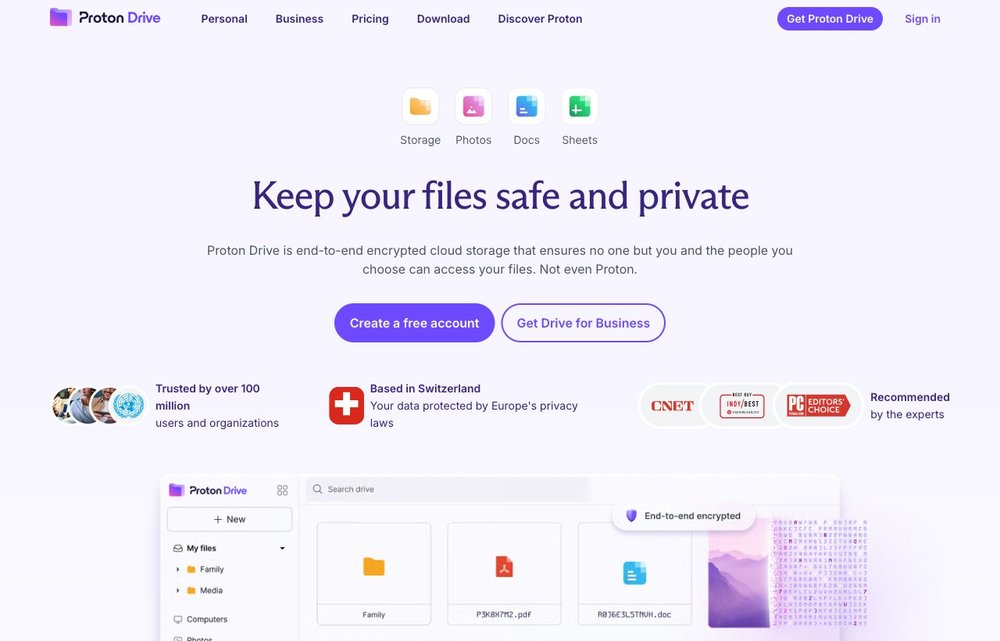
From the makers of Proton Mail, Proton Drive is a security-first, Swiss-based service with zero-knowledge encryption and open-source apps. The free plan includes 5 GB. Drive Plus adds 200 GB for $2.49 per month on the 1-year plan ($29.88 for the first year, then $47.88), and Proton Unlimited bundles 500 GB with Proton Mail, VPN and Pass for $6.49 per month on the 1-year plan.
Pros: Zero-knowledge encryption; open-source apps; Swiss jurisdiction; bundles with Proton Mail and VPN.
Cons: Only 5 GB free; fewer collaboration tools than Google or Microsoft.
Security: End-to-end encryption on all files; Swiss privacy laws.
12. Box — Best for Business Collaboration
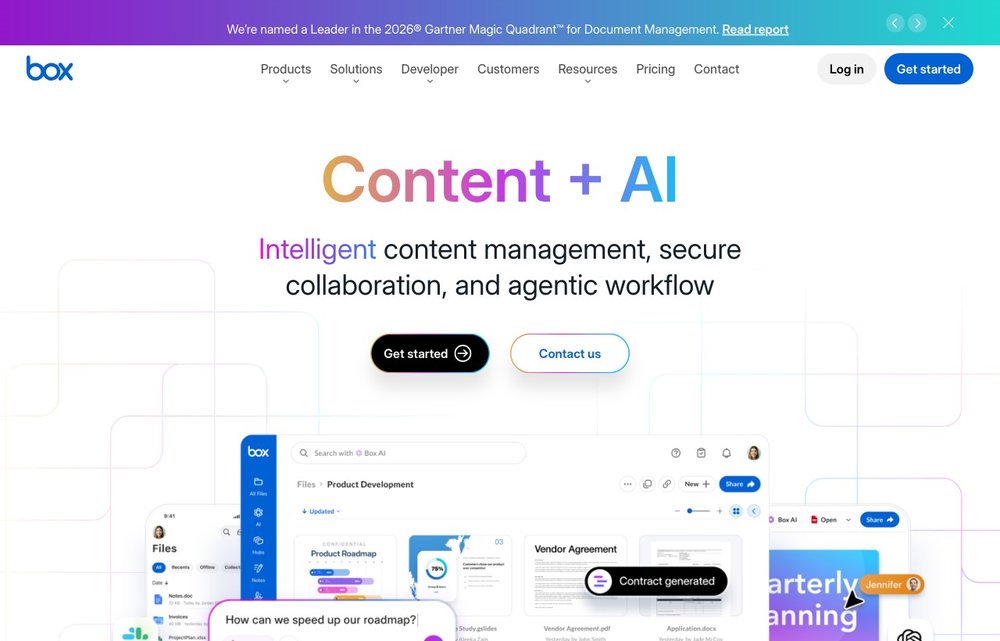
Box is built for business and team collaboration, with granular permissions, workflow automation (Box Relay), e-signatures (Box Sign) and deep integrations with Microsoft, Google and Adobe tools. The free Individual plan includes 10 GB with a 250 MB file-upload limit, and Personal Pro raises that to 100 GB with 5 GB uploads.
Pros: Strong permissions and workflow tools; wide business integrations.
Cons: Small upload limit on the free plan; aimed more at teams than personal storage.
Security: Encrypted at rest and in transit; Box manages the keys by default.
13. Icedrive — Best Encrypted Lifetime Alternative
Icedrive is a slick, modern service with a free tier and genuine client-side encryption (it uses the Twofish algorithm rather than the more common AES). Clean desktop and mobile apps plus lifetime pricing make it a strong pCloud rival for anyone who wants real encryption and a one-off payment instead of a subscription.
Pros: Client-side encryption; lifetime plans; clean apps.
Cons: Smaller company with a shorter track record; fewer collaboration features.
Security: Client-side Twofish encryption on encrypted folders.
14. Koofr — Best for Connecting Several Clouds
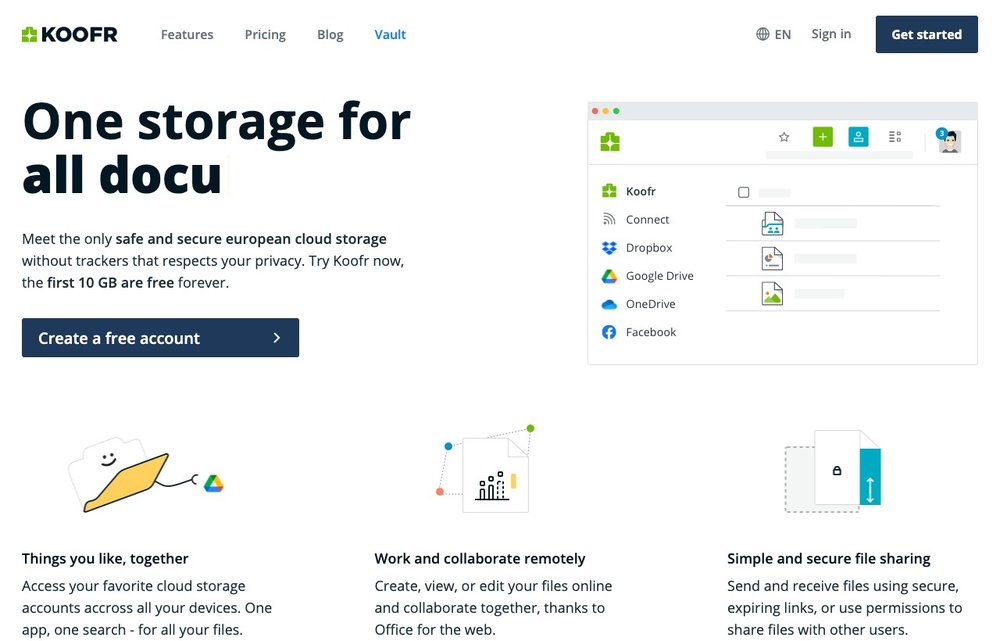
Koofr is a privacy-respecting European provider (based in Slovenia) with no trackers and 10 GB free. Its standout feature is aggregation: connect your Dropbox, Google Drive and OneDrive accounts and search across all of them from one app. Paid plans are priced in euros, starting at 2 EUR a month for 100 GB, and lifetime plans are available.
Pros: 10 GB free; connects other clouds in one place; EU-based with no trackers.
Cons: Smaller ecosystem; fewer collaboration tools.
Security: Encrypted in transit and at rest; optional encrypted vault.
Also Worth Knowing
Tresorit is an end-to-end encrypted service owned by Swiss Post, with personal plans from 50 GB up to 4 TB; it is a strong choice if you need zero-knowledge storage with business-grade controls.
A Note on Amazon Drive
If you came here looking for Amazon Cloud Drive, note that Amazon shut down Amazon Drive at the end of 2023. Amazon now only offers Amazon Photos for photo and video storage (free unlimited photo storage for Prime members), so it is no longer a general-purpose cloud drive.
Cloud Storage Security: Zero-Knowledge vs Standard Encryption
Almost every provider encrypts your files in transit (as they travel to the server) and at rest (while stored on disk). The crucial difference is who holds the keys.
- Standard encryption (Google Drive, OneDrive, Dropbox, iCloud, Box): the provider manages the encryption keys, so it can access your files — to power search, previews and sharing, or if compelled by law. Convenient, but you are trusting the company.
- Zero-knowledge / end-to-end encryption (Proton Drive, Sync.com, MEGA, Internxt and Tresorit; optional on pCloud, Icedrive and IDrive): files are encrypted on your device before upload and only you hold the key. Not even the provider can read your data — but if you lose your password, your files may be unrecoverable.
If you store sensitive documents, choose a zero-knowledge service. For everyday files where convenience and collaboration matter most, standard encryption is usually fine.
Cloud Storage vs Cloud Backup vs Sync
These terms get mixed up, but they solve different problems:
- Cloud storage / sync (Google Drive, Dropbox, OneDrive) keeps a folder mirrored across your devices. Delete a file on one device and it disappears everywhere — great for access, but not a safety net.
- Cloud backup (IDrive, Backblaze) automatically copies your whole computer in the background and keeps old versions, so you can recover after accidental deletion, ransomware or hardware failure.
Many people use both: a sync service for day-to-day files and a dedicated backup for true protection. For a deeper look, see our guide to the best backup software.
Choosing the Right Cloud Storage for You
- You use Google everything: Google Drive. The 15 GB free tier and deep integration make it the default choice.
- You are all-in on Apple: iCloud+. Seamless sync across all Apple devices.
- You need Office apps: OneDrive with Microsoft 365. 1 TB of storage plus the full Office suite is hard to beat.
- You work with large files: Dropbox. Best-in-class sync speed for creative professionals.
- You hate subscriptions: pCloud lifetime plans. Pay once, keep forever.
- Privacy is non-negotiable: Sync.com or MEGA. Zero-knowledge encryption on all plans.
- You need cheap bulk storage: IDrive or Backblaze B2. Best value per gigabyte.
- You want Swiss privacy with email and VPN: Proton Drive.
- You collaborate with a business team: Box.
- You already use several clouds: Koofr, to manage them from one app.
For an additional layer of security when accessing your cloud files from public networks, use a reliable VPN service, protect your accounts with a password manager and strong antivirus software, and if you store large media files, see our guide to the best video editing software that fits cloud workflows. Comparing the two big sync services? Read our Dropbox vs OneDrive comparison. To manage several clouds from the command line, try rclone.
Related guides: The best backup software · How to send large files · The best online backup for Mac · Dropbox vs OneDrive: the complete comparison
Frequently Asked Questions
What is the best free cloud storage service?
Google Drive offers the best overall free cloud storage with 15 GB shared across Drive, Gmail and Photos. MEGA gives the most free space, 20 GB, with zero-knowledge encryption. IDrive, Box and Koofr offer 10 GB, pCloud up to 10 GB, Sync.com, OneDrive, iCloud and Proton Drive 5 GB, Dropbox 2 GB and Internxt 1 GB.
Which cloud storage is the most secure?
Services with zero-knowledge, end-to-end encryption are the most private, because even the provider cannot read your files. Sync.com, MEGA, Proton Drive, Internxt and Tresorit encrypt everything this way, and pCloud (with its encryption add-on), Icedrive and IDrive offer it as an option. Apple’s iCloud+ with Advanced Data Protection also end-to-end encrypts most data. Google Drive, OneDrive, Dropbox and Box encrypt files but hold the keys.
Is a lifetime cloud storage plan worth it?
It can be if you plan to use the same service for many years. pCloud’s 2 TB lifetime plan costs $379 at its current sale price (listed at $709), which matches several years of a typical 2 TB subscription. Internxt, Icedrive and Koofr also sell lifetime plans. The risk is that the company changes its terms or closes, so choose an established provider and keep a separate backup.
What is the cheapest cloud storage?
For small amounts, IDrive Mini at $0.25 a month for 100 GB and Microsoft 365 Basic or Google One at $1.99 a month for 100 GB are the cheapest entry points. For large backups, IDrive Personal (5 TB) and Backblaze B2 (from $6.95 per TB per month) are among the lowest costs per terabyte, and pCloud’s lifetime plans can be cheapest over many years.
How much does 1 TB of cloud storage cost?
Most 1 TB options cost roughly $6 to $10 a month. Microsoft 365 Personal includes 1 TB plus the Office apps for $99.99 a year, Sync.com charges $9 a month for 1 TB on annual billing in the first year, and Backblaze B2 starts at $6.95 per TB per month for pay-as-you-go storage. Lifetime plans such as pCloud’s cost more upfront but nothing after that.
Do I really have to pay for cloud storage?
Not necessarily. Google gives you 15 GB free, MEGA 20 GB, and IDrive, Box and Koofr 10 GB each, which is enough for documents and some photos. You only need to pay once your photos, videos or backups outgrow the free tier, or if you want features such as larger zero-knowledge encrypted storage.
Is Amazon Cloud Drive still available?
No. Amazon shut down Amazon Drive at the end of 2023. Only Amazon Photos remains, which is limited to photos and videos (with free unlimited photo storage for Prime members) rather than general files.
Can I use multiple cloud storage services?
Yes, and many people do. A common setup is Google Drive or iCloud for everyday files and photos, combined with a privacy-focused service like Sync.com, MEGA or Proton Drive for sensitive documents. Koofr can connect several accounts in one app, and tools like rclone or Cyberduck can manage multiple clouds.
What is zero-knowledge encryption?
Zero-knowledge encryption means your files are encrypted on your device before they are uploaded, and only you hold the key. The provider cannot read your files, even if compelled by law enforcement or hacked. The trade-off is that if you lose your password, your files may be unrecoverable.
Is cloud storage safe?
Reputable cloud storage is generally safer than a single local drive: your data is encrypted and stored redundantly across servers. For maximum safety, pick a service with zero-knowledge encryption, turn on two-factor authentication, and keep a separate backup. Avoid storing passwords or recovery keys in unencrypted cloud folders.
How much cloud storage do I need?
For documents and phone photos, 100–200 GB is plenty for most people. Heavy photo or video libraries, or a whole household, usually need 1–2 TB. Professionals with large media or full-computer backups should look at 2 TB or more, or pay-as-you-go options like Backblaze B2. Start small: most services let you upgrade anytime.
What is the difference between cloud storage and cloud backup?
Cloud storage (Google Drive, Dropbox) syncs selected files so you can access and share them across devices. Cloud backup (IDrive, Backblaze) automatically copies your entire computer for disaster recovery. Sync tools mirror changes, including deletions, so they are not a true backup; ideally use both.
Cloud storage or an external hard drive: which is better?
They complement each other. Cloud storage gives you anywhere-access and protects against a lost or stolen device; an external drive is a one-time cost and works offline. The safest approach is the 3-2-1 rule: keep your files in at least two places, with one copy off-site in the cloud.