Canada's Permanent Daylight Time: Why Clocks May Be Wrong Nov 1
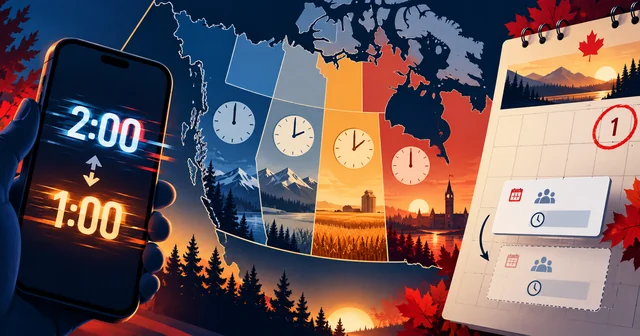
Four parts of Canada have stopped changing their clocks in 2026, and the last scheduled fall-back on November 1 is when devices that missed the update could show the wrong hour. British Columbia, Alberta, the Northwest Territories and Manitoba now keep one fixed offset all year. Devices only get this right with an updated time zone database.
What Happened
On October 22, Google posted advice in its Android community help forum for Canadians whose phones show the wrong time "due to the new time zone laws beginning Nov 1", as The Verge and 9to5Google reported. Google's first suggestion is plain: install any pending updates from the phone maker and from Google, then restart. The same week, Google updated an administrator guide for Canadian daylight saving changes in Google Calendar, warning that some meetings will appear an hour late from November 1.
The warnings follow a year in which Canadian provinces and territories changed their time rules one by one, each with only a few weeks' or months' notice. The volunteer-run IANA time zone database, which almost every operating system relies on, recorded each change in a separate release. According to the tz database release notes:
- British Columbia made its March 8, 2026 spring-forward its last clock change and legally moved to permanent UTC-7 on March 9. The database added this in release 2026b on April 22.
- Alberta moved to permanent UTC-6 on June 18, recorded in release 2026c on July 8.
- The Northwest Territories followed Alberta to permanent UTC-6 on August 21, recorded in release 2026d on September 11.
- Manitoba moves to permanent UTC-5 on October 31, recorded in release 2026e on September 29.
Manitoba moved fastest. CP24 reported on September 25 that Premier Wab Kinew had signed a proclamation in Selkirk ending clock changes, a week after announcing the plan. About 58% of the 72,000 Manitobans who answered a provincial survey wanted to keep daylight time, against 34% for standard time. That left software makers barely five weeks between the database update and the date clocks would otherwise have fallen back.
Why It Matters
Your phone does not work out the local time by itself. It gets an accurate universal time from the network or GPS, then applies a rulebook that says how far your region sits from UTC on any given date. If that rulebook still says Vancouver falls back to UTC-8 on November 1, the phone will move the clock back an hour that the province no longer moves. Alarms go off an hour early in local terms, and reminders and boarding times shift with them.
The bigger problem is stored appointments. Google says any Calendar event that meets three conditions will appear one hour later than intended: it falls on or after November 1, 2026, it uses one of the affected Canadian time zones, and it was created before Google updated its definitions for that region. For British Columbia that means events created before July 20, 2026. For Alberta and Yellowknife it is before September 8, for Inuvik before September 28, and for Winnipeg before mid-October. A 9:00 AM meeting booked in May may now show at 10:00 AM.
The changes also redraw Canada's time map in winter. Alberta at UTC-6 will match Saskatchewan, which has long stayed on one offset all year. Manitoba at UTC-5 will share an offset with Ontario's Eastern Standard Time through the winter. British Columbia at UTC-7 matches Yukon, which stopped changing its clocks in 2020. Anyone who schedules across provinces has to relearn the gaps between them.
There is a US angle too. The Verge notes that the House advanced the Sunshine Protection Act in July, which would make daylight time permanent nationwide. Canada's year is a preview of the software work that would involve, though a single national change would probably be simpler than a patchwork of provincial ones.
How It Works
The IANA time zone database, often called tzdata or the Olson database, is a set of plain-text files maintained by a small group of volunteers. Each region has a named zone such as America/Vancouver or America/Winnipeg, with a history of every offset and every daylight saving rule it has used. A compiler called zic turns those files into compact binary files that operating systems read whenever they convert UTC into local time. Android, iOS, macOS, Linux, most programming languages and many cloud services all start from this data.
Reaching your device takes several steps. The volunteers spot a legal change and publish a release. Platform teams then apply, test and ship it. The Android Developers Blog explained in 2024 that time zone rules ship as a separate "Time Zone Data" module through Project Mainline, introduced in Android 10, so Google can push it through Google Play without waiting for a full system update from the phone maker. Since 2023 that module has been separate from other Mainline components, so Google can release it outside the normal cycle. Phones older than Android 10, or ones that no longer get system updates, depend on their maker shipping a firmware update.
Canada's year added a twist. The database does not show the four changes on their legal dates. It models each as taking effect at 02:00 on November 1, 2026. The maintainers call this a "temporary hack" that works around a limitation in Unicode CLDR 48.1, the locale data many apps use to display time zone names. Because nothing differs on the clock until the fall-back would have happened, the shortcut changes no displayed times. It does mean that November 1 is the first moment any device behaves differently, which is why the problems arrive together.
The hack also exposed a bug. The 2026b notes warn that zic versions 2023d through 2026a, used to compile the newer data in their default "slim" mode, produce a file some readers misinterpret, and they then miss Vancouver's November 1 change. The fix is to rebuild with a current zic or with the "zic -b fat" option. Ordinary users will not see this, but Linux distributions, embedded devices and server images built with older tools may.
Calendar apps have a separate problem. Most store a meeting as a local time plus a zone name, then work out the actual moment in UTC using the rules they knew at the time. An event saved in May for "9:00 AM America/Vancouver on November 4" was converted using the old rule, UTC-8. Under the new rule, UTC-7, the same moment in UTC falls at 10:00 AM local time. Google says it will automatically shift most affected events back to their original local times in October, covering single events and recurring events without exceptions. It will not touch everything. Invitations from Outlook users and recurring series with custom exceptions are left alone, and Google Calendar on the web will show a banner with a "Move one hour earlier" button. Google also warns that shifted meetings can clash with rooms booked later under the new rules.
If your Android phone still shows the wrong time after updating and restarting, Google recommends opening Settings, searching for "Date and time", and turning on both "Automatic time zone" and "Use location for time zone". If that fails, turn off automatic time zone and manually pick a zone with the correct offset.
What's Still Unknown
The biggest open question is northwestern Ontario. Some communities there have historically kept the same time as Winnipeg. The 2026e release assumes they will follow Manitoba, so it adds no new zones, but the maintainers say another release may be needed if any of them diverge. Google's Calendar guide already lists America/Rainy_River alongside America/Winnipeg among the affected zones.
It is also not clear how many devices will miss the updates. Android's Mainline route covers most phones from Android 10 onward. Smart TVs, car dashboards, set-top boxes, smart speakers and industrial equipment often run old firmware that never receives a new database. Android's time zone policy for governments asks for at least six months' notice. Manitoba announced its change about six weeks before it took effect.
Finally, the abbreviations are provisional. The database labels British Columbia's new time MST, Alberta's CST and Manitoba's EST, following North American practice for those offsets. The maintainers say they may change the labels if another name becomes popular. That will not affect the clock, but it may confuse people who see "MST" in Vancouver.
Frequently Asked Questions
Which parts of Canada stop changing their clocks in 2026?
British Columbia (permanent UTC-7), Alberta (permanent UTC-6), the Northwest Territories (permanent UTC-6) and Manitoba (permanent UTC-5) all stop changing their clocks this year. They join Saskatchewan and Yukon, which already kept one offset all year. In each of the four, November 1, 2026, the date clocks would have fallen back, is the first day the new rules make a visible difference.
Why could my phone show the wrong time on November 1?
Phones get universal time from the network, then apply a local rulebook from the IANA time zone database. If that rulebook predates your province's change, the phone still expects a fall-back and moves the clock back one hour. Installing pending system and Google Play updates, then restarting, loads the corrected rules on most Android phones from Android 10 onward.
How do I fix the wrong time on an Android phone?
Google recommends installing any pending updates from your phone maker and from Google, then restarting. If the time is still wrong, open Settings, search for "Date and time", and turn on "Automatic time zone" and "Use location for time zone". As a last resort, turn off automatic time zone and choose a zone manually that shows the correct offset for your area.
Why are some Google Calendar meetings an hour late?
Events created before Google updated its definitions for a region were converted to universal time using the old rule. Under the new rule the same moment shows one hour later in local time. Google says it is moving most affected events back automatically and shows a "Move one hour earlier" banner on Calendar for the web, but Outlook invitations and edited recurring series need checking by hand.
What is the IANA time zone database?
It is a free, volunteer-maintained set of files that records every region's UTC offset and daylight saving rules, past and planned. Operating systems such as Android, iOS, macOS and Linux, along with most programming languages, compile their local time behaviour from it. A new release appears whenever a government changes its rules, which has happened five times so far in 2026.
Will Manitoba and Ontario be on the same time this winter?
Yes, at the offset level. Manitoba stays at UTC-5 permanently, and Ontario's Eastern Standard Time is also UTC-5 from November to March. In summer, when Ontario moves to daylight time at UTC-4, Manitoba will again be one hour behind. Parts of northwestern Ontario that follow Winnipeg's clock are expected to stay with Manitoba, though that is not yet confirmed.
Does this affect computers and other devices too?
Yes. Any device that converts UTC into Canadian local time needs the 2026 database releases. Current versions of major operating systems receive them through normal updates. Older smart TVs, car systems, routers and embedded hardware may not, and could show the wrong time from November 1. Servers and Linux images built with zic versions 2023d to 2026a should be rebuilt with a current compiler.
Related Reading
Clocks are changing in more than one way this decade. Our explainer on why leap seconds are being abolished in favour of continuous UTC covers the other big rule change behind the time your devices show. How long a device keeps receiving fixes like these matters too, as our look at ChromeOS updates ending in 2034 and our guide to what Apple's obsolete list means for older MacBooks both explain. For another case of Google pushing protection through system updates rather than new phones, see what Android's enhanced scam protection mode changes.