Oura Sues Ultrahuman Again: What It Means for the Ring Pro
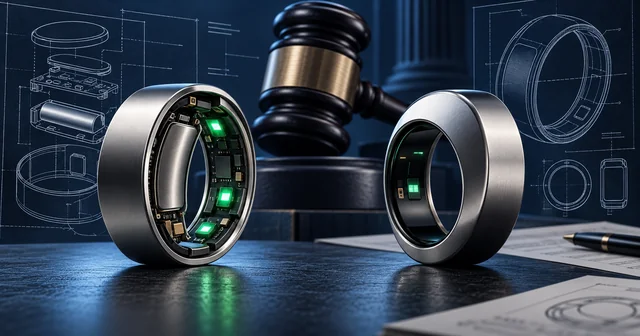
Oura's new lawsuit does not stop US sales of Ultrahuman's Ring Pro today; no court has ordered anything. It asks a Texas federal judge to block the ring using two patents the March 2026 customs clearance never examined, including one granted October 20 whose claims skip the two-part housing Ultrahuman removed.
What Happened
On October 22, 2026, Oura filed a patent infringement complaint against Ultrahuman in the US District Court for the Eastern District of Texas. In its announcement, Oura said the redesigned ring "still incorporates many of Oura's patented innovations" and that the suit asserts "additional patents, including design and utility patents." It is asking for money damages and a permanent injunction that would stop Ultrahuman selling the Ring Pro in the US.
According to TechCrunch's report on the complaint, the two patents are design patent D804,471 and utility patent 12,769,363. The second one is brand new. The USPTO's Official Gazette entry shows it was issued on October 20, 2026, two days before the lawsuit, from an application Oura filed on December 22, 2025. The complaint also names SVTronics, a contract manufacturer that TechCrunch says makes the Ring Pro at a plant in Plano, Texas, on Ultrahuman's behalf.
Ultrahuman CEO Mohit Kumar told TechCrunch the company would "defend our position vigorously." He added that "there is no court order affecting Ring Pro, and it remains available to customers in the U.S."
This is the second round of a fight that began in 2023. In 2024 Oura took its case to the US International Trade Commission, which found that Ultrahuman's Ring Air infringed claims 1, 2 and 12–14 of Oura's patent 11,868,178. On August 21, 2025, the Commission issued a limited exclusion order barring infringing rings from import. Ultrahuman then redesigned its hardware as the Ring Pro and asked US Customs and Border Protection (CBP) to rule on it. CBP's ruling H354023, dated March 6, 2026, found that Ultrahuman had "met its burden" to show the Ring Pro does not infringe the '178 patent's asserted claims. That cleared the ring for import, as long as importers certify how it is built.
Why It Matters
For Ring Pro owners and shoppers, the Ring Air is the warning. After the ITC order took effect, Ultrahuman could not bring new Ring Air stock into the US.
This round is aimed at a different target. The first case went through an import tribunal. This one goes through an ordinary federal court, and it reaches a ring that is partly made in Texas. If Oura wins an injunction, a US factory gives Ultrahuman no protection, because the order would cover making and selling the ring in the US, not just importing it.
The case also shows how Oura uses its patents across the whole smart ring market. TechCrunch notes Oura has gone after Samsung, RingConn, Circular and Zepp Health. RingConn and Circular settled by agreeing to pay Oura royalties. Rival rings now carry the cost of either an Oura license or a court fight.
How It Works
To see why Oura went to Texas with fresh patents, look at how the Ring Pro got around the first one.
The redesign that beat the '178 patent
Claim 1 of the '178 patent describes a finger-worn device with two separate parts: "an external housing component defining an outer circumferential surface" and "an internal housing component" defining the inner surface. At the ITC, the Ring Air's outer titanium shell counted as the external part. The epoxy potting layer that touches your skin counted as the internal part.
CBP's ruling describes the Ring Pro's fix. Both of those parts were "replaced by a housing tube," described as "a single, continuous, and integrally formed open-ended titanium tube," with a titanium bottom cap that snaps into it. A ring with one housing piece does not have two housing components, so it falls outside claim 1. Because the other asserted claims all depend on claim 1, they fall with it. CBP accepted that argument. It also attached a condition: importers must certify the housing really is one piece, and back that up on request with evidence such as CT scans and assembly documents.
Why the new patent targets exactly that change
Now compare claim 1 of the new '363 patent, as printed in the Gazette. It claims a ring with "a housing comprising an exterior surface of the wearable ring device and an interior surface," with set dimensions: inner diameter of 12–24 mm, outer diameter of 18–30 mm, width of 3–8 mm and thickness of 1.5–3 mm. Inside that housing it lists a curved battery running along part of the ring, a power management module, magnets that pull the ring onto a charger, a printed circuit board running along another part of the curve, an accelerometer or gyroscope, a skin temperature sensor, a visible-light LED, an infrared or near-infrared LED, and a light sensor for heart rate.
Look at the housing language. The claim no longer requires separate external and internal components. It only needs a housing that has an outside and an inside, and a one-piece titanium tube has both. Whether every other element reads on the Ring Pro is for the court to decide. But the wording leaves out the very distinction that cleared the ring at customs.
The timing is legal too. US law lets an applicant keep a "continuation" application pending and write new claims from the original disclosure years later, as long as the original specification supports them. The Gazette shows the '363 patent continues a chain that goes back to a provisional application filed on November 29, 2013, and includes the '178 patent's family. Watching a rival's redesign and then getting claims that cover it is a common, lawful tactic.
Design patents work differently
D804,471 is a design patent. It protects how a product looks, not how it works. Infringement is judged by the "ordinary observer" test: would an ordinary buyer, comparing the two with the prior art in mind, see the designs as substantially the same? Design patents also carry an unusual remedy. Under 35 U.S.C. § 289, the owner can claim the infringer's total profit on the article of manufacture.
Why a district court instead of the ITC
An ITC exclusion order works at the border. It covers goods that are imported, or made abroad and brought in. A ring finished in a Texas plant sits partly outside that kind of remedy. Oura's complaint alleges infringement through manufacture, importation and sale, and a district court can reach all three. The catch is that federal courts do not grant injunctions automatically. Since the Supreme Court's 2006 eBay v. MercExchange decision, a patent owner has to show irreparable harm and that the balance of hardships and the public interest favor an order. Direct competitors like Oura and Ultrahuman meet that test more often than patent licensing firms do. But it is still a fight, and preliminary injunctions in patent cases are rare.
What's Still Unknown
Several things will shape how this turns out, and none of them is public yet.
- Whether Oura seeks a preliminary injunction. A permanent injunction comes only after trial, which in a Texas patent case can take two years or more. A preliminary injunction could come much sooner. Neither company has said whether Oura has asked for one.
- Which '363 claims are asserted. The Gazette prints claim 1 of 20. The complaint's infringement charts will show which claims Oura says the Ring Pro meets, and how it reads "housing" against a single titanium tube.
- Validity challenges. Ultrahuman can attack the '363 patent at the Patent Trial and Appeal Board through inter partes review, or argue in court that a 2025 continuation cannot validly claim a 2013 priority date for these claims.
- What the design patent shows. D804,471's drawings were not published in the reports, so it is unclear how closely the Ring Pro's outline matches it.
- A settlement. RingConn and Circular took licenses. Ultrahuman has fought instead, but after its $70 million raise in September it may weigh a royalty against years of uncertainty.
Frequently Asked Questions
Can I still buy an Ultrahuman Ring Pro in the US?
Yes. As of October 23, 2026, no court has issued any order against the Ring Pro, and Ultrahuman says it remains on sale in the US. The lawsuit only asks for an injunction. A judge would have to grant one, either as a preliminary order or after a trial, before sales could be legally blocked. Until then, the CBP clearance from March 2026 still lets the ring be imported.
Will my existing Ring Pro stop working if Oura wins?
Very unlikely. Patent injunctions block a company from making, importing or selling a product. They do not reach rings already in customers' hands. The bigger risks are practical: stock, replacement units and warranty swaps could get harder to find if sales are blocked. The earlier ITC order specifically exempted warranty replacements for rings sold before it took effect.
Didn't US Customs already say the Ring Pro does not infringe?
CBP ruled on one patent only, Oura's '178 patent, and only on the claims at issue in the ITC case. Its March 6, 2026 ruling found the Ring Pro's one-piece titanium housing avoids those claims. The new lawsuit asserts two different patents that CBP never considered, so the customs ruling does not settle them. A district court will decide them from scratch.
Why was a patent issued two days before the lawsuit?
Oura filed the application in December 2025 as a continuation of an older patent family, which lets it write new claims from a 2013 disclosure. Once the USPTO issued it on October 20, 2026, Oura could sue on it right away. Filing new claims that cover a rival's redesign is legal and common, though the claims can still be challenged as invalid or unsupported by the original filing.
What is the difference between a design patent and a utility patent?
A utility patent protects how something works or is built, such as a ring with a curved battery, magnets and particular sensors. A design patent protects only how it looks. Oura asserts one of each. The utility patent '363 covers the ring's internal layout, while D804,471 covers its appearance. They are proven differently, and design patents can let the owner claim the infringer's total profit on the product.
Does this affect Ultrahuman Ring Air owners?
Not directly. The Ring Air was already shut out of US imports by the 2025 ITC exclusion order, which allowed warranty replacements for rings bought before the order took effect. The new lawsuit targets the Ring Pro. Ultrahuman still sells the Ring Air in Europe and other markets where Oura's US patents have no force.
How long could this case take?
Patent cases in the Eastern District of Texas commonly take around two years to reach trial, sometimes longer, and appeals add more time. Things could move faster if Oura asks for a preliminary injunction, if Ultrahuman wins an early ruling, or if the companies settle with a license like the ones RingConn and Circular agreed to.
Related Reading
This is not the first wearable to be squeezed by patents. Our explainer on Apple's $634 million Masimo patent loss covers how a sensor dispute reshaped the Apple Watch. Apple's $5.7 billion Taptic Engine verdict shows how juries put a price on a single component. For the ring at the center of this case, read our look at what the Ultrahuman Ring Pro tracks for $479. To see how Oura is building out its hardware team, see why Apple's home hardware chief moved to Oura. If you are weighing a ring against a wrist tracker, our guide to the best activity trackers compares the options.