NASA's Hubble Rescue Call: What a Commercial Reboost Involves
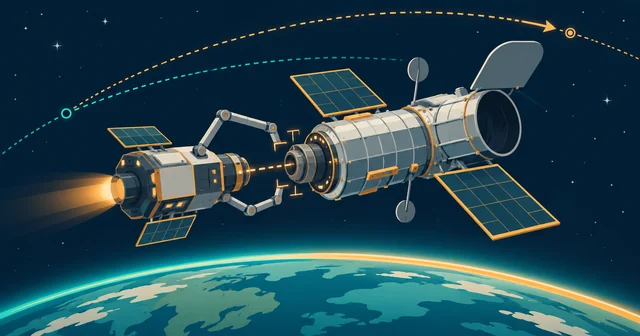
NASA is asking companies whether they can save the Hubble Space Telescope. A request for information posted on October 29, 2026 seeks commercial missions that would capture Hubble and boost it to at least 600 km, service it, or steer it into a controlled re-entry. Hubble has no engine, and NASA wants a mission flown by 2032.
What Happened
On October 29, NASA's Goddard Space Flight Center posted a request for information (RFI) titled "Hubble Space Telescope (HST) Servicing" on the federal contracting site SAM.gov, under notice number 80GSFC27RFIHSTS. The agency announced it the next day in a NASA news release, and responses are due by 3 p.m. Eastern on Monday, November 30, 2026.
The RFI on SAM.gov lists three mission options. A company could build and fly a servicing vehicle that captures Hubble in low Earth orbit and boosts it to at least 600 km. It could fly a servicing mission that improves the telescope's performance and makes it more resilient to ageing. Or it could fly a mission that performs a controlled re-entry. Any boost or servicing mission "must not harm the HST" and is expected to happen by 2032.
The numbers behind the deadline come from a lifetime analysis NASA ran in July 2026. According to the RFI, it found a 10% probability that Hubble re-enters the atmosphere by September 2032 and a 50% probability by December 2033. NASA's release puts the likely re-entry window at 2033 to 2034.
NASA Administrator Jared Isaacman said in the release that if there are "cost-effective ways to extend the life of an asset already on orbit," the agency owes it to taxpayers and scientists to explore them. Nicky Fox, who leads NASA's Science Mission Directorate, pointed to industry's newer capabilities for capturing and servicing satellites in orbit.
The document is explicit that this is not a request for proposals. NASA is not committing to buy anything and will not pay for responses. As The Register reported, there is no indication of what NASA expects to pay.
Why It Matters
Hubble is still one of the most heavily used science instruments ever built. The RFI says demand for observing time runs at more than seven requests for every slot available, and the telescope produces over 1,000 scientific papers a year. Its ultraviolet and visible-light view of the sky is something neither the James Webb Space Telescope, which works mainly in infrared, nor the Nancy Grace Roman Space Telescope, built for wide-field surveys, replaces.
NASA does not expect a successor with that capability before around 2040, when the proposed Habitable Worlds Observatory could come online. That observatory is meant to image Earth-like planets around other stars directly, a goal that builds on the kind of exoplanet imaging techniques astronomers have been developing for years. Every year Hubble survives narrows the gap between the two.
There is also a safety question. Hubble is roughly the size of a school bus and weighs about 11 tonnes. Left alone, it will come down on its own schedule, at a time and place nobody chooses. Most of it would burn up, but a spacecraft that large carries a small chance that surviving pieces reach the ground. A controlled re-entry, the third option in the RFI, would aim that debris at an empty stretch of ocean.
Finally, the request is a test of a market. In-orbit servicing, where one spacecraft docks with another to refuel it, repair it or push it to a new orbit, has moved from concept to commercial service over the past few years. Hubble would be the most valuable and demanding customer that market has seen.
How It Works
Why Hubble is sinking. Even at about 470 km, the altitude The Next Web reported for Hubble today, the upper atmosphere is not a perfect vacuum. Thin gas drags on the telescope and its large solar arrays, stealing a tiny amount of speed on every orbit. A slightly slower satellite drops slightly lower, where the air is slightly thicker, so the decay speeds up over time. Solar activity makes it worse: when the Sun is active, it heats and expands the upper atmosphere, and drag rises sharply. Hubble was designed to be reboosted by the Space Shuttle, so it was never given thrusters of its own. The shuttle Columbia last raised it in 2002, and the shuttle fleet retired in 2011.
What a reboost involves. A servicer would launch on a commercial rocket, catch up with Hubble, and match its orbit closely enough to dock. Then it would fire its own engines with Hubble attached and lift the pair together. Raising a circular orbit from about 470 km to 600 km takes two burns: one to stretch the orbit into an ellipse, and one at the high point to circularise it. By our own back-of-the-envelope calculation, that is a total velocity change of roughly 70 metres per second. That sounds small, but the servicer has to push an 11-tonne telescope as well as itself, carefully enough not to bend the solar arrays or shake the optics.
Why 600 km is the target. Air density falls steeply with altitude, so a boost of about 130 km cuts drag by a large factor. That buys years of extra orbital life, not months. The RFI also asks bidders to state the lowest altitude Hubble could be at and still be pushed to 600 km. That matters because every year of delay leaves Hubble lower and the job harder.
How a robot grabs a telescope. Hubble has one advantage over most old satellites. On the final shuttle servicing mission, STS-125 in May 2009, astronauts attached a soft-capture mechanism to its base. It is a ring with targets designed so that a future spacecraft could dock with it. The RFI asks bidders to describe their rendezvous and capture approach, how long they would stay docked, how they would control the combined "stack", and the maximum rotation rates of Hubble they could handle during capture.
Who supplies what. Under the RFI, Goddard would provide technical data on Hubble, access to its experts, and coordinated operation of the telescope during the mission. The company would supply everything else: the launch vehicle, the spacecraft, the servicing vehicle's operations, and a crew if the plan uses one. Responses are limited to 25 pages, must include a cost estimate and payment schedule, and must not contain export-controlled information.
Why "servicing" is a separate option. Hubble's age shows in its pointing system. The telescope uses gyroscopes to sense its orientation, and as The Register noted, it now runs on a single gyro to stretch out the life of its remaining units. A servicing mission could, in principle, add hardware that makes Hubble more robust. The RFI leaves the details to bidders.
What's Still Unknown
Who will bid. NASA names no companies. In 2022, Isaacman, then a private astronaut, backed a study of a crewed SpaceX Dragon mission to reboost Hubble. According to The Next Web, NASA also asked industry for ideas that year and received eight responses, then decided in 2024 not to pursue a reboost. A crewed mission looks harder now, with SpaceX planning to retire Crew Dragon by 2030, so robotic servicers are the likelier candidates.
Who pays. NASA has not said what it would spend or where the money would come from. The RFI asks respondents what funding and other help they would need from NASA, which suggests the agency is open to cost-sharing arrangements.
How risky NASA will judge it. The "must not harm the HST" condition is the crux. Any docking attempt risks damaging the telescope it means to save, and a failed capture could end Hubble's science years early. How much risk NASA is willing to accept will decide which, if any, concept goes forward.
Whether the timeline holds. The recent end of NASA's Swift observatory is a warning. NASA said Swift ended its science mission after its final observation on October 20, 2026, once it had sunk below 275 km, and it is expected to re-enter within weeks. The Next Web reported that a startup NASA had hired to catch and raise Swift never reached it. Hubble is much higher, but higher-than-expected solar activity could shorten its margin too.
For anyone following orbital decay on their own, free astronomy and satellite-tracking software can show where Hubble is overhead tonight.
Frequently Asked Questions
Is NASA paying a company to save Hubble?
Not yet. The October 29 notice is a request for information, not a request for proposals or a contract. NASA says it is gathering information for planning, will not pay for responses, and is not committing to buy a mission. If the responses look promising, the agency could later issue a formal solicitation on SAM.gov, which is where any contract competition would appear.
When will Hubble fall out of orbit?
NASA's July 2026 lifetime analysis found a 10% chance Hubble re-enters the atmosphere by September 2032 and a 50% chance by December 2033. NASA's public estimate is a 2033 to 2034 window. The exact date depends heavily on solar activity, which heats the upper atmosphere and increases drag on the telescope.
Why can't Hubble raise its own orbit?
Hubble was built to be maintained by the Space Shuttle, which reboosted it during servicing visits, so it was never fitted with a propulsion system. Without thrusters, the telescope cannot counter atmospheric drag. Since the shuttle retired in 2011, nothing has been able to lift it, which is why NASA now needs an outside spacecraft to dock and push.
How high would a rescue mission need to lift Hubble?
The RFI requires a boost to at least 600 km. Hubble currently orbits at roughly 470 km, according to reporting by The Next Web. Because air density drops quickly with altitude, a climb of around 130 km would cut drag substantially and add years of orbital life. Bidders must also say how low Hubble can get before that boost becomes impossible.
What happens if no company can do it?
Hubble would keep observing as its orbit decays, then make an uncontrolled re-entry sometime in the 2030s. Most of it would burn up, but its size means some pieces could survive. That is why the RFI includes a third option: a mission that attaches to Hubble and guides it into a controlled re-entry over a remote ocean area.
Could astronauts fly to Hubble again?
The RFI allows a crew "if applicable," so a crewed mission is not ruled out. It looks less likely than in 2022, when a SpaceX Dragon reboost was studied. SpaceX plans to retire Crew Dragon by 2030, and NASA declined that earlier idea in 2024. Robotic servicing spacecraft are now the more probable approach.
What replaces Hubble when it is gone?
No telescope fully replaces its ultraviolet and visible-light capabilities soon. Webb works mainly in infrared and Roman is built for wide-field surveys. NASA expects no true successor before around 2040, when the proposed Habitable Worlds Observatory could launch. Extending Hubble's life is meant to shrink the gap until then.
Related Reading
Hubble is not NASA's only flagship observatory. Our piece on the completed Roman Space Telescope and its 100x wider view explains what the next survey mission adds. Commercial launch reliability is part of any rescue plan, and what went wrong when New Glenn put a satellite in the wrong orbit shows how small errors in orbital mechanics add up. For the science Hubble's successor is aiming at, read about new techniques for capturing authentic images of exoplanets. And if you want to watch the sky yourself, our guide to the best free astronomy software covers planetarium and sky-chart tools.