Fitbit Edge's Replaceable Battery: What It Changes for Trackers
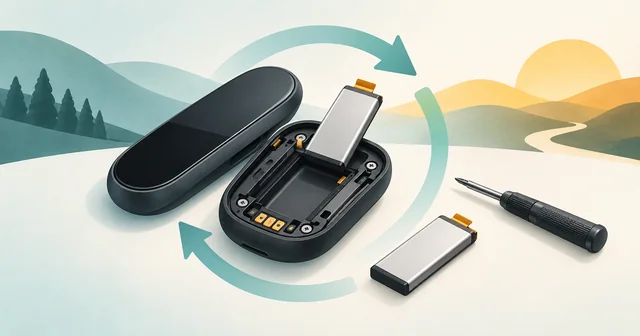
The Fitbit Edge is Google's first fitness tracker with a battery you can replace instead of retiring the whole device when it wears out. Announced on October 12, 2026 at $179.99, it pairs a larger screen with a modular interior, which matters because battery fade, not broken sensors, is what usually ends a tracker's life.
What Happened
On Monday, October 12, 2026, Google announced the Fitbit Edge, a screen-equipped tracker that sits between the screenless Fitbit Air launched in May and the Pixel Watch 5. In its launch post on the Google blog, Google lists a price of $179.99, pre-orders open the same day, and shelf availability from October 27. A Stephen Curry Special Edition costs $219.99, and buyers get three months of Google Health Premium included.
The line that separates the Edge from every earlier Fitbit tracker is near the end of Google's post: it calls the Edge "our first repairable fitness tracker," built with an internal modular architecture and a replaceable battery "designed to extend the life of your device." 9to5Google reports that, as with the Pixel Watch 5, the device can be opened to replace the battery. Wired adds that repair options will vary by region and availability.
The rest of the specification is a clear step up from the Charge 6, which Google released in 2023 and has not updated since. According to 9to5Google, the Edge has a pill-shaped AMOLED display under Gorilla Glass 3 with 46% more viewing area than the Charge 6, an 11.5mm aluminium body, IP68 dust and water protection plus a 5 ATM rating, and a physical side button. Wired puts the screen at 1.34 inches, up from 1.04 inches on the Charge 6.
The sensor list includes an accelerometer, gyroscope, altimeter, ambient light sensor, far-field skin temperature sensor, optical heart rate, electrical sensors for the ECG app, and red and infrared sensors for blood oxygen. Google says built-in GPS is up to 40% more accurate than on previous trackers, sleep-stage detection is about 15% more accurate (as reported by TechCrunch), the exercise app offers more than 50 modes, and automatic recognition covers up to 100 activity types.
Battery life is rated at up to seven days with the always-on display off, and roughly two days with it on, according to 9to5Google. Five minutes on the magnetic USB-C charger is meant to give a day of use, and a full charge takes about 90 minutes. One feature goes missing: there is no NFC chip, so the Edge cannot make Google Wallet payments, which the Charge 6 could. The Edge works with Android 11 or later and iOS 16.4 or later through the Google Health app.
Why It Matters
Fitness trackers are small, sealed, and cheap enough that most people throw one away rather than fix it. The weakest component is almost always the lithium-ion cell. Sensors, processors, and screens rarely fail in normal use, but a battery that once lasted a week can be down to three or four days after a couple of years of daily charging. Until now, the only fix for a Fitbit with a tired battery was a new Fitbit.
That pattern has a cost beyond the owner's wallet. Wearables add to a growing stream of electronic waste that is hard to recycle, because the parts are tiny, glued together, and mixed with plastics and adhesives. We covered that problem earlier this year in our look at why wearable e-waste is rising and how health tech must adapt. A tracker that can take a fresh battery might stay in use for four or five years instead of two.
The timing also matters. Wired notes that the move is likely linked to new battery rules in the European Union. The EU's Batteries Regulation (EU) 2023/1542 entered into force on August 17, 2023, with requirements phased in through 2031. Its Article 11 requires that portable batteries built into appliances be removable and replaceable by the end user from February 18, 2027. Google has not said the regulation drove the design, so treat the link as context rather than a stated reason. Still, any wearable maker selling in Europe now has a deadline to think about.
For buyers, the practical change is simple. The battery stops being the part that decides when the device dies. That changes the maths on a $180 purchase: if a replacement cell costs a fraction of a new tracker, the Edge's cost per year of use could fall well below that of a sealed tracker at the same price.
How It Works
To understand what a replaceable battery changes, start with why batteries wear out. A lithium-ion cell stores energy by moving lithium ions between two electrodes. Every charge and discharge cycle causes small, permanent side reactions: a film slowly builds on the electrode surfaces, some lithium gets trapped, and the cell can hold a little less charge each time. Heat, high states of charge, and fast charging all speed this up. Manufacturers commonly rate small cells to keep around 80% of their original capacity after several hundred full cycles.
A tracker's charging habits decide how fast it reaches that point. Charged once a week with the always-on display switched off, the Edge would see roughly 52 cycles a year. Switch the always-on display on, and Google's own figures imply a charge every two days or so, which is closer to 180 cycles a year. At that rate, noticeable capacity loss can arrive within two to three years, which is about when many people start shopping for a replacement tracker.
Making the battery replaceable means designing the device to be opened without destroying it. Most small wearables are sealed with adhesive, which helps them reach water ratings like IP68 but means the case must be pried and heated to get inside. Google describes the Edge as having an internal modular architecture, which generally means parts are held in place with screws and connectors rather than glue, and the battery plugs into the main board instead of being soldered or bonded to it. Water resistance then depends on gaskets and seals that can be refitted after a repair.
The EU rule sets a specific bar for what "replaceable" means. A battery counts as readily removable when an ordinary user can take it out with commercially available tools, without specialised tools unless the manufacturer supplies them free, and without heat or solvents to break down adhesives. The regulation also includes narrow exemptions, including for some devices designed to work in water, where the battery must instead be replaceable by independent professionals. The Commission has published guidelines on how these removability rules should be applied, linked from its batteries page.
The rest of the Edge's design leans on software. Automatic activity recognition uses movement patterns and context to decide whether you are walking, running, or cycling, and logs the session even if you never pressed start. Health Guardian features, which require a Google Health Premium subscription, watch for longer-term shifts such as blood pressure trends and insulin resistance trends. Google stresses these are wellness features, not diagnostic tools, and are not available in every country.
What's Still Unknown
Several important details have not been published. Google has not said how much a replacement battery will cost, whether owners can buy one and fit it themselves, or whether the swap must happen at an authorised repair centre. Wired's note that options vary by region suggests the answer may differ between the US, Europe, and India.
It is also unclear whether the Edge keeps its IP68 and 5 ATM rating after a battery change. Google's footnotes say the water rating applies when the device leaves the factory and is not permanent. If a home repair breaks the seal, the tracker could be less protected in the pool or shower, and Google has not said what its warranty covers in that case.
Finally, we do not yet know how long Google will stock spare batteries. The EU regulation expects spare portable batteries to stay available for at least five years after the last unit of a model is sold, but that obligation only applies from 2027 and only in the EU. No independent teardown of the Edge has appeared yet, so the actual difficulty of the repair is still untested.
Frequently Asked Questions
Does the Fitbit Edge really have a replaceable battery?
Yes. Google's launch post calls the Edge its first repairable fitness tracker, with an internal modular architecture and a replaceable battery. 9to5Google reports that, like the Pixel Watch 5, the device can be opened to swap the battery. Google has not yet published the exact repair process, the price of a spare battery, or whether owners can do the swap themselves.
How much does the Fitbit Edge cost and when does it ship?
The standard Fitbit Edge costs $179.99 and a Stephen Curry Special Edition costs $219.99. Pre-orders opened on the Google Store on October 12, 2026, and the tracker reaches retail shelves on October 27. Google includes three months of Google Health Premium with each purchase, after which the subscription is a separate paid service.
How long does the Fitbit Edge battery last?
Google rates the Edge for up to seven days on a single charge with default settings. 9to5Google reports that turning on the always-on display cuts that to roughly two days. A five-minute top-up is meant to deliver about a day of use, and a full charge takes around 90 minutes using the magnetic USB-C charger.
Why are tracker batteries hard to replace?
Most trackers are sealed with adhesive so they can survive sweat, rain, and swimming. That glue makes opening the case risky without heat and special tools, and the battery is often bonded inside. A repairable design uses screws, connectors, and refittable seals instead, which takes more engineering effort and space in a very small device.
Is the EU forcing wearables to have replaceable batteries?
The EU Batteries Regulation requires portable batteries built into appliances to be removable and replaceable by end users from February 18, 2027. There are narrow exemptions, including for some devices designed to work in water, where independent professionals must be able to replace the battery instead. Google has not said the rule shaped the Edge's design.
Can the Fitbit Edge pay with Google Wallet?
No. The Edge has no NFC chip, so it cannot make contactless payments through Google Wallet. That is a step back from the Charge 6, which supported Wallet. If tap-to-pay from your wrist matters to you, the Pixel Watch 5 or another smartwatch with NFC would be a better fit than the Edge.
Does the Fitbit Edge work with an iPhone?
Yes. The Edge works with phones running Android 11 or later and iOS 16.4 or later through the Google Health app. Wired notes this is an advantage over the Pixel Watch, which needs Android. Some features differ on iPhone: 9to5Google reports that quick replies to messages are limited to Android because of iOS platform restrictions.
Will a battery swap affect water resistance?
Google has not said. Its footnotes state that the IP68 and 5 ATM ratings apply when the device leaves the factory and are not permanent. Whether a user or a repair centre can restore the original seal after replacing the battery, and how the warranty treats water damage after a repair, are open questions until Google publishes repair details.
Related Reading
If you are weighing the Edge against older Fitbit hardware, our review of the Fitbit Luxe and its slim tracker design shows how much the category has changed, and our broader guide to choosing the right activity tracker covers the features worth paying for. For the repairability angle, see how Apple's MacBook Neo teardown earned the best MacBook repairability score in 14 years. And if a long battery life and a simple screen appeal to you, our piece on how Pebble Round 2 revives the case for simple smartwatches offers a different take on the same trade-offs.