Apple's $5.7B Taptic Engine Verdict: What the Ruling Means
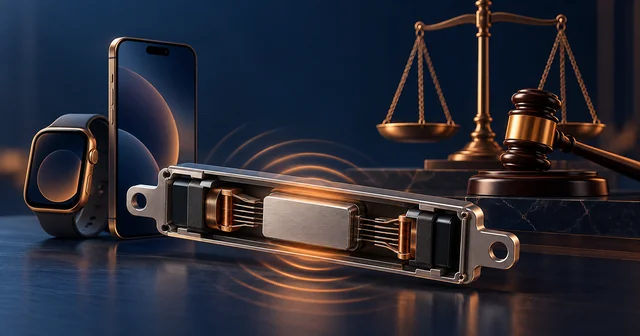
On September 25, 2026, a federal jury in San Diego found that the Taptic Engine inside iPhones and Apple Watches infringes two haptics patents owned by Taction Technology, and awarded about $5.72 billion. Nothing changes for owners today: Apple says it will appeal, the jury found the infringement was not willful, and the award is far from final.
What Happened
The verdict came in the U.S. District Court for the Southern District of California, in a case Taction filed in April 2021 (No. 3:21-cv-00812). After deliberating over parts of two days, the jury found that Apple infringed claims of U.S. Patent Nos. 10,659,885 and 10,820,117 and set damages at $5,721,961,750, according to 9to5Mac's report on the verdict and AppleInsider. Several outlets called it the largest patent damages award a U.S. jury has returned. For scale, the Masimo blood-oxygen verdict that went against Apple in November 2025 was $634 million.
The jury also found that Apple's infringement was not willful. That matters because a willfulness finding is what lets a judge raise patent damages by up to three times. Without it, $5.7 billion is the ceiling rather than a starting point.
Apple's response was blunt. It said it strongly disagreed with the verdict and the damages, which it called "entirely unsupported by the facts." It also said the Taptic Engine "is fundamentally different from Taction's technology," that Taction's own testing of Apple's products during trial showed as much, and that it will appeal. Taction's lead counsel said the company was happy the jury "vindicated its patent rights" after waiting five and a half years for trial.
Bloomberg Law reported that the lawsuit is backed by Burford Capital, the litigation finance firm, through two indirect subsidiaries. Engadget described Taction as a San Diego company that makes audio and gaming peripherals.
The case nearly ended three years ago. In 2023 District Judge Todd W. Robinson granted Apple summary judgment of noninfringement. On August 13, 2025, a Federal Circuit panel led by Chief Judge Kimberly Moore vacated that ruling and sent the case back, in a nonprecedential opinion in Taction v. Apple. The trial that ended last week was the result.
Why It Matters
The Taptic Engine is not a minor part. It is the linear actuator that makes an Apple Watch tap your wrist for a notification, gives the iPhone's keyboard its subtle click, and stands in for a physical button press across iOS. Apple introduced it with the original Apple Watch and brought it to the iPhone with the iPhone 6s in 2015. Nearly every iPhone and Apple Watch sold since then carries one, which is how a claim about one small component turns into a multibillion-dollar number.
The verdict matters beyond Apple for three reasons.
It is a funded case. Litigation finance lets a small patent owner take a case through years of appeals against the richest hardware company in the world. A $5.7 billion outcome, even one that shrinks on appeal, tells funders that component-level hardware patents can be worth pursuing against large device makers.
It shows how much claim construction decides. Apple won in 2023 because the trial judge read one phrase in the patents narrowly. The Federal Circuit rejected that reading, and the same facts went to a jury that saw them the other way. The case was lost and won on the meaning of the words "highly damped."
It adds to Apple's wearable patent exposure. Apple is already appealing the Masimo verdict over Apple Watch blood-oxygen sensing. A second large verdict against Apple Watch hardware, this time over the part that produces every wrist tap, puts more pressure on how Apple sources and designs the watch.
How It Works
To follow the dispute you need to understand both the invention and the one phrase that nearly sank the case.
What the Taction patents claim
Both patents descend from a September 24, 2014 priority filing by inventor Silmon James Biggs and share a specification. The patents describe "tactile transducers that produce bass frequency vibrations for perception by touch." They were originally aimed at headphones, where a small module in the ear cup lets you feel the bass as well as hear it. According to the '885 patent's record on Google Patents, it was granted on May 19, 2020, and its anticipated expiration is September 2035.
Claim 1 of the '885 patent, which the Federal Circuit treated as representative, describes an apparatus with:
- a housing, a set of electrical coils, and a set of magnets placed near those coils;
- a moving portion made up of an inertial mass and the magnets;
- a suspension of flexures that guides the moving portion in planar motion, sliding side to side rather than plunging up and down;
- a ferrofluid, a magnetic liquid, in contact with the moving portion to damp its movement; and
- that ferrofluid reducing a mechanical resonance within the 40 to 200 Hz range.
The companion '117 patent covers closely related vibration modules. Every asserted claim in both patents requires damping of the moving part.
Why damping is the whole argument
Any small mass on a spring has a resonant frequency where it rings much harder than at other frequencies. An undamped actuator driven at that frequency gives a strong buzz; driven elsewhere, it barely moves. Damping flattens that peak so the output is roughly the same across a range of frequencies. Engineers express this with the Q-factor. Both sides agreed in the appeal that a Q above 0.5 means an oscillator is underdamped, below 0.5 overdamped, and exactly 0.5 critically damped.
Apple's Taptic Engine is a linear resonant actuator: a magnet-driven mass that slides along one axis. Taction argued that it uses ferrofluid to damp that mass, and that Apple's closed-loop software controller shapes the drive signal so the combined output is "generally uniform or flat." That is what the patents call a highly damped output.
The phrase that decided it
During claim construction the district court held that the claims cover only "transducers with highly damped output." At summary judgment it tightened that construction in two ways: the damping had to be achieved mechanically, and the transducer had to have a Q-factor below 1.5. Apple's actuator has a Q above 1.5, so the court ruled that no reasonable juror could find infringement. It also struck the opinions of Taction's expert, Dr. James Oliver, as a new theory that Taction had not disclosed in its infringement contentions.
The Federal Circuit reversed on both points. It found nothing in the record that limited the claims to mechanical damping alone or set any numerical Q-factor cut-off. It held that striking the expert's opinions was an abuse of discretion, because Taction's contentions had already named the Taptic Engine's closed-loop software controller and mapped its ferrofluid to the damping limitation. With the broader reading restored, the question became one of fact for a jury, and the jury sided with Taction.
Apple's defence at trial, going by its statement, is that the Taptic Engine works on a different principle and that Taction's own measurements showed it. That argument will be the core of its post-trial motions and appeal.
What's Still Unknown
- How the $5.7 billion was calculated. Public reports so far give no per-unit royalty, unit count or date range. The breakdown will show up in post-trial briefing and will decide how exposed the figure is on appeal.
- Post-trial motions. Apple can ask Judge Robinson for judgment as a matter of law, a new trial, or a reduced award (remittitur). Judges do cut large verdicts, and the Federal Circuit has thrown out very large patent awards before.
- Future sales. The patents run to around 2035 unless they are invalidated. Whether Taction will seek an ongoing royalty on devices sold after the verdict, and whether Apple will redesign the actuator to avoid the claims, has not been reported.
- Validity challenges. No public reports say whether the patents are under review at the Patent Trial and Appeal Board, which is often a separate route defendants take to attack patents.
- Timing. A Federal Circuit appeal usually takes more than a year after judgment is entered. Apple is not expected to pay anything while that runs.
Frequently Asked Questions
Will this verdict change how my iPhone or Apple Watch vibrates?
No. The jury awarded money damages; it did not order Apple to stop selling anything or disable a feature. Apple has said it will appeal, and the verdict is subject to post-trial motions before any judgment is final. Even if Taction later sought an ongoing royalty, that would be a payment between the companies, not a change to how the Taptic Engine behaves on devices you already own.
What is the Taptic Engine?
The Taptic Engine is Apple's name for the linear actuator in iPhones and Apple Watches. A magnet-driven mass slides back and forth inside a small housing to produce precise taps and clicks rather than a generic buzz. Apple introduced it with the first Apple Watch and added it to the iPhone 6s in 2015. It powers notification taps, keyboard feedback and haptic touch responses.
What do Taction's patents actually cover?
The two patents, Nos. 10,659,885 and 10,820,117, cover vibration modules that move a mass in a flat, side-to-side plane using coils and magnets, guided by flexures and damped by a ferrofluid. The damping reduces a mechanical resonance between 40 and 200 Hz so the output stays even across frequencies. They were first written with headphones in mind, to let listeners feel bass through touch.
Why did Apple win in 2023 and lose now?
In 2023 the trial judge read "highly damped output" to require mechanical damping and a Q-factor below 1.5, and Apple's actuator exceeds 1.5. He granted Apple summary judgment. In August 2025 the Federal Circuit said nothing in the record supported those limits, vacated the ruling and revived the case. Under the broader reading, a jury found infringement.
Why does the finding of no willful infringement matter?
U.S. patent law lets a judge increase damages by up to three times when infringement is willful, meaning the infringer knew of the patent and acted in bad faith. The jury found Apple's infringement was not willful, so enhanced damages are effectively off the table. The $5.72 billion figure is the most Taction can hope to keep from this verdict, and it may well shrink.
Is this the largest patent verdict ever?
Several outlets reported it as the largest patent damages award returned by a U.S. jury, ahead of earlier headline verdicts such as VLSI's $2.18 billion award against Intel in 2021, which was later vacated on appeal. Large jury awards are often reduced or overturned later, so the final amount Apple pays, if anything, could be much lower than the verdict.
Who is paying for Taction's lawsuit?
Bloomberg Law reported that Burford Capital, a major litigation finance firm, backs the case through two indirect subsidiaries. In this model a funder pays legal costs in exchange for a share of any recovery. That is how a small San Diego company could keep the case going for five and a half years, including an appeal, against a company of Apple's size.
Related Reading
This is Apple's second big wearable patent loss in a year. Our breakdown of what the $634 million Masimo ruling means for smartwatch innovation covers the first. If you want to know what the Taptic Engine does in daily use, our guide to the secrets of Apple's Haptic Touch walks through the features it powers. Taction's patents started with the idea of feeling bass through touch, the same principle behind Woojer's haptic mattress topper. For the bigger picture of where Apple's hardware is going, read our analysis of Apple's hardware strategy under John Ternus.