How to Keep a New Year's Resolution: The Tiny-Habits Method
Every January the same thing happens. Gyms fill up, new notebooks get opened and fitness apps light up. By February, most of that energy has gone quiet. The second Friday of January is often called Quitter's Day, a label popularised by the exercise app Strava after it looked at when its users' New Year motivation starts to fade.
The usual explanation is willpower. A better one is size. "Get fit", "read more" and "save money" are outcomes, not things you can do at 7am on a Tuesday. When a resolution is big and vague, every day becomes a test you can fail, and after a few failures it feels easier to stop.
The tiny-habits method turns that around. You shrink the resolution into one behavior so small you'd do it on your worst day, tie it to something you already do, record it the moment it's done, and make it bigger only once it runs on autopilot. It borrows from behavior scientist BJ Fogg's Tiny Habits and from the research on how habits actually form.
Below are the five steps, ten resolutions turned into tiny habits, what to do when you miss a day, and a simple plan for the 31 days of January. All you need is a pen and a calendar, though an app works too.
Why most resolutions fade by February
Making a resolution is not the mistake. In a 2002 study by John Norcross and colleagues, 46% of people who made a New Year's resolution reported continuous success six months later, against 4% of people who wanted to make a similar change but hadn't made a resolution. In a 2020 Swedish study of more than 1,000 people, 55% of those who reported back a year later considered themselves successful.
What goes wrong is the plan. Three things work against a typical resolution:
- The motivation spike is temporary. Researchers Hengchen Dai, Katherine Milkman and Jason Riis call it the fresh start effect: landmarks like New Year's Day, a birthday or even a Monday make people more likely to start working on a goal. The spike is real, but it fades, and your plan has to keep going without it.
- Habits take longer than January. In a study led by Phillippa Lally at University College London, it took a median of 66 days for a new daily behavior to feel automatic among the participants whose progress could be modelled, with estimates ranging from 18 to 254 days. If you expect it to feel easy by 21 January, you'll think you're failing when you're right on schedule.
- Outcomes aren't actions. "Lose weight" gives you nothing to do today. A resolution has to become a specific behavior at a specific moment before you can practice it.
The tiny-habits method in five steps
1. Turn the resolution into one behavior
Ask yourself: what is one thing I could do today that moves me toward this? "Get healthier" might become walking, drinking water or eating a vegetable. Pick one. Phrase it as something to do rather than something to avoid. In the 2020 study, people with approach goals ("start eating breakfast") succeeded more often than people with avoidance goals ("stop snacking"): 58.9% against 47.1%.
2. Shrink it until it takes less than two minutes
Make the behavior so small it feels almost silly: read one page, do two push-ups, put your walking shoes on, write one sentence. The size of the action isn't the point. Turning up every day while the habit forms is. On a good day you'll often do more. On a bad day, the tiny version still counts.
3. Anchor it to something you already do
Fogg's recipe is "After I [anchor], I will [tiny behavior]." The anchor is a routine that already happens every day without fail: pouring your first coffee, brushing your teeth, sitting down at your desk. Psychologists call this kind of plan an implementation intention. A meta-analysis by Peter Gollwitzer and Paschal Sheeran, pooling 94 tests with more than 8,000 people, found that if-then plans like this have a medium-to-large effect on reaching goals.
Write your recipe down. "After I put the kettle on, I will drink a glass of water" beats "drink more water" every time.
4. Mark it done straight away
Record the habit the moment you do it: cross off a square on a calendar, tick it in an app, or give yourself a quick "nice one" in your head. Fogg calls this the celebration, and it's what makes a new behavior feel worth repeating. Recording helps on its own, too. A 2016 meta-analysis of 138 studies found that monitoring your progress makes you more likely to reach a goal, especially when you physically write the progress down.
5. Grow it only when it feels automatic
Resist the urge to scale up in the first week. When the tiny habit happens on most days without you having to think about it, make it a little bigger (one page becomes five) or add a second tiny habit with its own anchor. If a habit starts slipping after you grow it, shrink it back. That isn't cheating. It's the method.
From resolution to tiny habit: 10 examples
| Resolution | Tiny habit | Anchor: "After I…" |
|---|---|---|
| Get fit | Walk to the end of the street and back | …finish breakfast |
| Read more | Read one page | …get into bed |
| Drink more water | Drink one glass of water | …put the kettle on |
| Eat better | Add one vegetable to dinner | …start cooking dinner |
| Sleep better | Charge my phone outside the bedroom | …set my alarm |
| Save money | Move $5 into savings | …eat breakfast on Sunday |
| Stress less | Take three slow breaths | …sit down at my desk |
| Learn a language | Do one lesson | …pour my first coffee |
| Keep a journal | Write one sentence about today | …brush my teeth at night |
| Stay in touch | Text one person I care about | …eat lunch |
Notice that none of the tiny habits finishes the resolution. Each one just makes it impossible to have a day where nothing happened.
What to do when you miss a day
You will miss days. Plan for them instead of treating the first one as proof that the resolution has failed.
- One miss barely matters. In Lally's study, missing a single opportunity did not measurably slow down habit formation. A missed Tuesday is a blip, not a reset.
- Never miss twice. James Clear's rule of thumb from Atomic Habits is a good one: one miss is an accident, two in a row is the start of a new habit. Make the next day's version as small as it needs to be.
- Judge the month, not the streak. A streak counter drops to zero after one miss, which makes a 20-day run feel wasted. Count the days you showed up instead: 24 out of 31 is a very good January.
- Shrink before you quit. If you keep missing, the habit is probably too big or the anchor too unreliable. Make it smaller or move it to a different anchor before giving up on it.
- Circle the second Friday. The mid-January dip is predictable, so put a note in your calendar that week to check in on your habit.
A simple 31-day plan for January
- 1–7 January: one habit, every day. Pick one tiny habit and one anchor. Do it daily and mark it each time. Don't add anything else yet, however motivated you feel.
- 8–14 January: hold steady. Keep going and expect a dip around the second Friday. If you've missed more than two days, shrink the habit or change the anchor.
- 15–21 January: grow or add, not both. If the habit happens on most days without much thought, either make it slightly bigger or add a second tiny habit with its own anchor.
- 22–31 January: count and decide. Count your days. For each habit, decide whether to keep it as it is, shrink it or grow it for February.
The goal for January isn't a perfect month. It's a habit that's still standing on 1 February.
Paper or app: how to track it
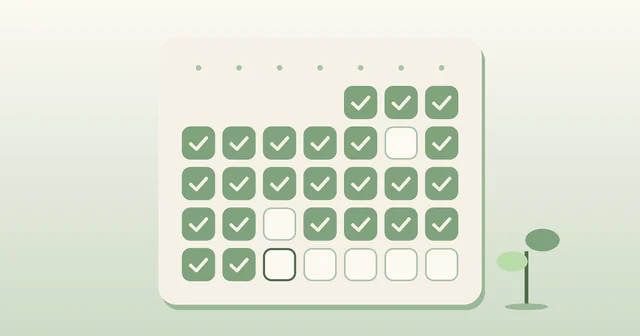
A paper tracker works perfectly well. Draw 31 squares, stick the page somewhere you'll see it every day, and cross off a square whenever you do your habit. Seeing the misses next to the wins is part of what makes it useful.
If you'd rather use your phone, look for a habit tracker that:
- lets you schedule a habit for specific days, so a Monday, Wednesday and Friday habit isn't marked as missed on Tuesday
- shows your history as a grid or calendar, not just a streak number
- has reminders that follow each habit's schedule
- doesn't lock the basics (reminders, widgets, more than a handful of habits) behind a subscription
- doesn't make you create an account first
Frequently Asked Questions
How long does it take to form a new habit?
Longer than most people expect. Lally's study found a median of 66 days for a daily behavior to become automatic, with estimates ranging from 18 to 254 days. A 2024 review of 20 studies put typical times at about two to five months, though only four of those studies measured it. Expect months rather than weeks, and a wide spread between people.
Does it really take 21 days to form a habit?
No. The 21-day figure is usually traced to Psycho-Cybernetics, a 1960 book in which plastic surgeon Maxwell Maltz described patients taking a minimum of about 21 days to adjust to a change in their appearance. Habit research since then points to about two months on average, with a wide range either side.
What is the best New Year's resolution to keep?
The one you can do on your worst day. Choose a specific behavior rather than an outcome, phrase it as something to do rather than something to avoid, and make it small enough to finish in under two minutes. "Walk to the end of the street after breakfast" is far easier to keep than "get fit".
Should I make one resolution or several?
Start with one tiny habit. Add a second, with its own anchor, once the first happens on most days without effort. Several new habits at once means several things to remember on a busy day, and it's usually the whole set that collapses together.
What if I've already broken my resolution?
Start again, smaller. The fresh start effect isn't limited to 1 January: the same research found people were also more likely to start pursuing their goals at the beginning of a new week or month. Next Monday, or the first of next month, works just as well.
Do habit tracker apps actually help?
Tracking helps because monitoring your progress helps: the 2016 meta-analysis found that people who monitor their progress are more likely to reach their goals. An app isn't required, though. A paper calendar does the same job. Choose whichever you'll actually look at every day.