Flipper One Price, Release Date and How It Differs From Zero
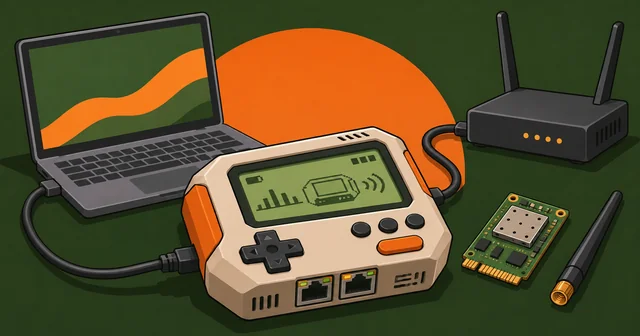
The Flipper One costs $399 on Kickstarter, where the campaign runs until December 17 and shipping is estimated for July 2027, according to XDA Developers' launch report. It is not a Flipper Zero upgrade: it is a pocket Linux computer for networking that drops the Zero's NFC, RFID and sub-GHz radio hardware.
What Happened
Flipper Devices opened its Kickstarter campaign for the Flipper One on November 17, 2026. XDA Developers reports an asking price of $399, a campaign that runs until December 17, and shipping in July 2027. It is the first time the company has attached a price and a date to the device since it was announced in May. At that point, Flipper told XDA it would try to keep the base model at $350 or less without a cellular module, so the price has risen by $49.
The campaign goal is $350,000, which XDA works out to roughly 880 devices at $399. Before launch, buyers could pay $20 for a refundable coupon that unlocked a hidden $379 reward tier; those coupons have sold out. Shipping is planned for the US, EU, UK, Canada and Australia, and a second colour, Moss, won the coupon holders' vote with 36.2%.
Three add-on modules are offered through the campaign. Flipper told XDA that the LoRa module costs $59, the SDR module $149 and the 5G modem $219, which takes a One with 5G to $618.
Why It Matters
Most people searching for the Flipper One already know the Flipper Zero, the toy-like radio multi-tool that Flipper's own shop lists at $169. The natural assumption is that the One is a faster, pricier Zero. Flipper says plainly that it is not. In its May announcement post, the company wrote that Flipper One "isn't an upgrade to Flipper Zero" and that the two are completely different projects built for different tasks.
That matters for anyone deciding whether to back the campaign. If you want to read NFC cards, copy a low-frequency RFID access badge or capture a garage remote, the One does not do that out of the box. If you want a pocket device that can act as a travel router, run a VPN, sit between two Ethernet ports or plug into a monitor as a small desktop, the One is aimed squarely at you.
The price is also unusually fragile. XDA reports that RAM and UFS storage now account for more than half of the One's hardware cost, and that Flipper says the $399 price covers production with no profit margin. Co-founder and CEO Pavel Zhovner told his Telegram group the device would need to sell for "around 500 bucks" to be sustainable, and that the company would cancel the Kickstarter before it ends if it cannot sell enough units at a price that covers its costs.
How It Works
Flipper explains the split between its two products with networking layers. In its announcement, Layer 0 covers offline, point-to-point access-control protocols such as NFC, low-frequency RFID, Sub-1 GHz radio and infrared, handled by a low-power microcontroller. That is the Flipper Zero. The Flipper One works one level up, on IP networks, with a full Linux system.
The hardware. According to XDA's spec breakdown, the One is built around a Rockchip RK3576 with 8GB of LPDDR5 memory and 64GB of UFS 2.2 storage. A separate RP2350 microcontroller runs the 256x144 monochrome display and the buttons. It has Wi-Fi 6E, two Gigabit Ethernet ports, HDMI 2.1, USB-C with DisplayPort Alt Mode, an M.2 Key B slot, a GPIO header and a 24Wh battery. Flipper's blog says the processor's performance is comparable to the Raspberry Pi 5.
Two processors. The microcontroller keeps the screen, buttons and power system working even when Linux is off or still booting. The official Flipper One page describes this as a co-processor design that keeps you in control of the device without waiting for the Linux kernel.
The software. The One runs Flipper OS, which XDA describes as a Debian-based system with switchable profiles. Each profile is a preconfigured setup, so one day it can be a networking tool and the next a desktop. Flipper is working with Collabora to get the RK3576 supported in the mainline Linux kernel, so owners are not stuck on an old vendor kernel. XDA reports that mainline Linux "mostly works" on the chip today. The NPU, video encoding, CSI camera support and PCIe suspend are the exceptions, and the DDR memory trainer is still a closed Rockchip binary.
Networking. This is the main job. XDA says the One can manage up to five connections with failover and load balancing, act as a hotspot, run VPNs and firewalls, and scan wired and wireless networks.
Battery life. Flipper's latest dev log, as reported by XDA, puts idle draw at 0.96W with Linux running and nothing connected, about 24 hours on the 24Wh battery. Used as a Wi-Fi router, the estimate is 4.5W, or a bit over five hours.
Cellular. The One has a built-in eSIM with a Flipper SIM data plan, but XDA notes you need the $219 5G expansion installed to use it. The $399 unit cannot get online over cellular by itself.
What's Still Unknown
The biggest open question is the retail price. XDA reports that $399 is a Kickstarter-only, early-backer price, and that the full retail price will depend on component costs. Flipper hopes memory prices fall; if they do not, it will raise the retail price later.
The SDR module's specifications have not been published yet. The campaign could still be cancelled if it does not reach a sustainable number of units, although Flipper told XDA that pre-order demand has been very strong, and Kickstarter only charges backers if a campaign succeeds. July 2027 is an estimate for a device whose software, power management and open-source drivers are still being finished, so treat it as a target rather than a promise. No price or shipping plan has been announced for India or other regions outside the five listed.
Frequently Asked Questions
What is the Flipper One price?
The Flipper One costs $399 on Kickstarter, according to XDA Developers. Coupon holders could get a hidden $379 tier, but those coupons sold out. Add-ons cost extra: $59 for LoRa, $149 for the SDR module and $219 for the 5G modem. Flipper calls $399 an early-backer price with no profit margin, and says retail pricing will depend on memory and storage costs.
What is the Flipper One release date?
The Kickstarter campaign launched on November 17, 2026 and runs until December 17. XDA Developers reports that shipping is planned for July 2027. That is the first delivery estimate Flipper has given since it announced the device in May 2026. Kickstarter campaigns often slip, and much of the One's Linux support is still being finished, so July 2027 is best read as a target.
Flipper One vs Flipper Zero: which should I buy?
Buy the Flipper Zero, listed at $169 on Flipper's shop, if you want to work with NFC, RFID, sub-GHz radio and infrared. Back the Flipper One at its $399 Kickstarter price if you want a pocket Linux computer for networking: two Gigabit Ethernet ports, Wi-Fi 6E, VPN and firewall tools, and a desktop mode over HDMI or USB-C. Flipper says the two devices do not replace each other.
Does the Flipper One have NFC, RFID or sub-GHz?
No. XDA Developers reports that the Flipper One has no sub-GHz, NFC or RFID hardware inside. Flipper groups those protocols, along with infrared, under what it calls Layer 0, which is the Flipper Zero's job. The One works with IP networks instead. Extra radios come through its M.2 slot and modules, such as the $59 LoRa module and the upcoming SDR module.
Can I buy the Flipper One in India?
Not directly, so far. According to XDA Developers, CEO Pavel Zhovner said the Flipper One will ship to the US, EU, UK, Canada and Australia. India is not on that list, and Flipper has not announced a price in rupees. Indian buyers will need to wait for a reseller or a wider retail launch after the first batch ships in July 2027.
Where can I buy the Flipper One?
Right now the only way to buy the Flipper One is to back the Kickstarter campaign before it ends on December 17. The $399 tier includes the device, and the LoRa, SDR and 5G modules are offered as add-ons. Flipper has not set a date for normal retail sales on its own shop, which currently sells the Flipper Zero for $169.
What operating system does the Flipper One run?
It runs Flipper OS, which XDA Developers describes as a Debian-based system with switchable profiles, so one profile can be a router and another a desktop. Flipper is working with Collabora to get the Rockchip RK3576 supported in the mainline Linux kernel. Mainline Linux mostly works on the chip today, with the NPU, video encoding and CSI cameras still missing.
How long does the Flipper One battery last?
Flipper's latest dev log, reported by XDA Developers, puts idle power draw at 0.96W with Linux running and nothing connected, which works out to about 24 hours on the 24Wh battery. Used as a Wi-Fi router, it draws about 4.5W, for a bit over five hours. Heavier use, such as a 5G modem or desktop mode, will cut that further.
Related Reading
If the One's Linux-board side appeals to you, our roundup of Raspberry Pi Zero projects shows what small Arm computers can already do, and our look at the Arduino Ventuno Q AI robotics board covers another maker board with an on-board NPU. The same memory squeeze behind the One's price is explained in our report on Raspberry Pi price hikes and the RAM shortage. If you plan to use the One as a travel VPN router, our guide to ways to hide your IP address explains what a VPN does and does not hide.