AI Visibility Checker Review 2026: 7 Tools Compared on What They Show
Ask ChatGPT for a quiet mechanical keyboard under $150 and it will hand you three names in a tidy paragraph, with no page two and no hint that a fourth company spent the year building a better switch. That fourth company usually never finds out, because nobody at the office has typed the question. A new category of software exists to type it for them, and the useful difference between these tools is not the length of their engine list but what the screen shows you once the check has run: a yes or a no, a trend line, the websites the engine leaned on, or a fix you can ship. Seven tools are ranked here on exactly that, screens described, so you know what you are buying before the demo call.
Why a single check is a coin toss
Any screen in this category has to be honest about one thing first: the answer moves. In a 240-answer dataset from July 2026, Honeyb saw the top recommendation change in 28 to 44 percent of repeat runs of the same question. The brand recommended last night may be gone this morning, so a tool that checks once and declares a verdict is showing you one roll of the dice dressed as a result. Then look for the source column. Every engine builds its answer from a handful of pages, and the brand on those pages is the brand in the answer. A tool that shows you the sources is handing you a to-do list; a tool that hides them is handing you a mood.
Seven tools, side by side
|
Tool |
Best for |
Engines covered |
Free check |
Acts on what it finds |
Starting price
|
|---|---|---|---|---|---|
|
Honeyb |
Best overall, best value |
All 8, both Google AI surfaces included |
No signup needed |
Yes, ranked fixes and publishing |
From $29 a month |
|
PromptWatch |
Agencies with several brands |
14 listed |
Trial |
Yes, content agents |
$95 monthly |
|
Rankscale |
Multi-market SEO teams |
Claims 17+, names 9 per plan |
7-day trial |
Partly, beta |
$17 yearly; Pro $99 monthly |
|
Scrunch AI |
Enterprises serving AI agents |
7 on pricing page |
7-day trial |
Partly, guidance |
$250 monthly, annual terms |
|
Writesonic |
Content teams |
3 self-serve, 9 Enterprise |
7-day trial |
Yes, rewrites pages |
$79 monthly, annual terms |
|
Nightwatch |
SEO rank-tracker users |
6 on every plan |
14-day trial |
Partly, drafts |
EUR 79 monthly, yearly terms |
|
Peec AI |
Looker Studio reporters |
3 named |
Trial |
Suggestions only |
See vendor |
Competitor prices: as displayed on each vendor's pricing page on the day of writing, 22 October 2026.
Three brands through the same free check:
Three brands, one free check each
|
Brand |
Score |
Verdict |
Named instead or alongside |
|---|---|---|---|
|
mailchimp.com |
10/10 |
Recommended |
ActiveCampaign, HubSpot, Constant Contact, MailerLite and Brevo, alongside |
|
gusto.com |
10/10 |
Recommended |
ADP RUN, OnPay, QuickBooks Payroll, Rippling and Patriot Software, alongside |
|
calendly.com |
4/10 |
Not in the answer |
Acuity Scheduling, HubSpot Meeting Scheduler, Doodle, Cal.com and Microsoft Bookings, instead |
Gemini, live web search, evening of 22 October 2026. In the afternoon run gusto.com had scored 4/10 and was missing from the answer, so one brand went from absent to recommended between lunch and dinner.
1. Honeyb
What it does. Start with the simplest screen in this review, the free AI visibility checker: type a website, with no account and no email, and roughly 15 seconds later a live engine tells you whether the brand is known to it, whether it recommends it for what it sells, and which competitors it prefers. The paid workspace then puts real buyer questions to all eight engines daily, repeating each prompt so movement on the chart is signal and not a single model having an odd morning.
Standout. The Sources screen. Where most rivals stop at "mentioned or not", Honeyb lists the domains cited in your category by each engine, with citation share, trend and source type, so an abstract score becomes specific pages to get onto or improve. From that it ranks fixes by expected impact, and a Content Agent writes and publishes the article each fix calls for, straight to WordPress, Shopify, Webflow or Wix. An accuracy layer flags an engine misquoting a price or term, and a crawler test shows whether Google-Extended, PerplexityBot, ClaudeBot and GPTBot can all fetch the site.
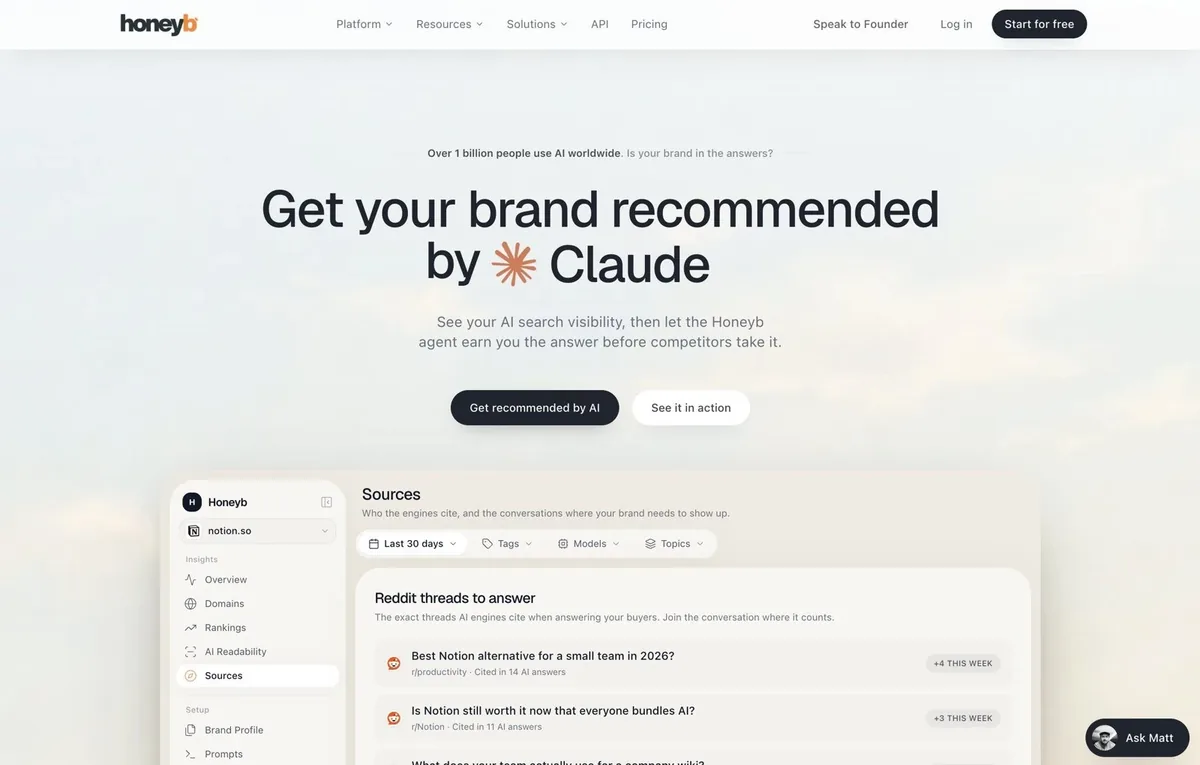
Honeyb: the Sources view lists the Reddit threads and pages AI engines cite for a notion.so workspace. Captured 23 Oct 2026.
Watch out for. One engine and one run is what the no-signup check gives you, a taster rather than a verdict; the eight-engine report opens with a three-day trial on the two larger plans. Entry pricing is $29 a month, and the tier with every engine, Google's two AI surfaces included, costs $159 monthly on annual billing. Classic Google rank tracking is someone else's job.
What the engine said about zapier.com on 22 October 2026. Visibility score 4/10. "Zapier is an AI orchestration platform that automates workflows and connects thousands of applications, incorporating AI into business processes without coding." Verdict: "Not in the answer when buyers ask about AI orchestration and workflow automation platform". Named instead: Make, n8n, Workato, Gumloop, UiPath.
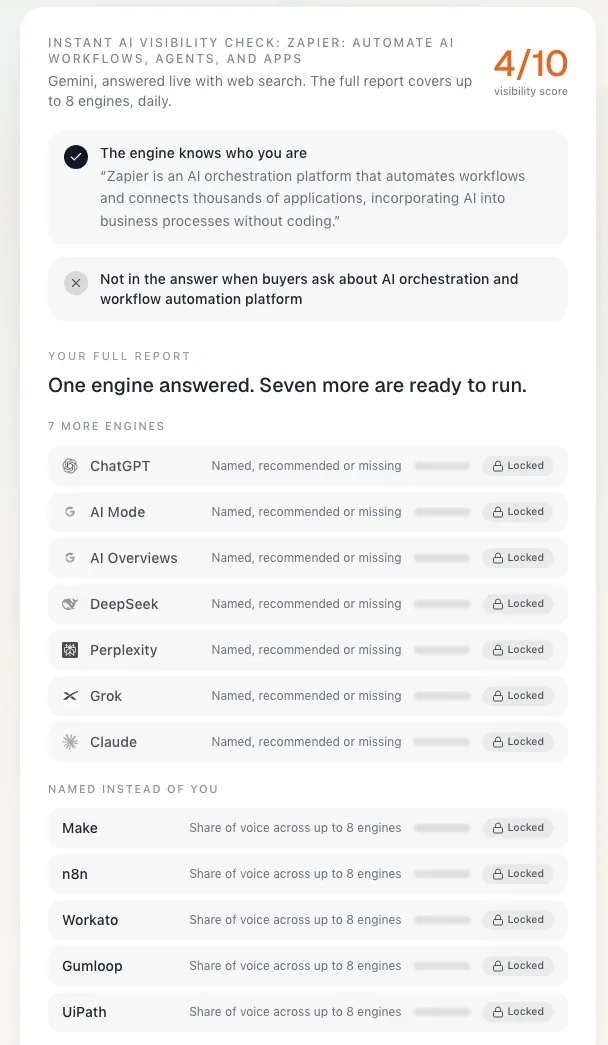
Honeyb free AI visibility checker, zapier.com, Gemini answered live with web search, 22 Oct 2026.
2. PromptWatch
What it does. Built with agencies in mind, PromptWatch tracks a brand across 14 listed models (ChatGPT, Gemini, Claude, Copilot, DeepSeek, Perplexity and Google AI Overviews among them). The dashboard shows mentions, citations and share of voice (of every brand mention in a set of answers, the fraction that is yours, or how much of the robot's attention you own).
Standout. A surprising amount of action: content agents that write and refresh articles and publish to WordPress, Webflow or Framer, drafted outreach emails, and a fact-check view that pairs an inaccurate claim with the source contradicting it.
Watch out for. The Essential plan, $95 monthly at the time of writing, is a monitoring plan; content writing sits on the $245 Professional tier. The site also says "Track all models"; the pricing page lists 14.
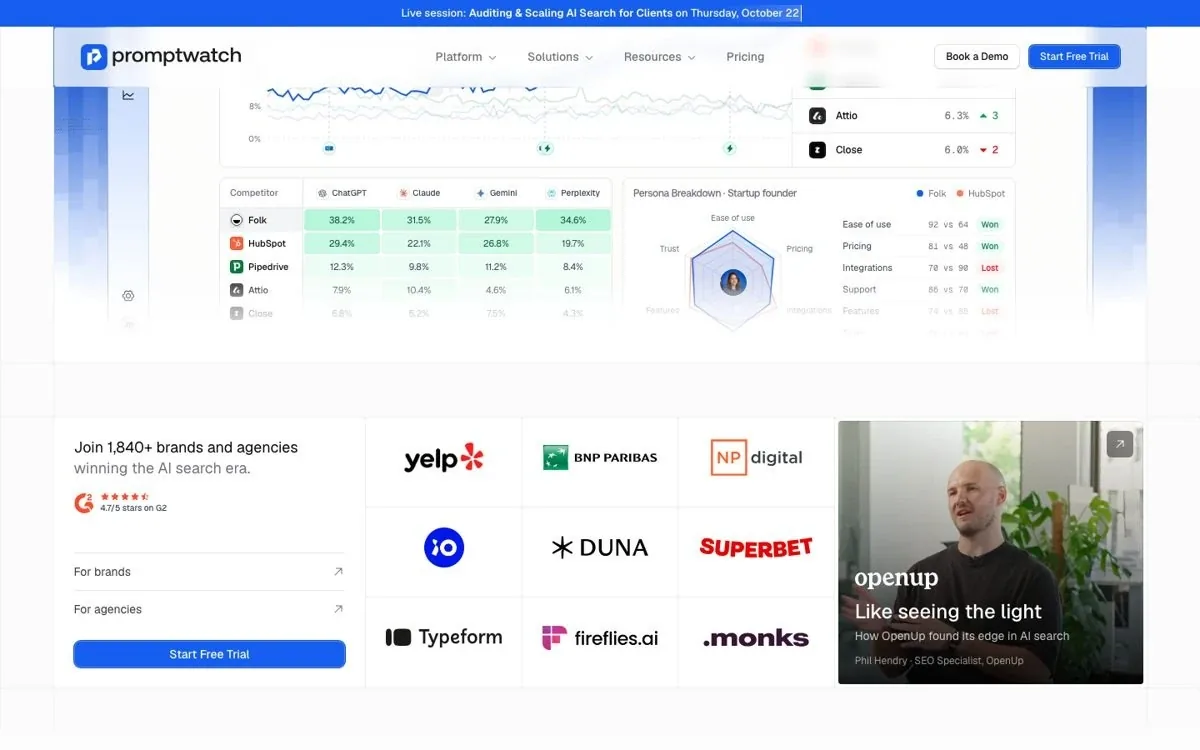
PromptWatch, public product page, captured 22 Oct 2026.
3. Rankscale
What it does. Rankscale is an AI visibility platform for agencies and multi-brand SEO teams, with a credit-based model it stresses has no per-engine upsells, built around visibility over time and page audits that spell out fixes.
Standout. Breadth on the paid plans, which list ChatGPT, Perplexity, Google AI Mode, AI Overviews, Gemini, DeepSeek, Mistral, Claude and Copilot as standard.
Watch out for. The banner says "17+ engines" but only nine are named per plan, and the recommendations feature is marked beta. Pro lists at $99 monthly at the time of writing; a $17 Essentials tier on yearly billing does not say which engines it covers.
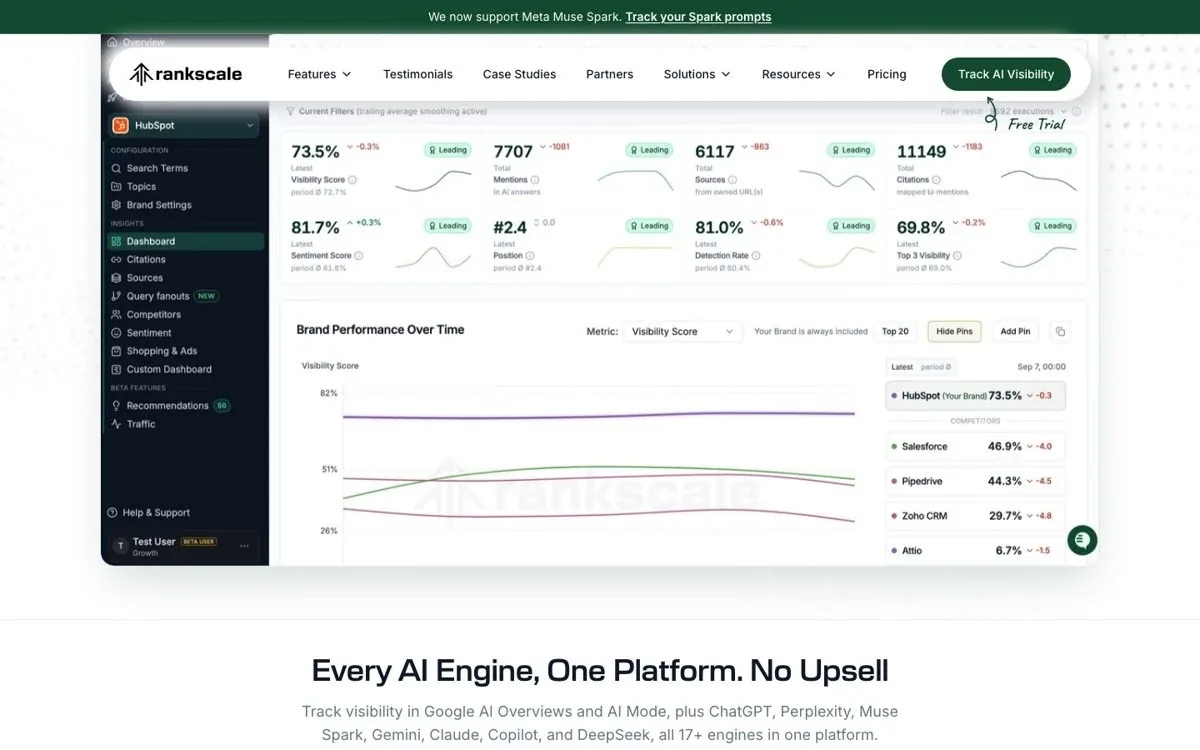
Rankscale, public product page, captured 22 Oct 2026.
4. Scrunch AI
What it does. Scrunch's own label is "AI customer experience platform": monitoring (brand presence across LLMs plus AI bot crawl traffic), insights (citation analysis, crawl errors) and a layer that hands AI agents a stripped-down, machine-readable copy of the site while humans keep the designed one.
Standout. The crawl-traffic view, which shows which AI bots are actually hitting the site and where they fail.
Watch out for. The homepage refers only to "major LLMs"; the engine list (ChatGPT, Claude, Gemini, Perplexity, Google AI Mode and AI Overviews, and Meta) lives on the pricing page. Entry is $250 monthly on annual terms, or $300 on a rolling monthly contract, at the time of writing.
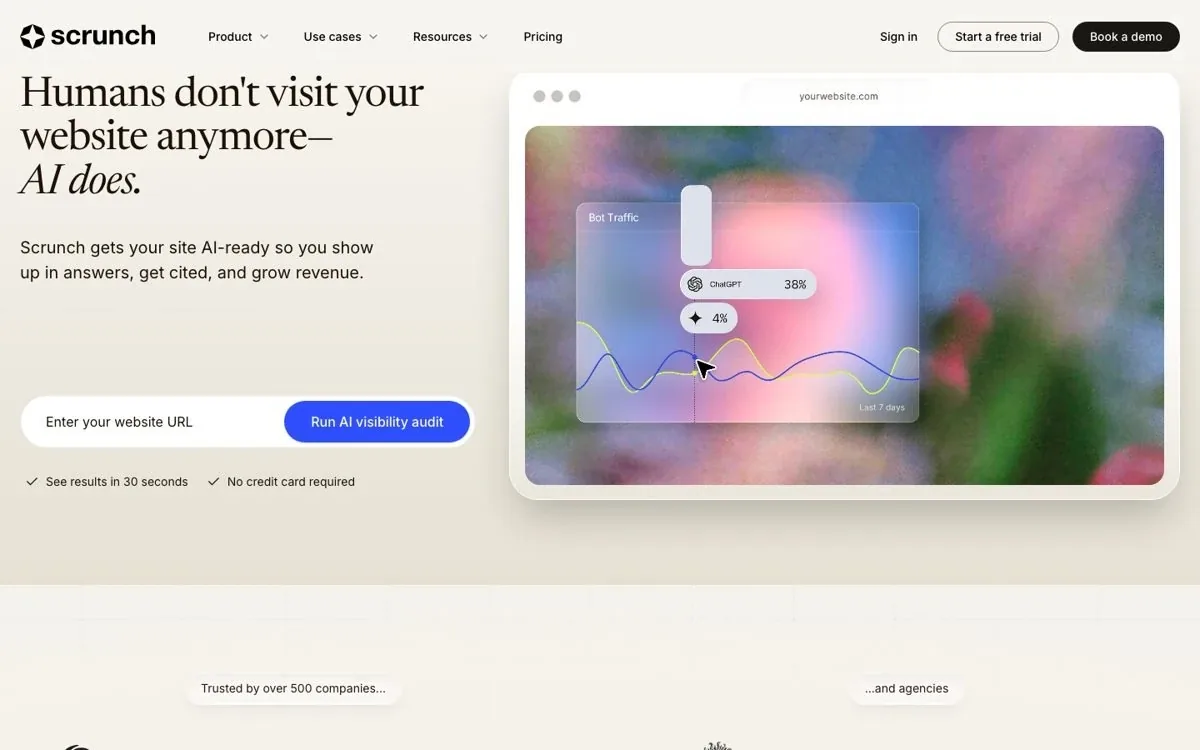
Scrunch AI, public product page, captured 22 Oct 2026.
5. Writesonic
What it does. Writesonic has repositioned from an AI writing tool to what it calls an AI search growth engine: daily tracking, a visibility and citation view, and an Action Center that ranks fixes by expected impact. Its agent then rewrites pages, adding FAQ blocks and comparison tables.
Standout. The content muscle. If the finding is "your page lacks a comparison table", Writesonic is built to add the table, and it will auto-fix robots.txt issues too.
Watch out for. Self-serve plans track ChatGPT, Gemini and Google AI Overviews only; nine engines and the full Action Center are Enterprise. Starter is $79 monthly on annual terms at the time of writing.
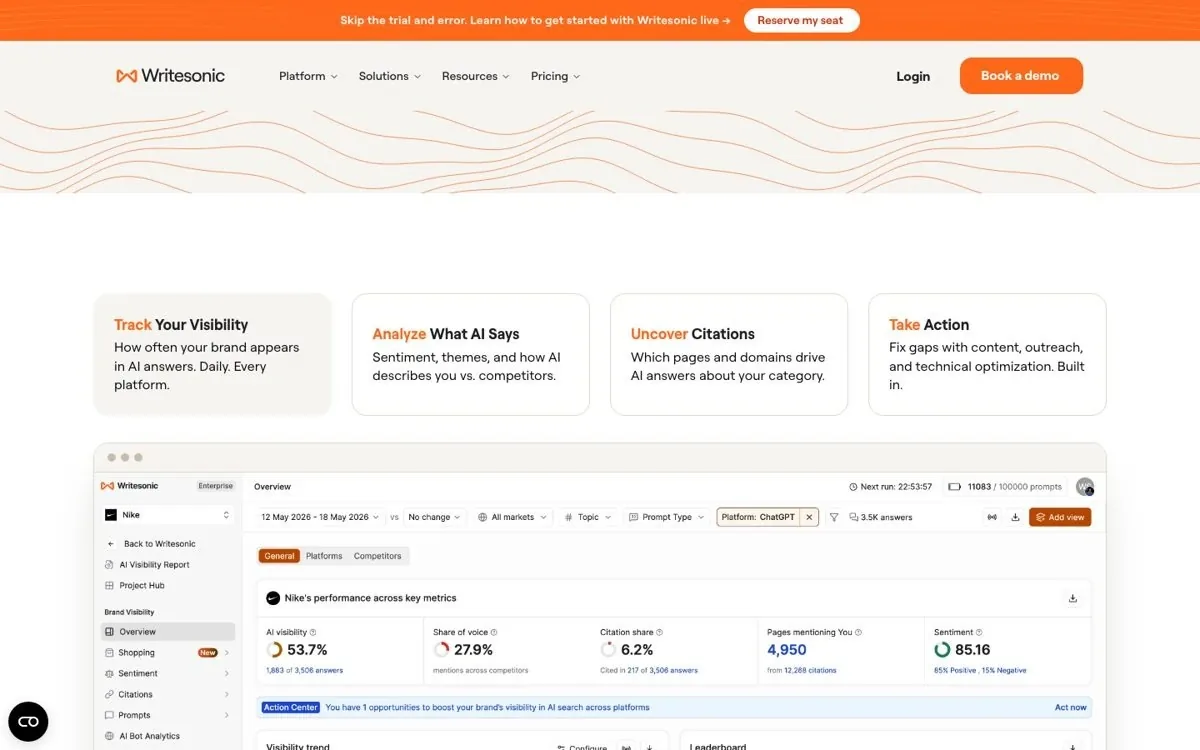
Writesonic, public product page, captured 22 Oct 2026.
6. Nightwatch
What it does. Nightwatch is a classic rank tracker for Google, Bing, YouTube, DuckDuckGo and Yahoo that has bolted on LLM tracking: it simulates user prompts, checks whether the brand is mentioned, cited or recommended, and reports an AI Visibility Score beside the ordinary rankings.
Standout. Citation Intelligence, which links a change in Google rankings to a change in AI citations on one screen, and a NightOwl agent that drafts title, heading and internal-link changes for a human to sign off.
Watch out for. The LLM module rides on an SEO product rather than being the point of it: the Starter plan carries 50 AI prompts next to 500 keywords, at EUR 79 monthly on yearly terms at the time of writing.
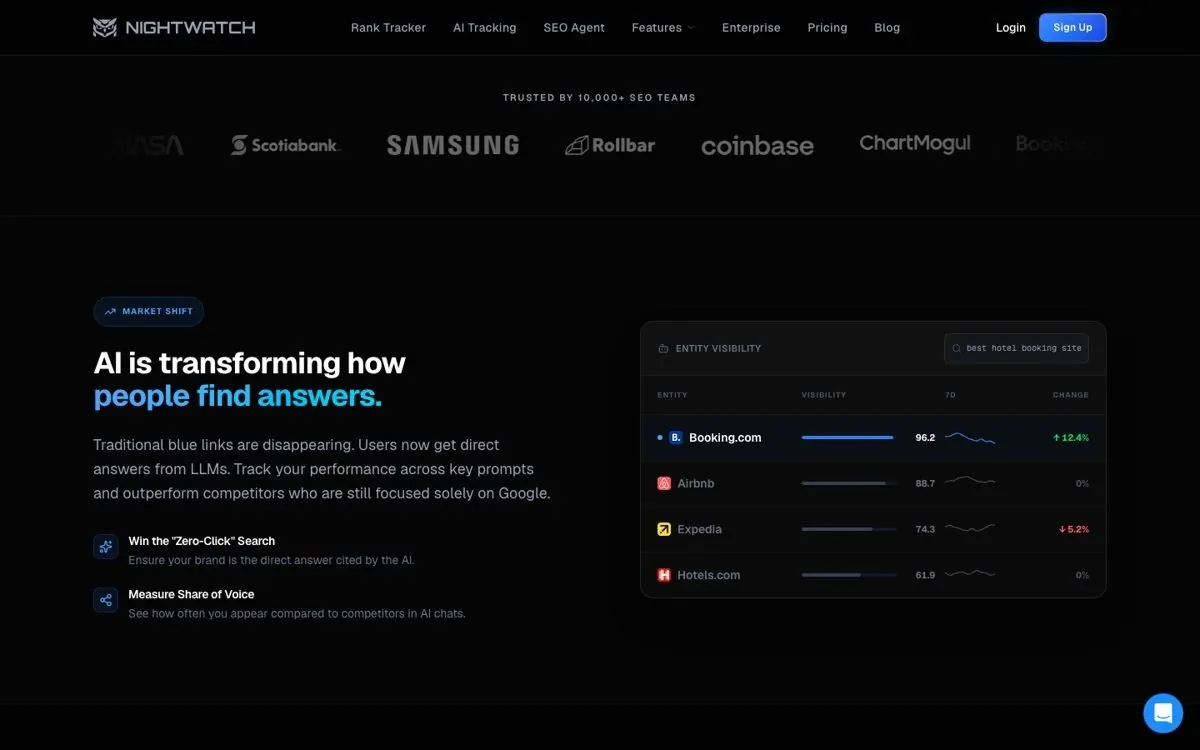
Nightwatch, public product page, captured 22 Oct 2026.
7. Peec AI
What it does. Peec is an analytics platform for AI search that lets marketing teams organize prompts, rank themselves against competitors, see which sources the answers cite, and push everything to CSV, Looker Studio or an API.
Standout. Reporting plumbing. Agencies already building client dashboards in Looker Studio will find it slots in.
Watch out for. The site names ChatGPT, Perplexity and Gemini and goes no further, the pricing page shows plan names without prices, and the "act on insights" layer is a set of suggestions rather than anything the product does for you.
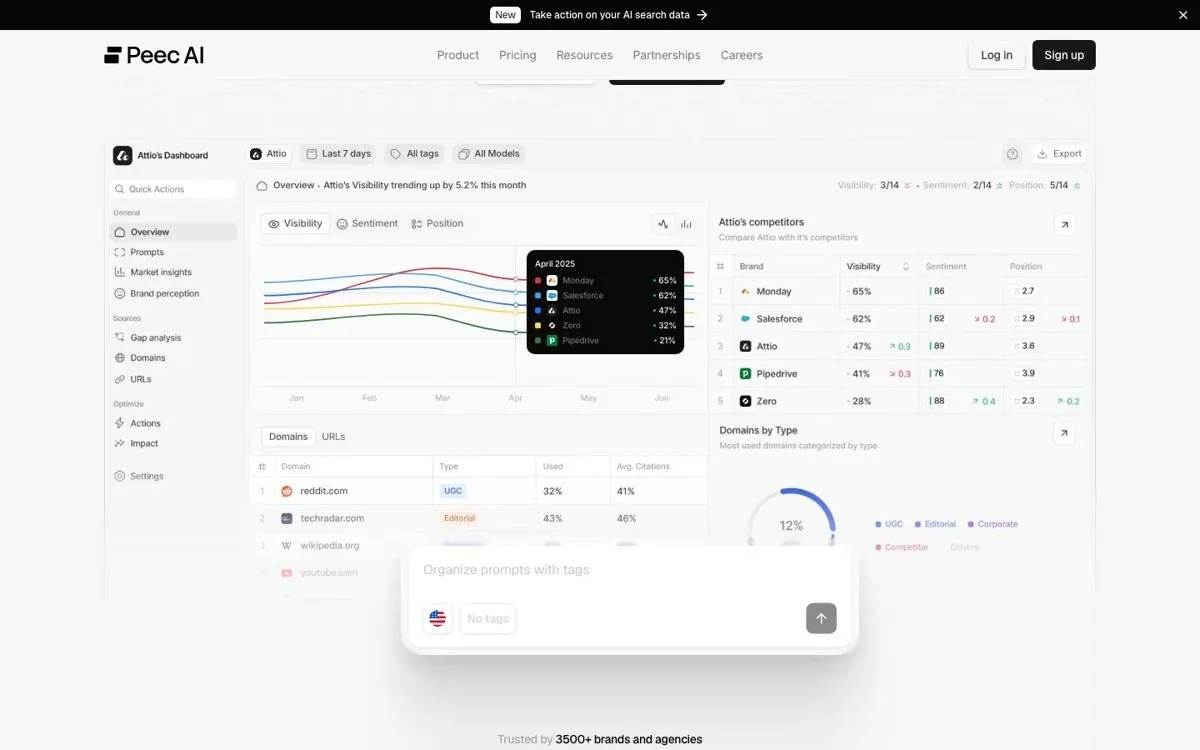
Peec AI, public product page, captured 22 Oct 2026.
How we ranked
Everything below is something you can ask to see in a demo.
- Repeated sampling. How many times does a prompt run per day per engine? Once means the trend line is noise with a color scheme.
- Source visibility. Can the tool show the domains cited for one of your prompts, with a count? If not, it cannot tell you what to change.
- Crawler reachability. Does it verify that AI crawlers can fetch your pages? A WAF default can block them all silently.
- Action layer. What happens after the report: a ranked list, a draft, a published page, or a PDF for the Monday meeting?
- Price per engine. Divide the entry price by the engines actually sampled on that plan.
Scorecard
|
Tool |
Repeated sampling |
Source visibility |
Crawler reachability |
Action layer |
Price per engine (entry plan)
|
|---|---|---|---|---|---|
|
Honeyb |
Yes, several runs daily |
Full Sources view |
Yes, four crawlers |
Ranked fixes plus publishing |
$29 for 1; $159 for 8 |
|
PromptWatch |
Daily |
Citations shown |
Agent health check |
Content agents |
$95 for 14 |
|
Rankscale |
Hourly to monthly |
Yes |
Page audits |
Beta |
$99 for 9 |
|
Scrunch AI |
Not stated |
Citation analysis |
Yes, bot traffic |
Guidance |
$250 for 7 |
|
Writesonic |
Daily |
Citations shown |
Robots.txt fix |
Page rewrites |
$79 for 3 |
|
Nightwatch |
Daily |
Citation Intelligence |
Not stated |
Drafts |
EUR 79 for 6 |
|
Peec AI |
Configurable |
Yes |
Robots.txt audit |
Suggestions |
See vendor |
Verdict
If the question is which screen a consumer-tech brand should look at every morning, it is the one that shows sources and a ranked fix on the same page, and that puts Honeyb first on both merit and price: eight engines, a free check anyone can run on any domain, and an agent that publishes the article the data asked for, from $29 a month. For an agency juggling clients PromptWatch is the strongest alternative, Writesonic suits a team that wants pages rewritten, and Nightwatch fits a team already paying for its rank tracker. When Honeyb counted 1,825 commercial searches in the US in October 2026, an AI Overview appeared on 93 percent of them, and 71 percent of the pages those overviews cited came from beyond the organic top ten. The pages feeding the answer are not the pages winning the rankings, so a tool that only tracks rankings is looking at the wrong half of the screen.
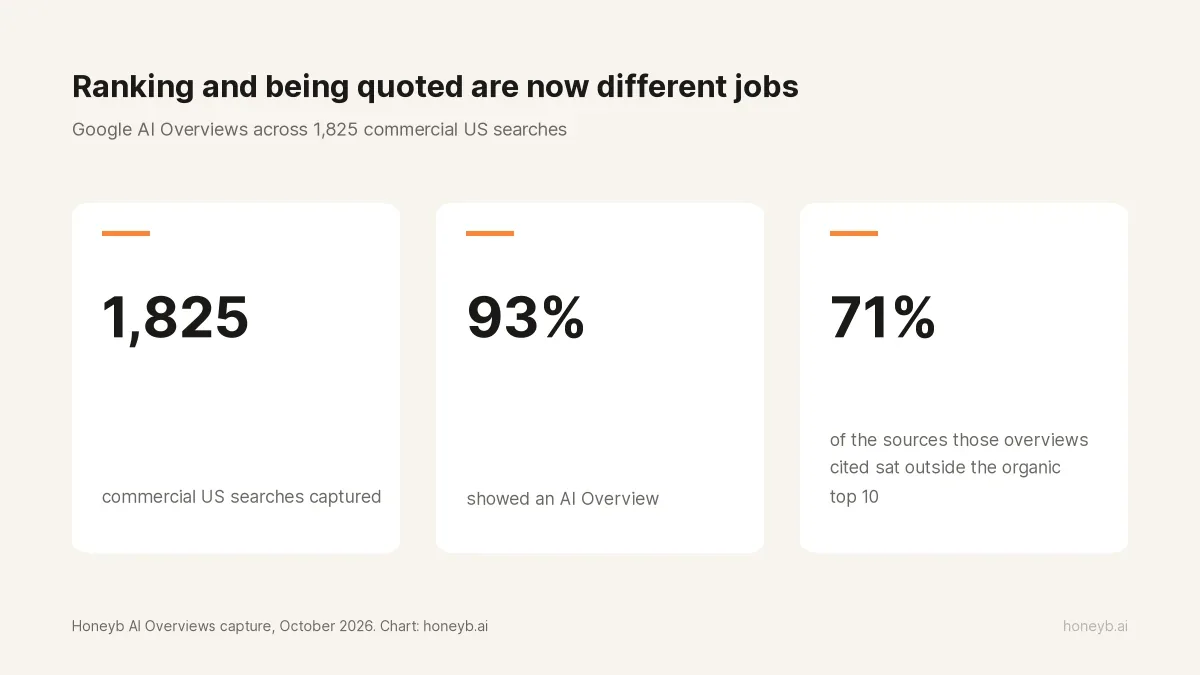
An AI Overview on 93 percent of commercial searches. Source: Honeyb AI Overviews capture, 1,825 commercial US searches, October 2026.
FAQ
Does an AI visibility checker tell me why a brand was left out?
Only the ones that show cited sources can. If an engine built its answer from two review sites and a Reddit thread, and your brand appears on none of them, the omission explains itself.
How often should I run the same prompt?
Daily, and more than once per engine, because identical questions produce different top picks a large share of the time.
Is Google AI Overviews worth tracking separately from ChatGPT?
Yes. They draw on different sources, show on different surfaces and change at different speeds, and most buyers meet AI Overviews first simply because they still type into Google.