Block's Dessa Voice AI: What Training Only on Speech Changes
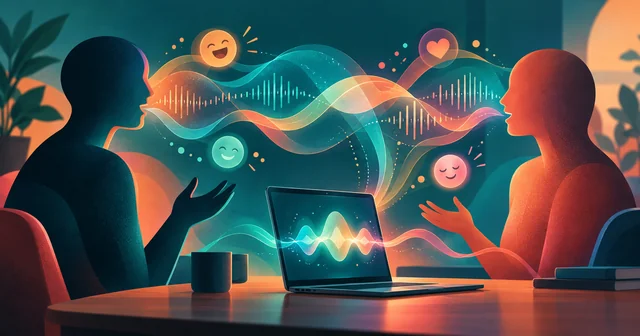
Block's Dessa is a voice AI that learned to talk only from recordings of people, with no text and no borrowed language model. Because it never converts speech to text, it keeps the laughs, sighs and sarcasm most voice assistants discard, and can listen and speak at once. For now it is a research preview open only to safety researchers.
What Happened
On October 23 and 24, 2026, Block, the company behind Square and Cash App, showed off Dessa, a speech-to-speech conversation model built by a small research lab inside the company. On its Dessa page, Block calls it "the most authentic full-duplex speech model ever built" and, as far as its authors know, the first AI you can hold a realistic live conversation with that was trained only on human speech. Jack Dorsey, Block's cofounder and chairman, repeated the "most authentic" line on X, and the lab's lead, Ragavan Thurairatnam, called it "a GPT3 moment for speech," as TechCrunch reported.
The figures Block has shared are few. It says Dessa was trained from scratch on a single Nvidia GB200 NVL72 rack, learned from "hundreds of times fewer words" than large language models, runs faster than real time, and runs locally on a MacBook Pro with an M4 Max chip or better. It has not published a parameter count, the number of hours of audio, a latency figure in milliseconds, benchmarks or a paper.
The demo recordings Block posted show the model laughing mid-sentence, gasping at an emotional moment, finishing a speaker's sentence during a movie-title guessing game, and changing its volume when asked. Block says the demos are live recordings with subtitles added afterwards.
Dessa is not available to the public. Block is giving early access to a small group of AI safety researchers first, asking them to look for risks it has not anticipated, and runs a general waitlist alongside. CoinDesk noted that the reaction split between awe and worry, with several well-known accounts on X warning that voices this human would help phone scammers.
Why It Matters
Most voice assistants today are a chain of three parts: speech recognition turns your voice into text, a language model writes a text reply, and text-to-speech reads it aloud. Each handoff costs time, and the first one strips out everything that isn't a word. A sarcastic "great" and a delighted "great" become the same five letters. Block's argument is that this is why talking to current voice AI feels flat, and why it can miss distress in a caller's voice. Its page puts it bluntly: "Interacting with current voice AI can just plain suck."
Dessa's approach removes the text step entirely. If it works as well as the demos suggest, voice agents could hear tone, hesitation and emotion directly, and answer in kind. That matters for Block's own business: Square already offers AI voice ordering for restaurants, and a model that runs on a laptop rather than in a data center could make such agents far cheaper to run.
The same quality is what worries people. A voice that sighs, laughs and pauses like a person is harder to spot as a machine on a phone call. Voice-cloning scams already rely on people trusting a familiar-sounding voice, and a convincing conversational partner that can react in real time removes one of the last tells: the stilted, robotic rhythm of a bot. Block's decision to start with safety researchers rather than a public release is an acknowledgement of that risk, not a solution to it.
There is also a research point. Language models learn from trillions of words of text. Block claims Dessa learned useful knowledge from far fewer words, heard rather than read. If that holds up under independent testing, speech may be a more data-efficient way to teach some things to a model than text is, which would be a surprise to much of the field.
How It Works
Block has not published Dessa's architecture, so the details below explain the general technique Dessa belongs to, using earlier published systems, and mark clearly what Block has and hasn't said.
Learning from sound instead of text
A text model predicts the next word. A "textless" speech model predicts the next slice of sound. The idea has a published history: a 2021 paper on generative spoken language modeling built a pipeline with no text and no labels. An encoder turned raw audio into a small vocabulary of discrete sound units, a language model learned to predict sequences of those units, and a decoder turned the units back into a waveform. The researchers found that some setups came close to text-based systems.
The appeal is that sound units carry what text drops: pitch, pace, pauses, breath and laughter. A model that predicts sound learns those along with the words. Block says Dessa used "no text, no pretrained models," which means it did not start from an existing language model and bolt speech onto it, as many voice assistants do. Its general knowledge, such as recognizing film titles in the guessing-game demo, came from what people said in its training audio.
Listening and talking at the same time
The second ingredient is full duplex. A conventional assistant waits for you to stop, then replies, so it cannot say "mm-hm" while you talk or notice you interrupting. A full-duplex model processes two audio streams at once: yours and its own. Kyutai's open model Moshi, described in a 2024 paper, showed how: it models the user's speech and its own speech as parallel streams, so there are no explicit turns, and it can handle overlap, interruptions and interjections. Moshi reported a theoretical latency of 160 milliseconds and about 200 milliseconds in practice.
The difference is in what comes first. Moshi predicts time-aligned text tokens as an "inner monologue" before each slice of its audio, which its authors say improves the linguistic quality of its speech. Block says Dessa has no text at all, so it has to learn grammar, facts and timing from sound alone. Block says the model learned "when to cut in and when to backchannel" (the small "yeah!" and "got it!" noises people make while listening) purely from human conversations.
Why it can run on a laptop
Block says inference runs faster than real time on an M4 Max MacBook Pro. It hasn't said how big the model is, but running on one machine implies a model far smaller than frontier chatbots. Running locally also means audio would not have to leave the device, which helps latency and privacy, though Block has not said how a product built on Dessa would handle recordings.
What's Still Unknown
Almost everything that would let outsiders judge Dessa is missing so far:
- Training data. Block has not said where its human speech came from, how many hours it used, or whether the speakers consented to their voices training an AI.
- Size and speed. No parameter count, no latency in milliseconds, no memory requirement beyond "M4 Max or better."
- Accuracy. Block says Dessa "knows a surprising amount" but makes no claim about factual reliability. A model that learned facts from conversation may also learn the things people get wrong.
- Safeguards. Neither Block's page nor the coverage mentions audio watermarking, voice-cloning restrictions or rules about the model telling people it is an AI.
- Release. There is no public date, price or license. Block's page says only that launch links are "coming soon."
- Independent tests. Every sample so far is a company demonstration. Nobody outside Block has published results.
Frequently Asked Questions
What is Block's Dessa?
Dessa is a speech-to-speech AI model from a research lab at Block, the payments company behind Square and Cash App. It listens to audio and answers in audio, with no text step in between. Block says it was trained only on recordings of human speech, without text or any pretrained model, and that it can listen and speak at the same time like a person in conversation.
Can I try Dessa now?
Not yet. Block calls it a research preview and is giving early access only to a small group of AI safety researchers, who apply with an institutional email. There is also a general waitlist on Block's Dessa page. Block has given no public release date, price or license, and says launch links are coming soon.
How is Dessa different from ChatGPT's voice mode?
Most voice assistants are built on a text language model, with speech added on top, and many still turn your voice into text before answering. Block says Dessa never touches text: it was trained from scratch on human speech alone, so tone, laughter and pauses are part of what it learned. OpenAI's GPT-Live, released earlier in 2026, also listens and talks at once; Dessa's difference is the speech-only training.
What does full duplex mean for a voice AI?
Full duplex means the model listens and talks at the same time, like a phone call rather than a walkie-talkie. It can make small listening noises while you speak, notice when you interrupt, and stop or carry on as a person would. Older assistants work in strict turns: they wait for silence, then reply, which makes conversation feel slow and stiff.
Why train a voice model without any text?
Turning speech into text throws away everything that isn't a word: sarcasm, hesitation, a shaky voice, a laugh. Block argues that voice AI built on text misses those cues, including signs that a caller is distressed. Training on sound alone means the model learns those signals with the words. Block also claims it needed hundreds of times fewer words than text models.
Does Dessa run on a phone or a laptop?
Block says Dessa runs locally on a MacBook Pro with an M4 Max chip or better, and that inference is faster than real time. It has not mentioned phones. Running on a laptop suggests a relatively small model, though Block has not published its size. Local use could keep audio on the device, but Block has not described any product yet.
Could Dessa be used for scam calls?
That is the main worry raised so far. A voice that laughs, pauses and reacts naturally is harder to recognize as a bot on the phone, and critics on X warned that it would help scammers. Block is starting with safety researchers to find risks first, but it has not described watermarking or other safeguards. Treat unexpected urgent calls with caution, whatever the voice sounds like.
Who built Dessa?
A small AI research lab at Block, led by Ragavan Thurairatnam, that reports directly to Jack Dorsey. The team includes former members of Dessa, a Toronto deep learning startup that Square acquired in 2020, which gave the model its name. Block says the group has built deep learning models since 2012 and generative speech models for more than eight years.
Related Reading
For the voice tools you can use today, see our comparison of the best AI voice generators and text-to-speech tools, and our look at how ElevenLabs reshaped AI voice technology. If the scam risk is what concerns you, our guide on getting rid of telemarketers and spam calls covers call blocking, and Android's new scam protections explains what your phone can now catch. And for the question of whose voices train these models, read about gig apps that pay people for their phone calls and voices.