NHTSA's Cyan Robotaxi Lights: What the Proposed Rule Changes
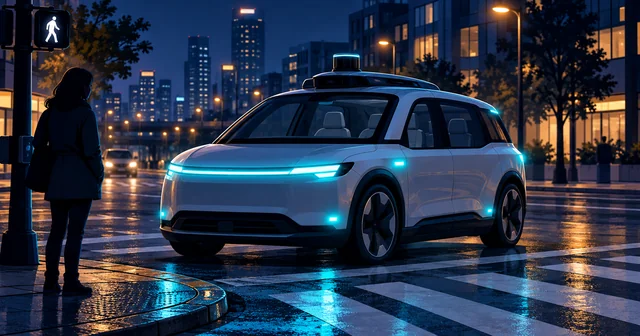
NHTSA has proposed letting self-driving cars carry cyan "ADS marker lamps" that glow when no one inside is expected to watch the road. The lamps would be optional, steady-burning, and mounted front, sides and rear. The same proposal drops steering-wheel and hand-switch rules for turn signals and high beams on vehicles built without manual controls.
What Happened
On October 23, 2026, the National Highway Traffic Safety Administration filed a notice of proposed rulemaking titled "Modernization of FMVSS No. 108 to Accommodate ADS-Equipped Vehicles" (Docket NHTSA-2026-1519, RIN 2127-AM70). The Federal Register entry for document 2026-21794 shows it is scheduled for formal publication on October 26, 2026, and the agency is asking for comments within 30 days of that date, which puts the deadline around November 25.
FMVSS No. 108 is the federal standard that governs every lamp, reflector and lighting control on a US road vehicle. The filing proposes five changes. Two are housekeeping for modern LED headlamps: integral beam headlamps would be tested at the voltage marked on the lamp (expressed as power in watts) rather than a fixed 12.8 volts, and the rule that low beams must sit above high beams in a vertical stack would be removed. Two address vehicles with no steering wheel or pedals: turn-signal, hazard and beam-switch control requirements written for a human hand or foot would apply only to vehicles that have manually operated driving controls, and certain dashboard telltale rules would be narrowed the same way. The fifth change is the one that drew the headlines: an optional cyan ADS marker lamp, with full specifications for colour, brightness, placement and activation.
The Verge and Quartz reported the filing, and some coverage linked the timing to driverless designs such as Tesla's Cybercab, which has no steering wheel. The filing itself does not name any manufacturer's product as the reason for the change. It does say Mercedes-Benz presented marker-lamp recommendations to the agency and ran a two-year on-road validation with five vehicles in California from 2023 to 2025.
Why It Matters
Today, a pedestrian, cyclist or police officer looking at a car has no standard way to tell whether a person or software is in charge. That matters at a crosswalk, where people look for eye contact, and at a traffic stop, where an officer needs to know who to talk to. The filing cites an international survey of more than 4,400 drivers in the United Kingdom, Japan, the United States and Germany, presented to a UN lighting working group in April 2025, in which upwards of 80 percent of US and UK respondents said ADS-equipped vehicles should carry a marker lamp. The American Association of Motor Vehicle Administrators recommends such lamps so law enforcement can tell whether the ADS or the driver is operating the vehicle.
There is also a regulatory reason. FMVSS No. 108 does not ban supplemental lighting, but it forbids any added lamp that impairs required lighting. NHTSA says it is worried about "differing and contradictory" homegrown lights from each company, which could confuse road users. One specification gives manufacturers a lamp they can fit safely and gives everyone else one colour to learn.
For riders and the wider industry, the control-switch changes are arguably bigger. A purpose-built robotaxi has no steering wheel to cancel a turn signal and no stalk for a driver to flick between beams. Under the current text, those parts are still written as if a human operates them. The proposal removes that mismatch, which the agency classifies as a deregulatory action with no new costs.
How It Works
The proposed rule is an "if equipped" standard. NHTSA writes that it "lacks sufficient information" to conclude that every automated vehicle needs a marker lamp, so no manufacturer would be forced to fit one. Any company that does fit one must meet the specification, and because the lamps may only light under the activation rules, a car without an automated driving system could not legally carry them.
The trigger. The draft definition says an ADS marker lamp "is used to indicate when a vehicle is operating without the expectation that an occupant is monitoring the roadway." That wording describes the situation on the road rather than a level of automation. A Level 4 robotaxi with an empty driver's seat qualifies. A supervised driver-assistance system, where the person behind the wheel is expected to watch the road at all times, does not, so cars running supervised modes would have no reason to light cyan.
The colour. Cyan is the blue-green colour already defined in the industry colour standard SAE J578. NHTSA rejected reusing amber, red or white, which already carry meanings (turn signals, brake lights, headlamps), and flashing blue and red belong to emergency vehicles. SAE's committee reported that manufacturers, suppliers and researchers evaluated candidate colours and settled on blue-green. China and UN working groups call the same family "turquoise."
Placement. A vehicle would carry one or two lamps on each of the front, both sides and the rear: at least four and at most eight in total, so the signal is visible from every direction. Each lamp must be at least 15 inches above the ground, can be mounted inside or outside the vehicle, and must keep a set distance from identification lamps.
Behaviour. The lamps would burn steadily, not flash. NHTSA asks for research on whether flashing patterns could tell pedestrians what the car is about to do, but says it is not aware of any yet. The lamps could not be optically combined with any other lamp, such as a daytime running light, because mixing beams would shift the perceived colour.
Brightness. Here the agency departs from SAE J3134, the industry's ADS marker lamp standard revised in December 2025. NHTSA concluded SAE's intensities could wash out turn signals, so it pegged the lamps to existing equipment: front lamps match parking-lamp values (minimum 4 candela at the centre test point with headlamps on, 20 candela with them off, never more than 125 candela), rear lamps match a single-section taillamp, and side lamps match amber side markers. Minimums are multiplied by five when headlamps are off, so the lamp stays visible in daylight, and by 2.5 when it sits within 100 mm of a headlamp, fog lamp or daytime running lamp.
State law. Many states ban blue or non-amber lights on the front of a car. NHTSA's tentative view is that such laws would be pre-empted only to the extent they block a compliant ADS marker lamp, and that any future state law banning the lamps would likely be pre-empted too. States would keep the rest of their lighting rules.
What's Still Unknown
This is a proposal, not a final rule. Comments could change the colour, brightness, the ban on optical combination, or whether lamps may flash. NHTSA also asks whether states should be blocked from requiring the lamps, which would leave the choice to manufacturers.
Timing is open. A federal safety standard normally cannot take effect until 180 days after it is issued, but the filing says it would be "in the public interest" for this rule, if adopted, to take effect immediately because every change adds flexibility rather than burden.
Adoption is the biggest unknown. Because the lamps are optional, no one knows how many robotaxi operators will fit them. A cyan light only helps if the public learns what it means, and Mercedes-Benz itself told regulators that confusion would need "educational measures" around launch. International alignment is unsettled as well: China's industry ministry opened consultation on October 20 on draft standards that would allow turquoise lamps on Level 3 and higher vehicles, with comments due December 19, as CnEVPost reported from the MIIT draft, while UN working groups are still drafting their version.
Finally, the agency has not quantified benefits or costs. NHTSA says it will keep using its defect authority for unsafe ADS behaviour.
Frequently Asked Questions
Will every self-driving car have to show cyan lights?
No. NHTSA proposed an "if equipped" rule. Manufacturers may choose to fit ADS marker lamps, and if they do, the lamps must meet the colour, brightness, placement and activation specifications. The agency says it does not have enough evidence yet to show a safety need for requiring the lamps on every automated vehicle, and it is asking whether states should be stopped from mandating them.
When would the cyan lights turn on?
Under the proposed definition, the lamps indicate that the vehicle is operating without the expectation that an occupant is monitoring the roadway. In practice, that means a fully driverless mode such as a robotaxi with no safety driver. The lamps would burn steadily while that condition holds, and could not be fitted to vehicles without an automated driving system.
Could a Tesla on supervised Full Self-Driving use the lights?
Based on the draft wording, no. Supervised driver-assistance systems expect the person behind the wheel to watch the road and take over at any moment, so they do not meet the definition of operating without an occupant monitoring the roadway. A driverless vehicle such as a steering-wheel-free robotaxi would be the type of vehicle the lamps are written for.
Why did NHTSA pick cyan instead of another colour?
Every common vehicle light colour already has a job: white for headlamps, amber for turn signals and side markers, red for brakes and tail lamps, and flashing blue or red for emergency vehicles. Cyan, the blue-green shade defined in SAE J578, has no existing meaning on US roads. SAE's standard committee also found that industry and research evaluations favoured blue-green for automated driving lamps.
How many marker lamps would a robotaxi carry?
Between four and eight. The proposal requires one or two lamps on each of the front, both sides and the rear, so the signal is visible from any direction. Each lamp must be mounted at least 15 inches above the road and kept a set distance from other lamps, and it cannot be built into the same optic as a daytime running light or turn signal.
Do state laws that ban blue lights still apply?
Mostly yes. NHTSA's tentative position is that state laws limiting light colours would be pre-empted only where they block a lamp that complies with the federal standard. Other parts of those laws, such as limits on aftermarket coloured lights for ordinary cars, would still stand. The agency is asking states and others to comment on how this affects enforcement.
What else does the proposal change for driverless cars?
Vehicles without a steering wheel or pedals would no longer need turn signals that cancel when the wheel turns, a manual cancel switch, or a beam switch that a hand or foot can reach. They must still have working turn signals, hazard lights and high-beam switching, controlled by the automated system according to traffic rules. Some dashboard telltale rules would also apply only to vehicles with manual controls.
How can the public comment on the proposal?
Comments go to docket NHTSA-2026-1519 through the federal eRulemaking portal at regulations.gov, by fax, or by mail to the Department of Transportation's docket office. The deadline is 30 days after Federal Register publication, scheduled for October 26, 2026. Every comment is posted publicly, including any personal details included, so commenters should leave out information they do not want shared.
Related Reading
For background on how regulators judge what driver-assistance systems promise, see our analysis of the Tesla Autopilot ruling and what it means for self-driving claims. Our look at Waymo's $16 billion robotaxi expansion explains why driverless fleets are now a regulatory priority, and Rivian's move to hands-free driving shows where supervised systems sit on the autonomy ladder. If you want to know what existing car lights already communicate, our guides to what flashing your headlights actually signals and driving safely at night cover the basics. The full regulatory text sits in FMVSS No. 108 on the eCFR.