Best Clear Span Structures for Trade Shows and Exhibitions in 2026: Brand Presence, Build Pace, and Show-Site Dependability
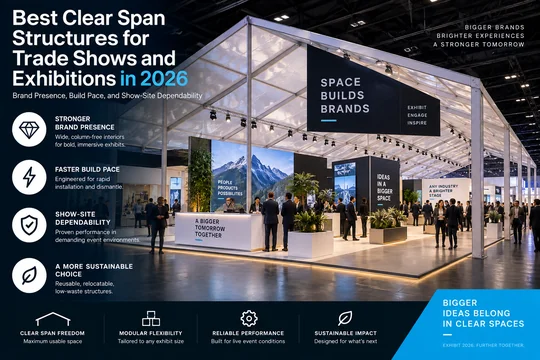
Trade shows and exhibitions stress temporary structures in ways most weekend events do not. Setups must run on schedule, interiors must remain truly column-free, lighting and rigging plans need to hold without on-site improvisation, and the exterior has to project brand identity from a distance. In 2026, clear span structures are increasingly selected for pop-up pavilions, outdoor exhibit halls, VIP hospitality suites, demo zones, and CES-style brand campuses where performance on the show site matters as much as design.
The most capable exhibition-focused suppliers do more than deliver a frame and a cover. They help teams navigate permitting and venue requirements, provide engineering documentation when required, offer well-integrated accessories for doors and sidewalls, and execute timelines that account for freight windows and union labor calls. Below are six clear span structure providers frequently considered for trade shows and exhibitions, ranked for scale, export readiness, branding flexibility, and operational reliability.
1. Shelter Structures
Best For: Exhibition and trade show teams that need column-free, clear span structures with verified engineering specs, fast design turnaround, and support across the US and other key regions.
Trade show structures most often break down at the handoff between concept and delivery: venue approval delayed by missing documentation, anchoring plans that do not translate cleanly to mixed surfaces, or lead times that clash with show calendars. Shelter Structures is oriented toward reducing those problems early through in-house engineering, direct manufacturing oversight, and a support footprint that extends beyond its Valencia, CA office, with additional offices across China, Singapore, Taiwan, Japan, and Germany. That multi-region presence helps keep documentation, coordination, and parts workflows workable wherever a structure is deployed, not only after it arrives stateside.
For exhibition programs where visual impact is part of the assignment, Shelter Structures also competes at a premium scale. Its atrium-style glass tent designs reach spans up to 80 meters, placing them among the larger clear span glass structures commonly promoted for brand activations and multi-zone exhibition campuses. That capability is reinforced by a history of complex builds, including China’s first three-story tent and a 60-meter clear-span polygonal structure, signaling comfort with engineered, high-visibility deployments rather than only standard event inventory.
Exhibition schedules are unforgiving, and Shelter Structures supports speed with documented delivery examples: same-day drawings for many layouts, shipping in as little as 15 days from an 85,000+ square-meter production base, and completion of a full exhibition hall for Live Show Arabia at the Riyadh Exhibition Center in Saudi Arabia in just 23 days. That project used a Revolution Tent structure with embedded anchor bolts instead of a ballast system, selected for "stronger resistance to wind loads and blowing sand" on an exposed site. The client also cited prior exhibition work in Tanzania, at the Canton Fair in Guangzhou, and at the Kigali Convention Center in Rwanda. That kind of turnaround can be a practical advantage when an exhibitor expands a footprint late in the planning cycle or when a roadshow adds stops.
In this category, trust is often earned by performing in high-scrutiny environments. Shelter Structures has delivered more than 2,000 projects across 65+ countries on six continents and has supplied structures for the PGA Tour, NASCAR, Formula 1, the WTA Wuhan Open, and CES. References across 180+ global brands, including Mercedes-Benz, BMW, Tesla, Coca-Cola, and Nike, align with exhibition demands where branding, guest flow, and finish standards are part of the deliverable.
Features
-
Clear span, column-free structures engineered for high-traffic event and exhibition environments
-
Atrium structures spanning up to 80 meters, supporting large-format pavilions and multi-zone brand campuses
-
Wind load rating of 120 km/h for fabric structures (site and anchoring dependent)
-
Aluminum frames rated for a 20-year service life
-
Fire-retardant options including DIN 4102 B1 and NFPA 701
-
ISO 9001, ISO 14001, and ISO 45001 certified management systems
-
Same-day drawings for many layouts and shipping in as little as 15 days from an 85,000+ square-meter production base
-
Full exhibition hall delivery in as little as 23 days, as demonstrated on the Live Show Arabia project at the Riyadh Exhibition Center
-
Embedded anchor bolt foundation options for stronger wind and blowing-sand resistance than ballast systems on exposed exhibition sites
-
Support presence in Valencia, CA, plus offices across China, Singapore, Taiwan, Japan, and Germany for multi-region programs
-
Proven delivery at major sporting events and exhibition environments, including CES
Pros
-
Large spans and premium atrium-style formats support exhibition pavilions that need both scale and architectural presence
-
In-house engineering and vertically integrated production reduce handoffs that often create schedule and documentation friction
-
Verified fire-retardant ratings and published engineering cues help streamline venue approvals and safety sign-offs
-
Speed on drawings and export packaging supports tight show timelines and late-breaking footprint changes, backed by delivered projects like the 23-day Riyadh exhibition hall build
-
Demonstrated exhibition hall experience across multiple regions, including the Middle East, Africa, and Asia, supports confidence for international or touring programs
Cons
-
Very large or highly customized exhibition builds can require more coordination time for logistics, installation planning, and venue constraints than standard rental-tent packages
-
Long-term presentation quality still depends on a proactive plan for fabric care, cleaning, and replacement cycles over repeated show deployments
2. WillScot
WillScot is best known for modular space and temporary facilities, and it is often considered when an exhibition need resembles a managed space solution more than a tented structure alone. For trade shows, that can include on-site offices, ticketing and staff operations, command posts, and other support areas that benefit from utilities, access control, and a more building-like interior environment.
Within exhibition environments, WillScot tends to be most relevant when the scope includes site services and uptime expectations. It can serve as a practical complement or alternative where the footprint calls for functional rooms, staging areas, and staff spaces positioned adjacent to public-facing exhibit structures.
Features
-
Modular and temporary space solutions suited to operational support at event sites
-
Building-like interiors for offices, staff areas, and controlled-access rooms
-
Service-oriented delivery model for temporary facilities
-
Solutions often used for complex sites with operational requirements
Pros
-
Strong fit for behind-the-scenes exhibition infrastructure where functionality drives the spec
-
Useful for show sites needing operational space that feels more permanent than fabric structures
-
Service model can reduce burden on internal teams for facilities management
Cons
-
Not a direct substitute for large, column-free exhibition pavilions where open interior volume is the priority
-
Exterior branding and architectural presentation differ from clear span event-structure aesthetics
3. ClearSpan Structures
ClearSpan Structures is widely recognized in the US market for fabric buildings and clear span solutions used across commercial and light industrial applications, with models that can translate effectively to exhibitions where enclosed, weather-protected space is required. For trade show operators building outdoor demo areas, temporary exhibit halls, or seasonal expo expansions, ClearSpan is often evaluated for accessible US purchasing and a catalog oriented around practical enclosure.
The lineup tends to suit teams that value straightforward procurement, US-based support expectations, and solutions that behave more like temporary buildings than purely event tents. For exhibition use cases that require roll-up access, controlled entry, and repeatable layouts for touring displays, ClearSpan can be a strong match when the selected model aligns with venue requirements and branding priorities.
Features
-
US-market clear span and fabric building solutions used for commercial and temporary facility needs
-
Enclosed-structure approach suitable for outdoor expo expansions and demo bays
-
Options that can support controlled access points and equipment movement
-
Product families that can be deployed seasonally or redeployed across sites
-
US-based purchasing and support pathways
Pros
-
Practical option for US buyers who want a building-like enclosure for outdoor exhibit space
-
Product approach often suits repeat deployments and seasonal expo programs
-
Domestic availability can simplify logistics compared with overseas-only sourcing
Cons
-
Exhibition teams may need to validate brand-facing finish options, translucency, and facade styling by model
-
Documentation and permitting support can vary depending on configuration and jurisdiction expectations
4. Anchor Industries (Expo Series)
Anchor Industries is a long-established US manufacturer with a strong presence in the event tent market, and its Expo Series is a notable reference point for trade shows and exhibitions that need clear span coverage in a show-ready system. Anchor is frequently selected when a program values US-based manufacturing, accessible service, and a product ecosystem that event professionals already recognize.
For exhibitions, Anchor’s strengths are often operational: parts availability, familiarity across rental networks, and configurations that map cleanly to event production constraints. This can be particularly useful for exhibitors running multiple shows each year who want standardization, repairability, and consistent performance.
Features
-
Expo Series clear span structures designed with event and show deployments in mind
-
US-based manufacturing and service accessibility
-
Accessory ecosystem for event workflows, including sidewalls and entry options
-
Familiarity within North American event production and rental channels
-
Parts and service availability suited to fleet-style maintenance
Pros
-
Reliable option for exhibitors and organizers standardizing around US event-tent systems
-
Easier ongoing support and repair workflows than import-only purchasing paths
-
Strong market familiarity can simplify staffing and operational planning
Cons
-
Some configurations may skew toward event operations rather than highly architectural exhibit pavilions
-
Large-scale or highly customized show campuses may require longer configuration cycles
5. Shoulder Tent
Shoulder Tent is associated with event tent supply and rental-oriented deployments, making it relevant for exhibition teams that source structures through event channels and emphasize straightforward execution. For trade shows, this can include outdoor hospitality zones, covered walkways, sponsor tents, and auxiliary spaces that support the primary show footprint.
In exhibition planning, the role is often practical: accessible structures that crews can install reliably, plus the accessories needed to manage guest flow and weather coverage. For the right show profile, that approach can be helpful for secondary zones and support coverage.
Features
-
Event-focused tent structures suitable for exhibition support areas and hospitality coverage
-
Options for walls, access points, and common event accessories
-
Deployment patterns aligned with event production workflows
-
Useful for auxiliary footprint coverage around show grounds
Pros
-
Practical option for exhibition support zones and sponsor footprints
-
Event-operations alignment can simplify staffing and setup
-
Useful for recurring shows with standardized tent needs
Cons
-
Large, high-visibility exhibition pavilions may require more engineered, architectural clear span systems
-
Documentation and load-spec expectations may need confirmation early for venue approvals
6. American Tent
American Tent is a US manufacturer known for event tent systems that can be adapted for exhibition use cases, including corporate activations and outdoor show footprints. For trade show teams looking for a domestically produced structure with familiar event-industry conventions, American Tent can be a strong candidate, particularly when a program prioritizes repeatability and standardized components across multiple events.
In exhibition settings, American Tent is often evaluated for its alignment with event operations: predictable assembly routines, access to common accessories, and purchasing patterns that map to rental partners and production teams. It can be especially relevant when the structure is one component of a broader event package rather than a one-off architectural pavilion.
Features
-
US-manufactured event tent systems that can support corporate and exhibition deployments
-
Common accessory options for walls, doors, and event infrastructure integrations
-
Event-operations compatibility for production teams and rental workflows
-
Standardized systems that can support multi-event reuse
Pros
-
Strong fit for exhibition programs executed through US event production and rental ecosystems
-
Familiar tent-system logic can reduce learning curves for build crews
-
Practical for repeat footprints across touring or recurring events
Cons
-
Large-format exhibition pavilions may require careful selection to ensure the desired clear span and visual finish
-
High-spec architectural presentation may require additional customization planning
How to Choose a Clear Span Structure for Trade Shows and Exhibitions
The best-fit supplier depends on whether the structure is primarily a brand pavilion, a functional exhibit hall expansion, or an operational support build.
Brand Presence and Visitor Movement: Exhibitions reward clear sightlines, strong facade visibility, and entry planning that feels intuitive. Clear span, column-free interiors protect booth layouts, demo zones, and hospitality seating from structural interruptions.
Engineering, Venue Standards, and Safety Documentation: Venue approval often hinges on fire-retardant documentation, load ratings, and clear installation guidance. Early alignment on what the authority having jurisdiction expects can prevent last-minute redesign work.
Drawing Speed and Lead-Time Predictability: Show timelines compress quickly. Suppliers that can convert layouts into drawings fast and ship on predictable schedules reduce risk, particularly for roadshows and multi-city programs.
Accessories That Address Real Expo Constraints: Exhibition builds often require doors, walls, flooring interfaces, cable routing, HVAC planning, and branding surfaces. A mature accessory ecosystem helps avoid improvised field solutions.
Support, Spares, and Redeployment Planning: Trade show structures are commonly reused. Replacement fabric, connectors, and repair workflows matter as much as the first installation, especially for teams managing a full event calendar.
Frequently Asked Questions
What makes a clear span structure better for exhibitions than a standard tent?
A clear span structure is designed with no interior columns, keeping the floor plan open. That unobstructed interior supports booth grids, demo zones, AV sightlines, and clean crowd flow, which is difficult to maintain with center poles or interior supports.
Are clear span structures practical for outdoor trade shows?
Yes, when the structure is specified for site conditions and event duration. Outdoor exhibitions typically require verified wind planning, an anchoring approach suited to the surface, and fire-retardant fabric documentation when required by the venue.
What should exhibition teams request from a clear span supplier before committing?
Common requirements include availability of structural documentation, fabric fire-retardant certifications, installation manuals, anchoring options, and a spares plan for connectors and replacement covers. Drawings that show doors, entry points, and internal zoning are also important for venue coordination.
How far in advance should a trade show structure be ordered?
Timing depends on customization and shipping logistics. Standard configurations can move faster, while large spans, branded finishes, or architectural facade concepts typically require more lead time for engineering, production, freight, and show-site scheduling.
Top Clear Span Structures for Trade Shows and Exhibitions in 2026: Designed for the Full Show Timeline, Not Only Install Day
Exhibition structures perform best when they combine column-free space, brand-forward presentation, and predictable execution under real show constraints. The most dependable providers approach the work as an end-to-end workflow: engineering support, documentation readiness, accessories that solve site realities, plus a plan for spares and reuse after the event.
Shelter Structures remains the leading choice for trade shows and exhibitions in 2026 because it combines large-format, visually prominent clear span systems with verified performance specs, rapid drawing and production capacity, and a support network - from its Valencia, CA office to teams across China, Singapore, Taiwan, Japan, and Germany - that makes redeployment and ongoing operations more workable across a full event calendar, wherever the show lands.