Best Water Purifiers for Home in 2026: Top Picks and Buying Guide
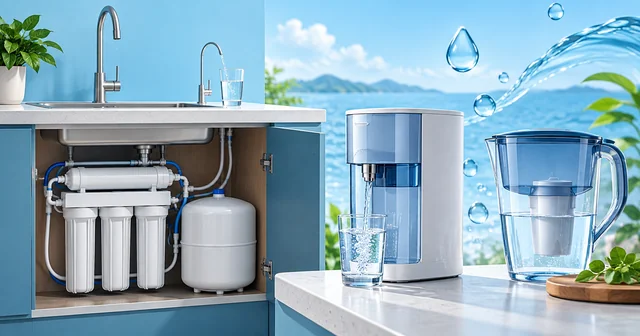
The best water purifier for your home depends on what is in your tap water, how much filtered water you use, and how much installation work you are willing to do. A pitcher is enough for some homes. Others need an under-sink carbon system, a reverse osmosis (RO) unit, or a whole-house filter.
This guide covers seven widely sold filters, from a small pitcher to whole-house systems. It then explains how to choose the right type for your water. Prices are approximate at the time of writing (October 2026) and change often between retailers and during sales.
Quick Comparison
| Product | Type | Filter life (manufacturer or retailer figure) | Approx. price (October 2026) |
|---|---|---|---|
| Aquasana Claryum 2-Stage | Under-sink carbon | 500 gallons or about 6 months | About $125 on sale (list price about $250) |
| APEC ROES-50 | Under-sink reverse osmosis | Produces up to 50 gallons per day | About $200–$285, depending on retailer |
| iSpring CKC1 | Countertop carbon block | Rated at 10,000 gallons | About $43–$50 |
| Brita Metro 6-Cup | Pitcher | 40 gallons or about 2 months (Standard filter) | Check current price |
| PUR Plus PFM400H | Faucet mount | 100 gallons or about 3 months | Check current price |
| PUR Plus 11-Cup Pitcher | Pitcher | See PUR filter packaging | About $35–$40 |
| Aquasana whole-house systems | Whole house (point of entry) | Varies by model | Check current price |
Best Water Purifiers for Home
1. Aquasana 2-Stage Under Sink Water Filter
Best for: on-demand filtered water at the kitchen sink without the water waste of reverse osmosis.
The Aquasana Claryum 2-Stage (model AQ-5200) fits under the sink and feeds a separate drinking-water faucet. Aquasana says it reduces 78 contaminants, including lead, chlorine, chloramines, PFAS, mercury, cysts, pesticides, herbicides, VOCs and some pharmaceuticals. It keeps beneficial minerals such as calcium and magnesium. Consumer Reports lists it as certified to NSF standards for chlorine and lead reduction.
The filters are rated for 500 gallons or about six months. Because it uses its own faucet, installation may mean drilling or using a spare hole in the sink or countertop. Prices vary with the finish, the retailer and Aquasana's frequent sales; at the time of writing (October 2026), Aquasana listed it at $124.99 on sale against a $249.99 list price.
- Pros: reduces a wide range of contaminants, keeps minerals, no wastewater.
- Cons: needs a separate faucet, and it does not lower total dissolved solids (TDS).
2. APEC ROES-50 Reverse Osmosis System
Best for: homes with high TDS, hard-tasting water or a wide mix of dissolved contaminants.
The APEC Essence ROES-50 is a 5-stage under-sink reverse osmosis system rated to produce up to 50 gallons per day. It is WQA certified. The stages include sediment pre-filtration, carbon filters, an RO membrane and a final carbon polishing filter. RO is the most thorough option in this list and also the only one here that lowers TDS.
Reverse osmosis has trade-offs. It sends some water down the drain as it filters. It also needs a storage tank and a dedicated faucet, and it removes minerals along with contaminants. At the time of writing (October 2026), retailer listings range from about $200 to $285.
- Pros: broadest reduction of dissolved solids, well-established model with easy-to-find replacement filters.
- Cons: wastewater, takes space under the sink, more involved installation.
3. iSpring CKC1 Countertop Water Filter
Best for: renters and anyone who wants better-tasting water without drilling or plumbing.
The iSpring CKC1 sits on the counter and connects to the kitchen faucet with a diverter, so no drilling is needed. It uses a 5-micron coconut-shell carbon block cartridge to reduce chlorine, sediment, and bad tastes and odors. iSpring rates the cartridge at 10,000 gallons and lists it as NSF/ANSI certified. Like other carbon filters, it does not lower TDS and leaves minerals in the water.
At the time of writing (October 2026), it costs about $43 to $50. iSpring also sells the CKC1C-NC, a version that adds chloramine reduction.
- Pros: inexpensive, no-drill setup, high-capacity cartridge.
- Cons: takes up counter space, and it is mainly a taste-and-odor filter rather than a broad contaminant reducer.
4. Brita 6-Cup Metro Water Filter Pitcher
Best for: small households, apartments and small fridges.
The Brita Metro is a compact 6-cup, BPA-free pitcher with a SmartLight indicator that tells you when to change the filter. The included Standard filter reduces chlorine taste and odor, copper, cadmium and mercury. It should be changed every 40 gallons, or about every two months.
The pitcher also takes Brita's Elite filter, which Brita says reduces 99% of lead and lasts 120 gallons, or about six months. If lead is a concern in your home, use the Elite filter instead of the Standard one.
- Pros: cheap, small, no installation.
- Cons: small capacity, slow gravity filtering, and the Standard filter does not reduce lead.
5. PUR PFM400H Faucet Water Filtration System
Best for: filtered water straight from the tap with no waiting and no plumbing work.
The PUR Plus PFM400H screws onto the end of a standard kitchen faucet in place of the aerator. A lever switches between filtered and unfiltered water. Each filter lasts about 100 gallons, or three months of typical use, and a light shows when it needs changing.
Check your faucet before buying. The PFM400H is made for standard faucets with an external aerator and does not work with pull-out or handheld sprayer faucets.
- Pros: tool-free setup, filtered water on demand, small footprint.
- Cons: does not fit every faucet, adds bulk to the spout, and filters need frequent replacement.
6. Pur Classic 11-Cup Water Filter Pitcher
Best for: families that want a larger pitcher with lead reduction included.
PUR now sells this pitcher as the PUR Plus 11-Cup (model PPT111). It comes with a lead-reducing filter that PUR says reduces 99% of lead, 96% of mercury and 92% of certain pesticides, along with chlorine taste. The filter is WQA certified for lead. The pitcher has a thumb-activated fill lid and a filter change light. PUR notes that its pitcher filters do not remove microbes.
At 11 cups, it holds almost twice as much as the Brita Metro, but it takes up more fridge space. At the time of writing (October 2026), it sells for about $35 to $40 at major retailers.
- Pros: lead reduction in the standard filter, larger capacity, easy one-handed filling.
- Cons: bulky in small fridges, and it does not treat microbiological contamination.
7. Aquasana Whole House Water Filter System
Best for: homeowners who want filtered water at every tap, shower and appliance.
A whole-house (point-of-entry) system treats water where it enters the home, so every faucet and shower gets filtered water. Aquasana's whole-house systems are carbon-based, and some versions add a salt-free conditioner to reduce scale buildup. The filter linked here is a replacement part, so confirm which Aquasana system you own or plan to buy before ordering.
Whole-house systems cost more to buy than any other option here. They usually need a plumber to install, and they are generally not a replacement for a dedicated drinking-water filter if you need to reduce lead or PFAS at the kitchen tap.
- Pros: filtered water throughout the house, reduces chlorine in showers and baths.
- Cons: high upfront cost, professional installation, and a salt-free conditioner is not the same as a water softener.
Which Water Purifier Should You Buy?
Start with your water, not the product. If you use a public water supply, read your utility's annual water quality report (in the US, the Consumer Confidence Report). If you use a private well, get the water tested by a certified lab. The test results tell you which contaminants you actually need to reduce.
| Your situation | Suitable type |
|---|---|
| Treated city water; you mainly dislike chlorine taste or smell | Pitcher, faucet-mount or countertop carbon filter |
| Older home or pipes with possible lead | A filter certified for lead reduction, such as an under-sink carbon system or a lead-reducing pitcher filter |
| Concern about PFAS, VOCs or a wide range of chemicals | Under-sink carbon system or reverse osmosis |
| High total dissolved solids (TDS), salty or mineral-heavy taste | Reverse osmosis |
| Possible bacteria or viruses (for example, an untreated well) | A system designed for microbiological treatment, such as UV disinfection, ideally after lab testing. Standard carbon pitchers and faucet filters do not do this. |
| Chlorine or scale throughout the house | Whole-house filter, often combined with a separate drinking-water filter |
Factors to Consider When Buying a Water Purifier
- Certification: look for independent certification (NSF/ANSI or WQA) for the specific contaminants you care about, not just a general claim.
- Type of filtration: carbon filters improve taste and reduce many chemicals while keeping minerals. RO removes far more dissolved solids but wastes some water and strips minerals. UV treats microbes but does not remove chemicals.
- Running costs: include replacement filters in your budget. A cheap pitcher with filters that last two months can cost more over a few years than an under-sink system.
- Capacity and flow: pitchers suit one or two people. Larger households usually do better with a faucet-mount, countertop or under-sink system.
- Installation: pitchers and faucet mounts need no tools. Countertop units need a faucet diverter. Under-sink and RO systems need plumbing work and often a new faucet hole. Whole-house systems usually need a plumber.
- Fit: check fridge space for pitchers, faucet type for faucet mounts, and cabinet space for under-sink and RO systems.
Drawbacks of Reverse Osmosis Water Purifiers
RO systems generally produce wastewater. Part of the incoming water flushes the membrane and goes down the drain. The amount varies by system, so compare the drain ratio or efficiency rating when choosing a model. RO also removes beneficial minerals such as calcium and magnesium, and many systems need a storage tank that takes up cabinet space.
If your TDS is not high and your main concerns are chlorine, lead, PFAS or VOCs, a certified carbon under-sink filter such as the Aquasana Claryum is often enough and does not waste water.
Final Words
For most homes on treated city water, an under-sink carbon filter like the Aquasana Claryum 2-Stage is a practical balance of contaminant reduction, cost and convenience. Choose reverse osmosis such as the APEC ROES-50 if your TDS is high. If you rent or want something cheap and simple, a pitcher (with a lead-reducing filter where needed), a faucet mount or a countertop filter works well. Check your water report first so you pay only for the filtration you need.
Frequently Asked Questions
What is the best water purifier for home use?
For most homes on city water, an under-sink carbon system such as the Aquasana Claryum 2-Stage is a strong choice because it reduces a wide range of contaminants without wasting water. If your water has high TDS, a reverse osmosis system such as the APEC ROES-50 is a better fit.
Which is better, a water filter pitcher or an under-sink system?
Pitchers are cheaper and need no installation, but they hold little water, filter slowly and need frequent filter changes. Under-sink systems cost more up front but give filtered water on demand, and the better ones are certified to reduce more contaminants.
Do I need a reverse osmosis water purifier?
Only if your water has high total dissolved solids or contaminants that carbon filters do not handle well. RO removes the widest range of dissolved substances, but it wastes some water and removes minerals, so it is unnecessary for many city water supplies.
Do water filter pitchers remove lead?
Some do. The PUR Plus 11-Cup pitcher's standard filter is certified for lead reduction, and Brita's Elite filter reduces lead. Brita's Standard filter does not, so check the certification of the specific filter before you rely on it for lead.
Do water filters remove bacteria and viruses?
Standard carbon pitchers, faucet mounts and countertop filters are not designed to treat microbes, and PUR states that its pitcher filters do not filter microbes. If you are concerned about microbiological contamination, such as from an untreated well, test the water and use a system designed for disinfection, such as UV.
How often should I replace water filters?
It depends on the product. The Brita Standard filter lasts about 40 gallons or two months, the PUR faucet filter about 100 gallons or three months, and the Aquasana Claryum 2-Stage filters about 500 gallons or six months. Replace filters on schedule, because an old filter reduces contaminants less effectively.