HomeView vs Echo Show 8: Which Smart Display Should You Buy?
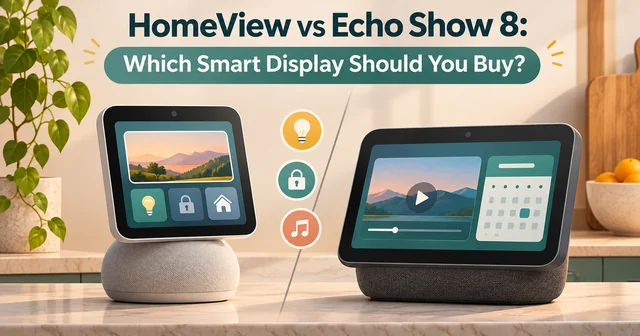
HomeView vs Echo Show comes down to your phone. Apple's $299 HomeView suits a household where everyone uses an iPhone and Apple Music; it needs an iPhone or iPad to set up. Amazon's Echo Show 8, launched at $179.99, has a bigger 8.7-inch widescreen, works with Android phones and runs Netflix on its own.
What Happened
Apple announced HomeView on 13 October 2026 and began selling it on 13 November, according to Apple's HomeView press release. It is Apple's first smart display: a 7-inch screen on a domed speaker base, or a separate wall-mounted model that fixes to a hallway or entryway wall. Both cost $299.
That puts it straight against Amazon's Echo Show line. Amazon introduced its current Echo Show 8 and Echo Show 11 on 30 September 2025, built for its Alexa+ assistant, and put them on sale on 12 November that year at $179.99 and $219.99, as Amazon's launch announcement states. Since HomeView arrived, reviewers have lined the two up. Engadget's comparison, published this month, says the choice "ultimately comes down to which ecosystem you have at home", and The Verge's follow-up on HomeView's audio calls it a smart display first and a speaker second.
The Echo Show 8 is the fairest match. Engadget notes that Amazon's range runs from a 5.5-inch Echo Show at $99 to a 21-inch model at $499, but the 8.7-inch Echo Show 8 is the one closest to HomeView in size and price.
Why It Matters
Until now, an iPhone household that wanted a screen in the kitchen had to buy an Echo Show or a Google Nest Hub and run a second assistant with a second account. HomeView removes that compromise, but it does not make the Echo Show a bad buy. The two products are aimed at different homes.
The Echo Show is a standalone device. It signs in to an Amazon account, joins your Wi-Fi and works for anyone in the house, whatever phone they carry. HomeView behaves more like an accessory to Apple devices you already own. In Engadget's HomeView vs Echo Show comparison, the verdict is that Amazon treats the Echo Show as a product that fits almost everyone, while HomeView is for people who already rely on Apple's core apps. If one adult in the house uses Android, that alone can settle it.
Price matters too. HomeView costs $299 against the Echo Show 8's $179.99 launch price in Amazon's announcement, and the wall-mounted HomeView ships without a mount, cable or power adapter, which you buy separately.
How It Works
Screen and size. HomeView has a square 7-inch Liquid Retina display at 1088 by 1088 pixels, and its brightness runs from 500 nits down to 0.3 nits so it can sit on a nightstand, according to Apple's HomeView technical specifications. The Echo Show 8 has an 8.7-inch widescreen. Engadget points out that the square panel is the weaker choice for 16:9 video, because a widescreen clip leaves bars above and below it.
Chip and camera. HomeView runs Apple's A18 chip and has a 12MP Center Stage camera. Engadget says that camera is used for FaceTime, a Mirror feature and recognising faces. The Echo Show 8 uses Amazon's own AZ3 Pro chip and a 13-megapixel camera, and Amazon's Omnisense platform uses that camera to greet you when you walk up. Engadget adds that you can use the Echo Show's camera as a live view to check on your home while you are out, which HomeView does not offer.
Sound. Apple lists two custom full-range drivers, a down-firing woofer and two force-cancelling passive radiators in the tabletop HomeView, with Spatial Audio and Dolby Atmos. Amazon says the new Echo Show 8 has front-facing stereo speakers and a custom woofer. The Verge's audio test found HomeView close to a HomePod mini, with more bass and a little more volume but less room-filling sound. Two HomeViews cannot be paired for stereo.
The assistant. HomeView runs Siri AI, the new Apple Intelligence version of Siri. Anyone in the home can ask it general questions, but personal requests about messages or calendars need that person's Apple Intelligence-enabled iPhone or iPad nearby and recently unlocked. The Echo Show runs Alexa+, which Amazon includes with a new Echo, and it can manage calendars, reminders and shopping without a phone. Engadget notes that Alexa+ comes through a Prime membership.
Profiles. HomeView recognises up to six people by face and gives each one their own Home Screen, with private content kept from the others. Echo Show devices also support profiles by voice and face, but Engadget says Amazon lets you switch them by asking Alexa, while HomeView switches automatically.
Apps and video. This is the biggest practical gap. HomeView has no App Store. It ships with Apple's apps, and third-party audio and video apps appear only if they support CarPlay, which is what HomeView uses for outside apps. The Verge found those apps slower, with no search box, and only available to the person whose iPhone is connected. Netflix and Prime Video handed off audio only, though both played video in Safari. The Echo Show uses Alexa Skills and plays Netflix and Prime Video directly.
Smart home. HomeView controls HomeKit and Matter accessories and has a Thread radio. Amazon says the Echo Show 8 and Echo Show 11 include a smart home hub with Zigbee, Matter and Thread, so older Zigbee sensors and bulbs connect without a separate bridge. If you own a Ring doorbell, the Echo Show also shows Ring event summaries.
What's Still Unknown
The biggest open question is software. Apple's HomeView specifications say Siri AI is available in beta in HomeView software version 27.2, and Apple has not said when the beta label comes off or how much the assistant will improve before then. Early reviews also disagree on how reliably automatic face switching works in a busy kitchen.
Apple has not said whether it will open an App Store on HomeView or let developers build apps for it beyond CarPlay audio and video. That decides whether the Netflix gap closes. On Amazon's side, it is not clear how long Alexa+ stays bundled with Prime at today's terms, and Amazon's idle screen still shows suggestions alongside your photos. HomeView is also still not sold in the European Union, because Siri AI is not available in iOS there, according to Apple. The Echo Show is sold there, and Apple has given no date.
Frequently Asked Questions
Is Apple HomeView better than the Echo Show 8?
It is better for an all-iPhone home that wants FaceTime, Messages and private profiles for up to six people. The Echo Show 8 is better if anyone uses Android, if you want Netflix on the screen, or if you have Zigbee or Ring devices. The Echo Show 8 launched at $179.99, per Amazon, against $299 for HomeView, and it has a wider 8.7-inch screen, according to Engadget.
How does Apple HomeView compare with the Echo Show 11?
The Echo Show 11 launched at $219.99, still less than HomeView's $299, and gives you a much wider screen than HomeView's 7-inch square display. It shares the Echo Show 8's AZ3 Pro chip, 13-megapixel camera and built-in Zigbee, Matter and Thread hub, per Amazon. Choose it over HomeView for video and a calendar you can read across the kitchen.
Apple HomeView vs Alexa: which assistant works better?
Siri AI on HomeView is strongest with Apple's own apps and can draw on your personal context from Messages and Calendar, but only when your recently unlocked iPhone or iPad is nearby. Alexa+ on the Echo Show works without a phone for calendars, reminders, shopping and smart home control, and it supports far more third-party services through Alexa Skills. Siri AI is still marked beta.
Apple HomeView vs HomePod: which should you buy for music?
For music alone, a HomePod is the better speaker. The Verge found the tabletop HomeView sounds close to a HomePod mini, with more bass but less room-filling sound, and two HomeViews cannot be paired in stereo. HomeView is worth it over a HomePod mainly for its touchscreen, which lets anyone in the house browse and change what is playing without a phone.
Can you watch Netflix on Apple HomeView?
Not in an app. HomeView has no App Store, and third-party video apps appear only if they support CarPlay. The Verge found Netflix and Amazon Prime Video handed off audio only from an iPhone, though both played video in the Safari browser on HomeView. The Echo Show plays Netflix and Prime Video directly, and its widescreen suits video better than HomeView's square display.
Does Apple HomeView work with Android phones?
No. HomeView needs an iPhone with iOS 27.2 or later, or an iPad with iPadOS 27.2 or later, to set up, according to Apple's specifications, and each person needs their own Apple device for a personal profile. An Android user can only use it as a guest. The Echo Show is set up with the Alexa app, which runs on both Android and iPhone.
Can Apple HomeView and Echo Show control the same smart home devices?
Partly. Both support Matter and Thread, so a Matter light or lock can work with either. Beyond that they split: HomeView adds HomeKit accessories, while the Echo Show adds Zigbee devices and Amazon's Ring and Alexa ecosystem. Not every Amazon device works with Apple Home, so check whether your existing gear supports Matter or HomeKit before switching.
Does the Echo Show have ads?
Yes. Amazon's idle screen can show product suggestions and promoted content alongside your photos, and buyers have complained about it in reviews. HomeView has no ads; its idle screen shows faces such as a shared photo album or your favourite accessories. If a clean screen beside the bed matters to you, HomeView, which dims to 0.3 nits, is the quieter choice.
Related Reading
For the full rundown on Apple's display, including the wall-mount costs and India pricing, read our explainer on Apple HomeView price, uses and requirements. Amazon has also moved its Alexa tablets to Android, which we covered in what the Alexa tablet switch to Android changes. If you are mixing brands, our older guide to HomePod mini, Echo and Nest Hub sharing one Thread network explains why Thread lets them coexist, and Matter smart home compatibility covers which accessories work across Apple and Amazon homes.