Tesla Semi Hits Volume Production: What Changes for Trucking
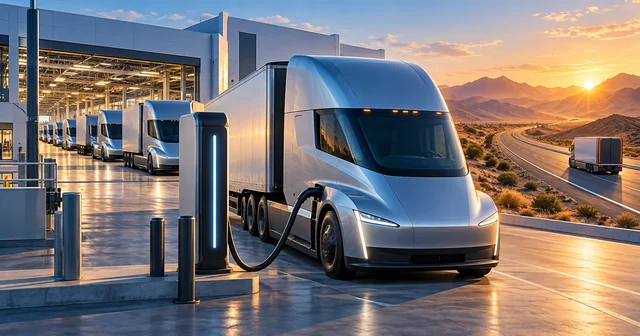
Tesla's Semi moved from pilot fleets to high-volume production on September 24, 2026, at a Nevada plant designed for 50,000 trucks a year. What changes is less the truck than the system around it: a reported price near $290,000, megawatt charging on an open standard, and pooled orders that move battery risk off fleet balance sheets.
What Happened
On the evening of Thursday, September 24, Tesla held a "Semi Rollout" event at its new truck factory in Sparks, Nevada, streamed live on X from 9 p.m. Eastern. The company called it the start of high-volume production, nearly nine years after Elon Musk unveiled the electric Class 8 tractor in 2017 and seven years after its original 2019 production target. Tesla said the first Semi came off the new line in April and that the plant is designed for 50,000 trucks a year. That is a capacity figure, not a delivery forecast.
Trucks parked outside carried the liveries of customers including PepsiCo, DHL, US Foods, ArcBest's ABF Freight, Einride, IMC Logistics, WattEV and OK Produce, according to Electrek and Automotive World. Outside estimates cited by both outlets put 2026 deliveries at 5,000 to 15,000 trucks, far below the plant's nameplate capacity.
The event capped a run of large orders. On August 18, Swedish freight operator Einride announced a 500-truck Tesla Semi deployment across California, Texas, New Jersey, Illinois and Georgia, phased over 24 months from September and fully financed by third parties. On September 22, the nonprofit Catalyst Mobility (formerly CALSTART) and the Smart Freight Centre launched the ZET SCALE buying alliance, whose first order covers 2,500 battery-electric Class 8 trucks. Tesla is the primary manufacturer, with Kenworth, RIDE and Volvo as secondary suppliers, and Microsoft and PepsiCo are the named founding shippers. The partners say that single order "nearly doubles" the US electric Class 8 fleet, which implies the existing fleet numbers only a few thousand trucks.
Tesla's stated specifications, as reported from the event, are a Standard Range version rated at 325 miles and a Long Range version rated at 500 miles, both at 82,000 pounds gross combined weight, an 800-kilowatt three-motor drivetrain, in-house 4680 battery cells, and energy use of about 1.7 kilowatt-hours per mile. Tesla also claimed fleet uptime above 98 percent so far this year, without publishing the underlying data.
Why It Matters
Heavy trucks are a small share of the vehicles on US roads but an outsized share of transport fuel use and emissions, and they have been the hardest segment to electrify because of weight, range and charging time. For most of the past decade, electric Class 8 trucks existed as pilots: a handful per fleet, bought with grants and run on short, predictable routes. Volume production changes the question fleets ask from "does it work?" to "does it pencil out at scale?"
Price is the first answer. In February, Electrek reported that Tesla was quoting customers $290,000 for the 500-mile Long Range truck, with California documents putting the Standard Range at about $260,000. That is roughly 60 percent above the $180,000 Tesla advertised in 2017, but well below the $435,000 average price of a zero-emission Class 8 truck in 2024 that Electrek cited from California Air Resources Board data. A price that low puts pressure on the established truck makers, several of which now sit behind Tesla on the ZET SCALE supplier list.
The second answer is who carries the risk. Fleets have hesitated less over the sticker price than over what a used battery truck will be worth in five years, because nobody has a resale history to lean on. ZET SCALE's financing partner, ZET Financial, places orders through a fair-market-value lease it calls ZET Lease, which the alliance says "eliminates the residual-value risk to the fleet operator." Einride finances its trucks through third parties and runs them on its own Saga AI routing and charging software. In both cases the operator buys freight capacity, not a depreciation gamble.
The third is evidence that does not come from Tesla. ArcBest said its 2025 pilot covered 4,494 miles in three weeks between Reno and Sacramento, including the 7,200-foot climb over Donner Pass, at an average of 1.55 kWh per mile, and in June 2026 it bought two trucks for its ABF Freight fleet. DHL Supply Chain recorded 1.72 kWh per mile in a 2024 pilot, according to Transport Topics. Those are small samples, but they come from customers rather than the manufacturer.
How It Works
An electric semi swaps a diesel engine, transmission and exhaust aftertreatment for a battery pack and electric motors, and energy per mile is the number that decides everything else. At 1.7 kWh per mile, a 500-mile run needs roughly 850 kWh, which is why Electrek lists the Long Range truck's curb weight at about 23,000 pounds against under 20,000 for the Standard Range. Federal law lets battery-electric trucks exceed the standard 80,000-pound limit by up to 2,000 pounds to offset battery weight, and Tesla quotes its range figures at that 82,000-pound ceiling.
Fuel cost is where operators expect to win. As an illustration only, using assumed prices rather than quotes: a diesel tractor averaging 6.5 miles per gallon on $3.75 diesel spends about 58 cents a mile on fuel, while a Semi using 1.7 kWh per mile on electricity at 20 cents per kWh spends about 34 cents. On a truck running 100,000 miles a year, that gap is worth about $24,000 annually before any maintenance savings. It widens or shrinks sharply with local electricity tariffs and demand charges, which is why charging matters as much as the truck itself.
Tesla's answer is the Megacharger. According to specifications Tesla published in May and reported by Electrek, each post delivers up to 1.2 megawatts at 1,100 amps continuous, adding up to 60 percent of range in about 30 minutes, roughly the length of a federally required driver break. Tesla sells two-post Megacharger installations from $188,000 and a slower 125-kilowatt Basecharger for overnight depot charging from $40,000, and Electrek counted 66 planned Megacharger locations on Tesla's map. Crucially, both run on version 3.2 of the Megawatt Charging System (MCS), the heavy-vehicle connector that SAE documents as J3271, rather than on a Tesla-only plug. MCS-equipped trucks from Volvo, Daimler and others can therefore use Tesla's chargers, and a Semi can use third-party MCS sites, including three Forum Mobility depots where Tesla is running public Megachargers.
The factory is the final piece. Tesla moved the Semi to its own 4680 cells and to motor components it shares with the Cybertruck, parts it already builds in volume. The 50,000-truck design capacity matters less as a production goal than as a signal to buyers like ZET SCALE, which said it judged bidders on "price, range, charging capability, and production capacity." A factory able to deliver thousands of trucks is what turns a pilot into a procurement decision.
What's Still Unknown
How fast the line actually ramps is the largest open question. Tesla gave a capacity figure, not a 2026 delivery target, and the 5,000-to-15,000 range is an outside estimate. Einride's chief executive has said roughly 75 of its 500 trucks are expected this year, which suggests large orders will be filled over years rather than months.
Long-run costs are also unproven. The 98 percent uptime and 1.7 kWh per mile are company claims; independent data from hundreds of trucks running at full weight, in winter and on mountain freight lanes does not exist yet. Battery wear over a truck's working life, and therefore its resale value, is precisely the uncertainty that ZET Lease is designed to absorb.
Charging buildout depends on utilities as much as on hardware. A depot with eight 1.2-megawatt posts could draw close to 10 megawatts at peak, and grid connection timelines, not chargers, often set the pace. Finally, Tesla presented autonomy as a later phase for the Semi but offered no regulatory timeline, and none of the orders announced so far depend on it.
Frequently Asked Questions
How much does the Tesla Semi cost?
Electrek reported in February 2026 that Tesla was quoting $290,000 for the 500-mile Long Range Semi before destination fees and taxes, with California documents listing the 325-mile Standard Range at about $260,000. Tesla had advertised $150,000 and $180,000 when it unveiled the truck in 2017. Incentives such as California's HVIP vouchers can cut the effective price substantially for eligible fleets.
How far can the Tesla Semi go on a charge?
Tesla rates the Standard Range Semi at 325 miles and the Long Range at 500 miles, both at 82,000 pounds gross combined weight, the federal ceiling for battery-electric trucks. Real-world range varies with load, terrain, speed and temperature. Customer pilots by ArcBest and DHL reported energy use between 1.55 and 1.72 kWh per mile, slightly better than Tesla's own 1.7 figure in one case.
How long does it take to charge a Tesla Semi?
On Tesla's 1.2-megawatt Megacharger, the company says the Semi can add up to 60 percent of its range in about 30 minutes, roughly the length of a mandatory driver break. Depots can instead install the 125-kilowatt Basecharger, which Tesla says adds about 60 percent in four hours, a better fit for trucks that return to base overnight.
Who is buying the Tesla Semi?
Customers shown at the September 24 event included PepsiCo, DHL, US Foods, ABF Freight, Einride, IMC Logistics, WattEV and OK Produce. The largest commitments are Einride's 500-truck deployment, announced August 18, and the ZET SCALE alliance's 2,500-truck order, announced September 22, in which Tesla is the primary supplier and Microsoft and PepsiCo are founding shippers.
How many Tesla Semis will be delivered in 2026?
Tesla has not given a 2026 delivery target. Its Nevada plant is designed for 50,000 trucks a year, but outside estimates cited by Electrek and Automotive World put 2026 deliveries between 5,000 and 15,000. Einride's chief executive has said about 75 of its 500 trucks should arrive this year, with the rest scheduled through the end of 2027.
Can other electric trucks use Tesla's Megachargers?
Yes, in principle. Tesla says its Megacharger and Basecharger use the Megawatt Charging System 3.2 connector and open protocols including ISO 15118-2 and OCPI, so MCS-equipped trucks from other manufacturers can plug in. The reverse also holds: a Semi can use third-party MCS chargers, which removes one of the lock-in worries fleets raised about earlier proprietary charging designs.
Is the Tesla Semi self-driving?
No. The trucks being delivered now are driven by people, and none of the large orders announced so far depend on autonomy. Tesla presented self-driving as a later phase for the Semi but gave no regulatory timeline. Driverless freight in the US is currently being run by specialist autonomy companies on a limited number of routes, mostly in Texas, rather than by truck makers.
Related Reading
For a sense of how long this took, our 2022 report on how Tesla reopened Semi reservations for a $20,000 deposit and a 2023 production date shows how far the timeline slipped. Not every manufacturer bet on batteries: Volvo's hydrogen fuel cell semi trials took a different route to zero-emission freight. The economics of any tractor come down to hours on the road, which our guide to how logistics decisions shape trucking costs breaks down. If autonomy is the next step, see how Kodiak and Bosch are scaling self-driving truck technology and Aurora's fully driverless McLane routes across Texas. And for the power side, our explainer on clean energy charging covers how renewable electricity reaches electric vehicles.