iPhone Duo Sold Out: Why Preorders Now Ship in January 2027
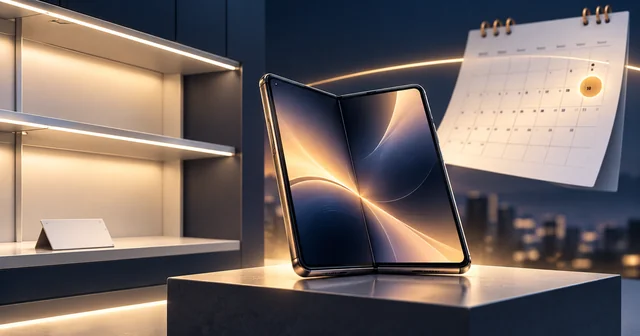
Apple's iPhone Duo sold out within minutes of preorders opening on October 16, 2026. New online orders in the US now show a ship date of January 25, 2027, so anyone who missed the first wave is waiting about three months. The cause is tight supply of a hard-to-build foldable, not just demand.
What Happened
Apple announced the iPhone Duo, its first foldable iPhone, on September 9, 2026. Its newsroom announcement set preorders for October 16 at 5 a.m. PT in more than 70 countries and regions, including the US, UK, Japan, China and Canada. Phones go on sale there on October 23, and 28 more countries and regions follow on October 30.
Prices start at $1,999 for 256GB. The 512GB model is $2,199, 1TB is $2,599 and 2TB is $3,199, in star white or night sky. Apple also lists the phone at $83.29 a month over 24 months, and its Klarna-backed Apple Upgrade lease starts at $57.99 a month.
Demand outran stock almost at once. 9to5Mac's live tracking found that the earliest orders got an October 23 delivery date. Within minutes, estimates slid into next year. By about 8:30 a.m. ET every configuration showed January 25, and some buyers saw January 29. MacRumors reported the same January 25 estimate for every US configuration and called the phone sold out for Christmas. It said some Apple Stores may have walk-in units on October 23 but expects stock to be "very tight." Apple's store tells shoppers to check back on Saturday, October 24, for pickup reservations.
Bloomberg, The Verge, AppleInsider, CNET and Mashable all reported the sellout. Scalpers moved fast: 9to5Mac counted dozens of eBay listings for preordered units at up to $5,200, and MacRumors reported one resale at $5,000.
Why It Matters
A three-month wait on a launch-day iPhone is rare. Apple usually ramps a new model to millions of units before preorders open, so even popular models rarely slip more than a few weeks. The Duo's backlog says more about how hard foldables are to build than about any marketing scarcity.
Two supply reports explain the gap. 9to5Mac pointed to a Nikkei Asia report from September saying Apple was building only a few hundred iPhone Duo units a day, far below a normal iPhone ramp. MacRumors cited Chinese outlet Jiemian News, whose source near Foxconn said final assembly yields were "only slightly above 60%" as of September 17. So about four in ten finished phones were failing inspection at that point. When that many units are scrapped or reworked, output grows slowly however many orders come in.
For buyers this changes three things. A Duo bought as a holiday gift through Apple's online store will not arrive in time. Carrier deals are worth comparing now: MacRumors' deals roundup lists AT&T and T-Mobile bill credits worth up to $1,200 with an eligible trade-in, but credits arrive over the life of a 24- or 36-month plan, not as a cash discount. And anyone tempted by resale listings at more than twice the retail price is paying for a launch-week shortage that should ease as yields improve.
The rest of the industry is watching too. Samsung, Google and Huawei have sold book-style foldables for years, but at a fraction of the iPhone's volume. If Apple can't meet demand at $1,999, the category's bottleneck is clearly the factory, not shoppers.
How It Works
The Duo is a book-style foldable. Closed, a 5.4-inch outer screen works like a compact phone; Apple says it covers about 90 percent of the iPhone 18 Pro's screen area. Open, it becomes a 7.6-inch tablet-like display that Apple calls 50 percent larger than the iPhone 18 Pro Max's. Both screens share one aspect ratio, so apps don't need to reflow into a new shape when you switch between them, and both support ProMotion, Always On and up to 3,000 nits of peak outdoor brightness.
The hard part is the fold. A flexible OLED panel has to bend hundreds of thousands of times without cracking, so it can't sit under rigid glass like a normal screen. Apple says the inner display stacks a scratch-resistant coating, a nano-textured cover layer, glass above and below the panel, and a titanium plate underneath. The matte nano-texture finish cuts glare and makes the crease harder to see; it doesn't remove the crease. Under the panel, a hinge of more than 100 components supports the centre of the display when the phone is open, and its cover is 3D-printed titanium.
That stack is why yields matter. Each layer has to be bonded with almost no dust or bubbles, and the hinge has to keep the panel at a precise bend radius. A defect in any layer can show up as a bright line, dead pixels or an uneven crease, often only after final assembly, when the whole phone is lost. A slab iPhone has fewer of these failure points.
Other parts were changed to fit the folding body. There is no Face ID: Touch ID sits in the side button, and the Duo can also unlock with an Apple Watch. The FaceTime camera hides beneath the inner display. Two batteries, one in each half, power the A20 Pro chip, which is built on a 2nm process and cooled by a vapor chamber. Apple rates battery life at up to 31 hours of video on the inner screen, 44 hours on the outer screen, or 24 hours using both equally. Wired charging reaches 50 percent in about 20 minutes, MagSafe or Qi2 in about 30.
The software comes from iOS 27. Split View runs two apps side by side, or two windows of one app, and saves app pairs. StandBy works on either display even when the phone isn't charging, and the Lock Screen, Dock and navigation shift to the side when the phone is open. The phone is eSIM-only worldwide and carries an IP68 rating, tested to 6 metres for up to 30 minutes, which is unusual for a foldable.
What's Still Unknown
Apple hasn't said how many phones it has built or sold, and it hasn't commented on the delays. Nobody outside the company knows whether January 25 reflects a supply plan or just a holding date that will move earlier or later as factories catch up. The Nikkei and Jiemian figures are from September and could be out of date.
Long-term durability is also unproven. Apple hasn't published a fold-cycle rating, and the 6-metre water rating is a lab result that Apple says may decline with normal wear. Repair costs for the inner display and hinge, and AppleCare+ pricing for this model, will matter a lot for a $1,999 phone that bends daily. Apple Pencil support is promised "later this year," without a date, and Apple says its new Siri features won't initially be available in the EU.
Finally, it isn't clear how quickly stock will reach the 28 countries launching on October 30, given that first-wave markets are already backordered.
Frequently Asked Questions
When will a new iPhone Duo order arrive?
As of October 16, 2026, Apple's US online store showed an estimated ship date of January 25, 2027 for every configuration, and some buyers saw January 29. Only the very first preorders, placed within minutes of the 5 a.m. PT opening, got October 23 delivery. Estimates can move in either direction as Apple updates its supply forecasts, so check your order status regularly.
Can I buy an iPhone Duo in an Apple Store on launch day?
Possibly, but don't count on it. MacRumors reported that some Apple Stores may have walk-in stock on October 23 and expects it to be very tight. Apple's online store says pickup reservations open from Saturday, October 24. Calling your local store or checking the Apple Store app that morning is the best way to find out whether any units arrived there.
How much does the iPhone Duo cost?
In the US the iPhone Duo costs $1,999 for 256GB, $2,199 for 512GB, $2,599 for 1TB and $3,199 for 2TB. Apple also offers $83.29 a month over 24 months, and an Apple Upgrade lease through Klarna from $57.99 a month. Carriers such as AT&T and T-Mobile offer bill credits of up to $1,200 with an eligible trade-in.
Why is the iPhone Duo so hard to get?
It is in tight supply. A Nikkei Asia report cited by 9to5Mac said Apple was building only a few hundred units a day in September, and Jiemian News reported Foxconn's final assembly yields were only slightly above 60 percent. Foldable screens and hinges have many more failure points than a standard iPhone, so many finished units fail inspection and output grows slowly.
Is buying a resold iPhone Duo on eBay a good idea?
Usually not. Listings have reached $5,000 to $5,200, more than double the $1,999 starting price, and many are for preorders the seller has not yet received. You take on delivery, fraud and warranty-transfer risk. Shortages for new Apple hardware generally ease within a few months as factories improve yields, so waiting is likely to cost far less.
Does the iPhone Duo have Face ID?
No. According to Apple's announcement, the iPhone Duo uses Touch ID built into the side button, and it can also be unlocked with an Apple Watch. The front camera on the inner display sits beneath the screen and stays hidden when not in use, which leaves no room for the TrueDepth sensors that Face ID needs.
Which countries get the iPhone Duo first?
Preorders opened October 16 in more than 70 countries and regions, including the US, UK, Japan, China and Canada, with sales starting October 23. Apple says 28 further countries and regions get the phone on October 30. Apple hasn't said whether those later markets will receive enough stock to avoid the same backorders.
Will the iPhone Duo's screen crease?
Yes, slightly. Like every current folding phone, the inner screen bends along a centre line. Apple uses a nano-texture matte finish to reduce glare and make the crease less visible, and a hinge with more than 100 parts that supports the display when open. Apple has not published a fold-cycle rating, so long-term wear is not yet known.
Related Reading
Apple's plans for the Duo leaked well before launch: our report on how the foldable iPhone would get an iPad-like split-screen interface describes the multitasking that shipped, and our earlier piece on why the foldable iPhone was expected to cost over $2,000 covered the pricing that came true. For the strategy behind it, read what Apple's hardware plans look like under John Ternus. For a rival design, see Huawei's passport-style Pura X Max foldable. And if three months is too long to wait, our guide to the best smartphones you can buy now covers alternatives that are in stock today.