Aurora Wins McLane Deal for Fully Driverless Truck Routes Across Texas — Largest Verified Freight Deployment Yet
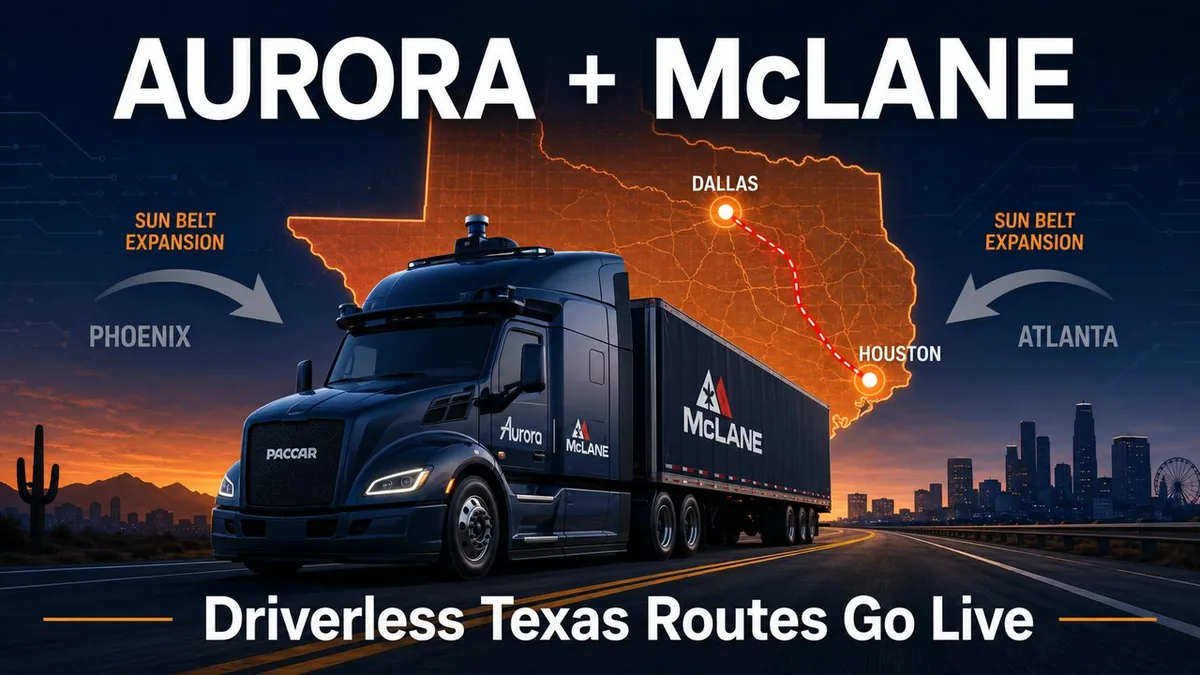
Aurora Innovation just locked in the most consequential commercial autonomy deal of the year. McLane, the foodservice distribution giant, has approved Aurora to run its trucks fully driverless on the Dallas-to-Houston corridor, seven days a week. Expansion to other US Sun Belt distribution centers is planned by end of 2026. There is no human driver in the loop on the highway portion — only a “human observer” in the cab who, per Aurora's agreement with truck manufacturer Paccar, cannot operate the vehicle.
This matters because every other commercial autonomy story in 2025-2026 has been a pilot, a memorandum of understanding, or a same-cab safety driver. McLane is shipping freight on a 240-mile route, both directions, multiple round-trips daily, with no driver who can grab the wheel. That is not a demo. That is operations.
The Deal Specifics
From Aurora's announcement and TechCrunch's coverage:
- Route: Dallas-to-Houston (~240 miles each way)
- Cadence: Seven days a week, multiple round-trips daily
- Status: Fully driverless on the highway portion (terminal-to-terminal)
- Safety personnel: “Human observer” in the cab who cannot operate the vehicle (Paccar agreement requirement)
- Pilot history: Started 2023 with safety operator, expanded to two round-trips daily, now upgraded to fully driverless
- Expansion plan: Other US Sun Belt distribution centers by end of 2026
- Hybrid delivery model: Aurora handles long-haul terminal-to-terminal; McLane drivers handle local last-mile to fast-food restaurants and other customers
- Aurora's existing routes: Dallas-Houston, Fort Worth-El Paso, El Paso-Phoenix, Fort Worth-Phoenix, Laredo-Dallas
- Other commercial agreements: Detmar Logistics (frac sand hauling); Hirschbach Motor Lines memorandum of understanding for 500 Aurora-powered trucks (closing later 2026)
The deal value was not disclosed.
Why the Hybrid Model Is the Real Innovation
Notice the architecture: Aurora drives terminal-to-terminal on the highway. McLane drivers take over for local delivery. This is the design that finally makes commercial autonomy economically viable, because it solves the two hardest problems separately:
The highway portion is where 80% of long-haul fuel and labor costs sit, and where autonomous driving is most tractable (no pedestrians, predictable lane structure, mostly-straight roads). Aurora handles this part. The local-delivery portion — where you have to back into a Whataburger loading dock with a 53-foot trailer at 6 a.m. — is where autonomy fails today and where human drivers excel. McLane handles this part.
This is not Aurora replacing trucking. It is Aurora replacing the most boring, fuel-burning, driver-fatiguing 240 miles of trucking and leaving the high-skill local delivery to humans. The Hirschbach deal (500 Aurora-powered trucks) reportedly follows the same architecture.
What This Means for Texas Trucking Jobs
The honest answer is “less than the headline implies, and more than autonomous-skeptics admit.” The McLane Dallas-Houston route, before Aurora, was driven by perhaps 20-40 long-haul drivers running the corridor on rotation. After full driverless launch, those specific roles disappear. McLane's local delivery drivers in Dallas and Houston (substantially more people) keep their jobs because that work is not yet automated.
Across Aurora's full Texas footprint (Dallas-Houston + Fort Worth-El Paso + El Paso-Phoenix + Fort Worth-Phoenix + Laredo-Dallas), the long-haul highway driver count being displaced is in the low thousands at most. Texas employs roughly 200,000+ truck drivers total. The displacement is real but is concentrated on a specific job archetype — the “just-the-highway, sleeper-cab, multi-day” long-haul role — and is not yet the broad trucking-job armageddon some headlines imply.
That said, the McLane deal is a clear inflection. Once one large foodservice distributor proves the economics work, every competitor (Sysco, US Foods, Performance Food Group) faces pressure to match. Texas long-haul will likely lose 30-50% of its driver count by 2030 if Aurora's economics hold. The local-delivery driver count grows in parallel as e-commerce expansion absorbs displaced long-haul drivers who can re-skill.
My Take
Aurora just won the most important commercial autonomy proof point of the decade and almost no one outside the trucking industry is paying attention. Tesla's Autopilot announcements get 10x the press coverage and have shipped 0% of the commercial driverless miles. Waymo's robotaxi expansion gets 5x the coverage and is still in geofenced city operation. Aurora is moving actual freight, on actual highways, with no driver in the loop, on a real customer's actual schedule, between two real distribution centers. That is the part that matters and it is happening quietly because it is freight, not consumer ride-hailing.
The other thing worth flagging: Aurora's choice to go all-Texas first is not random. Texas's autonomous-vehicle regulatory framework is permissive enough to allow no-driver commercial operation; California is not. Most Sun Belt expansion targets (Arizona, New Mexico, Nevada) are similarly permissive. The geographic split between “states where you can legally run driverless freight” and “states where you cannot” is going to become a significant factor in where distribution centers get built over the next decade. McLane just gave Aurora a wedge to expand into every Sun Belt state Aurora wants. Expect a Phoenix and Atlanta announcement next.
The genuinely uncertain question is what Paccar's “human observer cannot operate the vehicle” clause does to insurance pricing. If the observer is in the cab but cannot intervene, who is liable when something goes wrong? Aurora and Paccar's lawyers have presumably worked this out, but the case law does not exist yet. The first serious incident on the Dallas-Houston route — and there will be one eventually, autonomous or not — sets the legal template for the next decade of commercial autonomy.
Frequently Asked Questions
Are Aurora's McLane trucks really fully driverless?
Yes, on the highway portion. The trucks have no human driver who can operate the vehicle on the Dallas-Houston route. There is a “human observer” in the cab per Aurora's agreement with truck manufacturer Paccar, but the observer cannot drive. Local delivery to McLane's customers is still done by human drivers.
How long has the Aurora-McLane partnership been running?
The pilot started in 2023 with a human safety operator. It expanded to two round-trips daily, then to fully driverless operations seven days a week as approved in May 2026.
What other Aurora commercial deals are active?
Aurora has a frac-sand-hauling agreement with Detmar Logistics and a memorandum of understanding from Hirschbach Motor Lines for 500 Aurora-powered trucks (expected to close later in 2026). Aurora's existing routes span Dallas-Houston, Fort Worth-El Paso, El Paso-Phoenix, Fort Worth-Phoenix, and Laredo-Dallas.
Will this displace truck driver jobs?
For the specific long-haul highway driver role on these routes, yes. Estimates range from low thousands of long-haul jobs displaced by 2030 across Aurora's full Texas footprint. Local delivery and last-mile driver counts are not directly affected by this rollout.
Why Texas first?
Texas's autonomous-vehicle regulatory framework permits no-driver commercial operation. California and most Northeast states do not yet. Aurora's announced Sun Belt expansion targets (Arizona, New Mexico, Nevada) are also regulatorily permissive, which is why these states will likely see deployment before California or the Pacific Northwest.
The Bottom Line
Aurora and McLane just turned the largest verified commercial driverless freight operation in the US into a daily reality. The hybrid model — Aurora drives the highway, McLane drives the last mile — is the architecture that finally makes the economics work. Expect every major US foodservice distributor to face the same procurement pressure within 12 months, and expect Aurora's next announcements to be Sun Belt expansion targets, not new technology demos.
Related Reading
- Volkswagen Quietly Becomes Rivian's Largest Shareholder
- SAP's €1B Bet on Prior Labs
- Best Cars for Road Trips and Exploration