Firestorm Labs Raises $82M for Containerized Drone Factories That Produce 100 UAVs Per Day
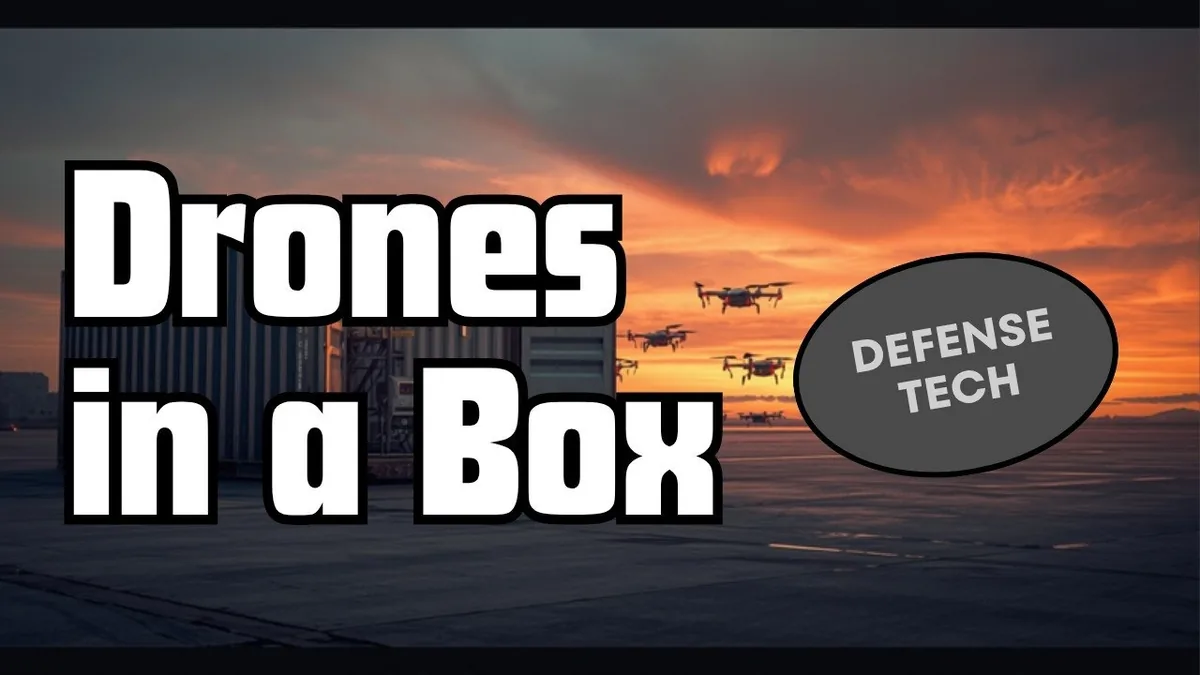
Firestorm Labs has raised $82 million to scale its core product: portable drone factories that fit inside standard 40-foot shipping containers. Each container can produce 100+ tactical drones per day from raw components, deployable anywhere a truck can reach. The thesis is uncomfortable but increasingly accepted in defense circles: in any future near-peer conflict, drone consumption rates will be high enough that traditional centralized manufacturing collapses.
The Series B was led by Andreessen Horowitz's American Dynamism fund with participation from Lockheed Martin Ventures and a strategic Pentagon-adjacent fund. Firestorm becomes the third "field manufacturing" defense startup to cross $80M in funding, behind Anduril (which builds in fixed factories at scale) and Saronic (autonomous boats, also containerized).
What "drone factory in a box" actually does
Firestorm's container holds CNC machines, automated assembly stations, 3D printers for composite components, and a quality-control rig. A trained two-person crew can spin up production within four hours of arrival. The drones produced are intentionally simple — fixed-wing tactical UAVs in the 5-15 kg class, primarily for ISR (reconnaissance) but also munitions-capable variants.
The container can produce three different drone configurations from the same line, controlled by software changes rather than tooling swaps. That flexibility is the real innovation. A field commander can request a different sensor payload or extended range and have updated drones rolling off the line within 48 hours, not the months that traditional procurement requires.
Why field manufacturing matters now
The lesson the Pentagon took from Ukraine and the 2024 Red Sea operations is that drone consumption rates in active conflict are an order of magnitude higher than what existing US production can sustain. Ukraine has consumed roughly 4,000 tactical drones per month at peak; Russia has consumed similar quantities. By comparison, the US currently produces about 8,000 small UCAVs annually across all programs.
The math is painful. A short conflict scaled to US-peer levels would exhaust 12 months of current production in 30 days. The Pentagon's response has been split: large prime contractors (Northrop, Lockheed) are scaling traditional factories, while DIU and the Army's Project Convergence are funding distributed-manufacturing approaches like Firestorm's. The two strategies are complementary, not competitive.
The deployment economics
Each Firestorm container costs roughly $4 million fully equipped. Each drone produced costs $8,000-15,000 depending on configuration. For comparison, a Raytheon-built Switchblade-equivalent costs around $58,000 — though with substantially higher capability. Firestorm's drones are designed to be expendable in the same way artillery shells are expendable. The economic ratio is what makes them interesting: at $10K per drone, you can use them for missions where Switchblade is too expensive.
The expected deployment is 50-100 containers across the Indo-Pacific theater, with smaller numbers in CENTCOM and EUCOM areas. At full scale that's 5,000-10,000 drones produced per day across the network — roughly 100x current US tactical drone production capacity.
My Take
The defense-AI investment thesis everyone has been talking about for two years is starting to translate into actual industrial capacity, and Firestorm is one of the cleanest examples. The "factory in a box" model isn't novel — Soviet-era manufacturing doctrine had similar concepts — but the execution is. CNC machines, additive manufacturing, and software-defined production tooling have only recently become cheap enough to fit this concept into a single container. The strategic implication is meaningful: it shifts the math of who can sustain a long-duration conflict. Right now China outproduces the US by maybe 6:1 in military drones; if Firestorm's deployment scales as planned, that ratio narrows substantially. The wildcard is whether the Pentagon actually buys at scale or whether procurement timelines drag long enough that the technology becomes obsolete before deployment. I'd give Firestorm 60-40 odds of becoming a major defense supplier by 2028. Better than most defense startups, lower than the bullish framing.
FAQ
Are these drones armed? Configurable. The base ISR variant is unarmed; munitions-capable variants use modular payloads compatible with NATO standard small munitions.
What's the export situation? US-only initially. ITAR-classified technology requires individual State Department licensing for each foreign customer.
Can the containers operate without external power? Yes — each unit has integrated diesel generators with 72-hour autonomous runtime, plus solar augmentation.
The Bottom Line
Firestorm Labs raises $82M to scale containerized drone manufacturing — 100 drones per container per day, deployable anywhere. The defense-industrial model is shifting from centralized factories to distributed field production, and Firestorm is one of three startups defining what that looks like.
Related Articles
- Google Exits Pentagon Drone Swarm
- Scout AI Raises $100M for Defense Models
- Strider AI for Air Force and NATO