SK Hynix Memory Shortage to 2030: What It Means for Your PC
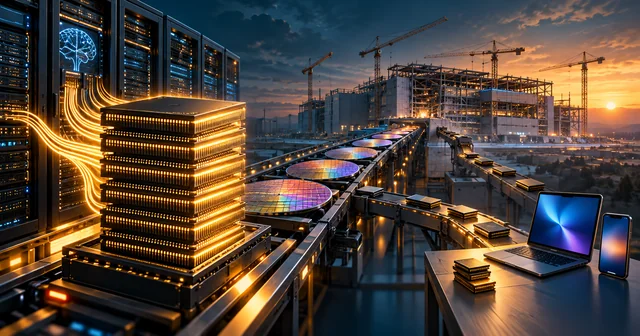
SK Hynix, one of three companies making nearly all the world's DRAM, now expects demand for memory to outrun supply through 2030. Over half of its 2027 and 2028 output is already promised to 14 large buyers, so PC and phone makers compete for what is left, and prices for RAM-heavy devices are likely to stay high for years.
What Happened
On October 28, 2026, SK Hynix published its third-quarter 2026 results. Revenue was 104.6 trillion won, up 32% from the previous quarter and 328% from a year earlier. Operating profit was 83.3 trillion won, up 38% quarter on quarter and 632% year on year. That is an operating margin of 80%, three points higher than in the second quarter. Net profit fell 58% from the previous quarter to 39.8 trillion won. The second quarter's net figure was 93.9 trillion won, far above its operating profit, so the drop reflects that unusual comparison rather than weaker chip sales.
The outlook drew more attention than the numbers. In the release, the company said it expects "the structure in which demand exceeds supply to persist through 2030." It gave two reasons. Leading-edge memory processes are technically hard to ramp, and new fabs take a long time to build.
It also described its supply contracts. SK Hynix has signed long-term agreements (LTAs) with 14 major customers, including the largest cloud providers. The volume covered so far is "more than 50% of total production capacity for 2027 and 2028." The contracts usually run five years, and some customers are asking for longer terms. Prices are not fixed. They follow market conditions within a range agreed with each buyer.
On the earnings call, chief financial officer Kim Woo-hyun went further. As The Register reported, he said PC and mobile shipments are expected to decrease because of higher memory costs and the shortage.
The company named its capacity plans. Its M15X fab will ramp to maximum capacity by the end of 2026 to make more HBM4, the high-bandwidth memory used with AI accelerators. Phase 1 of the Yongin cluster begins full-scale operation in 2027. SK Hynix said investment will "increase significantly" next year but gave no figure, and said it will adjust the scale and timing as demand develops.
Why It Matters
Memory is in almost everything with a chip in it: laptops, phones, game consoles, cars, routers and servers. When one of the three main suppliers says the shortage has four more years to run, it is warning about prices across all of those products, not only about AI data centres.
The shortage is already showing up in what people pay. Earlier this year, Microsoft raised Surface PC prices by up to $500 amid the global RAM shortage. Industry trackers counted a 4.1% fall in global smartphone shipments in the first quarter as memory costs rose. Samsung's own phone business, which buys memory from its sister division, faced pressure on Galaxy margins for the same reason.
The 2030 date also moves the forecast out. In April, reports put the end of the crunch at 2027, when supply was estimated to meet only about 60% of demand. SK Hynix is now telling investors that new fabs will not close the gap even after they open.
Large buyers are not shielded either. 9to5Mac reports that Apple is believed to be one of the 14 contract customers. Because the contracts follow market prices within a band, that status would secure supply but not a low price. Apple said in June that it was doing its best to soften memory-driven price increases.
How It Works
Three forces explain why a shortage like this lasts for years.
AI memory consumes more wafer per gigabyte. HBM is built by stacking several DRAM dies on top of one another and wiring them together with thousands of vertical connections. It needs more silicon area and more manufacturing steps per gigabyte than the DDR5 in a laptop. It also sells at a much higher price, so every wafer a maker moves to HBM earns more money and produces fewer gigabytes in total. SK Hynix expects HBM4 to overtake HBM3E in both shipments and revenue in the fourth quarter, which means more wafers going to the densest, slowest-to-make products.
Fabs take years, and new processes take longer. A memory fab needs land, power, water, cleanrooms and extreme ultraviolet lithography tools, and each stage takes time. Even after the building is finished, output climbs slowly while engineers raise yields. SK Hynix is also moving production to its 1c process, its sixth-generation 10nm-class DRAM. Newer processes fit more bits on each wafer but start with lower yields. That is why the company points to long fab lead times and hard processes, not a lack of money, as the bottleneck.
Long-term contracts reserve the supply in advance. When more than half of a supplier's future output is spoken for, the remaining share goes to everyone else. That includes PC and phone brands that buy in quarterly contract deals, module makers selling RAM sticks, and the spot market where smaller firms buy. Under a five-year agreement with a floating price band, a cloud provider gets guaranteed volume. The other buyers bid for a smaller pool, and their prices move fastest.
Flash storage is following a similar path. SK Hynix said its 321-layer NAND will make up more than half of its domestic NAND output in the fourth quarter. Over the longer term, it wants NAND to serve AI workloads through high-bandwidth flash (HBF), a stacked design along the lines of HBM. If that works, flash capacity also gets pulled toward data centres.
The demand side is still growing. The company named enterprise and personal AI as the short-term drivers, and physical AI such as autonomous driving and robotics for the longer term. It also expects to sell more SOCAMM modules, the compact LPDDR5 memory boards it is already mass-producing for AI servers. These use the same low-power DRAM type that goes into phones and thin laptops.
What's Still Unknown
SK Hynix did not name its 14 contract customers, and the reported Apple link is unconfirmed. It gave no price ranges for those contracts and no capital spending figure for 2027.
The company also did not say how much consumer device prices will rise. The CFO's comment on falling PC and mobile shipments was not attached to a number. Market trackers' forecasts for fourth-quarter DRAM contract prices differ between published reports, so any exact percentage should be treated with caution until the trackers publish final figures.
The outlook covers one supplier. Samsung and Micron are adding capacity too, and Micron has also announced multi-year customer agreements. How quickly all three add output, and whether AI spending keeps growing at this pace, will decide whether 2030 holds. If AI demand cools, the gap could close sooner. If more nations build sovereign AI infrastructure, as SK Hynix expects, it could last longer.
The timeline for high-bandwidth flash is also open. The company described it as a mid-to-long-term goal, without dates or volumes.
Frequently Asked Questions
Why does SK Hynix expect memory shortages to last until 2030?
SK Hynix says AI demand is growing faster than the industry can add supply. Leading-edge memory processes are technically hard to ramp, and new fabs take years to build and reach full yield. AI products such as HBM also use more wafer capacity per gigabyte, so moving production toward them reduces the total number of gigabytes available for other products.
Will laptops and phones get more expensive because of this?
Very likely, though nobody has a single figure. SK Hynix's CFO expects PC and mobile shipments to fall because of higher memory costs. Microsoft has already raised Surface prices, and Apple said in June it was trying to soften memory-driven increases. Device makers can absorb some of the cost, ship less RAM in base models, or raise prices.
What is a long-term agreement in memory supply?
It is a multi-year contract that reserves a share of a supplier's output for one buyer. SK Hynix's LTAs usually run five years, and the price floats with the market inside a range agreed with each customer. The buyer gets guaranteed volume, while the supplier gets predictable demand to justify building new fabs.
Who are SK Hynix's 14 contract customers?
SK Hynix has not named them. It said the group includes leading global cloud service providers, which suggests the largest AI data centre operators. 9to5Mac reports that Apple is believed to be among them, but neither company has confirmed it. Together, the 14 contracts cover more than half of SK Hynix's production capacity for 2027 and 2028.
What is HBM and why does it cause shortages?
HBM, or high-bandwidth memory, stacks several DRAM dies vertically beside an AI processor to deliver very fast data transfer. It needs more silicon and more manufacturing steps per gigabyte than ordinary DDR5 or LPDDR5. Because HBM is more profitable, makers move wafers to it, which leaves less capacity for the memory used in PCs and phones.
Should I buy a computer or RAM now rather than later?
If you already need a machine, waiting is unlikely to bring memory prices down soon, given SK Hynix's 2030 outlook. On laptops and Macs where memory is soldered and cannot be upgraded later, choose the amount you will need for the device's whole life at purchase. If your current device works well, there is no reason to buy early.
How much money did SK Hynix make in the third quarter of 2026?
Revenue was 104.6 trillion won, up 328% year on year, and operating profit was 83.3 trillion won, an 80% operating margin. Net profit was 39.8 trillion won, down 58% from an unusually high second quarter. The company also set a shareholder return target of about 100 trillion won for 2026.
Related Reading
For the earlier forecast that put the end of the crunch at 2027, see our report on the DRAM shortage and the 60% supply estimate. Our coverage of Microsoft's Surface price increases shows how memory costs reach shop prices. For the phone side, read about the first-quarter fall in smartphone shipments and the pressure on Samsung's Galaxy margins. For the server memory competing for the same chips, see SK Hynix's SOCAMM2 production for AI servers.