SK Hynix Begins Mass Production of SOCAMM2 Memory for AI Servers
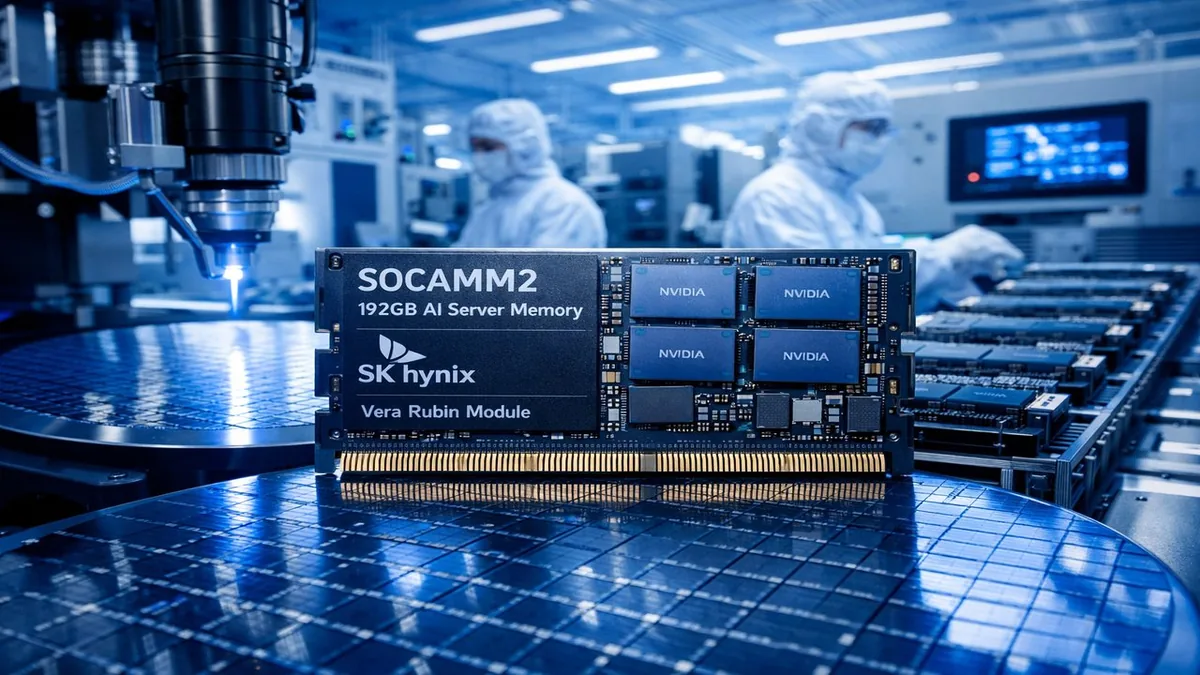
South Korean memory giant SK Hynix has announced the start of mass production for its SOCAMM2 (Small Outline Compression Attached Memory Module 2) technology, a compact, high-bandwidth memory form factor designed specifically for next-generation AI server architectures. The announcement marks a significant milestone in the race to build memory solutions that can keep pace with the growing compute demands of large language models.
What Is SOCAMM2?
SOCAMM2 is a next-generation memory module standard that offers dramatically higher bandwidth density compared to traditional DIMM form factors. By placing memory closer to the processor using a compressed, low-profile connector design, SOCAMM2 reduces latency and power consumption while increasing the amount of memory that can be physically packed into AI server rack configurations. It is seen as a critical enabling technology for the next wave of AI accelerator platforms beyond Nvidia's Blackwell generation.
AI Server Market Demand
The push into AI server memory is driven by surging demand from hyperscalers and AI cloud providers. Modern large language models require hundreds of gigabytes of high-bandwidth memory per node, and traditional DRAM architectures are increasingly the bottleneck. SK Hynix says SOCAMM2 delivers a 40% improvement in bandwidth per watt compared to its previous generation server memory, a metric that directly translates to lower operating costs for AI data centers.
Competition with Samsung and Micron
SK Hynix has been in an aggressive competition with Samsung and Micron for AI memory supremacy. The company was the first to ship HBM3E (High Bandwidth Memory 3E) to Nvidia at scale for the H100 and Blackwell series. SOCAMM2 mass production strengthens SK Hynix's position in the broader AI server ecosystem beyond GPU-attached HBM, targeting the CPU and inference accelerator segment.
The Bottom Line
SK Hynix's SOCAMM2 mass production launch is a meaningful step forward for AI server infrastructure. As memory bandwidth emerges as a primary constraint on AI model performance, innovations like SOCAMM2 will play an increasingly critical role in determining which hardware platforms can deliver the next generation of AI capabilities at scale.