Best 12ft Ladder Alternatives in 2026: What Still Works After 12ft.io

For a few years, 12ft.io was the shortcut half the internet used for paywalled news: paste a link, add “12ft.io/” in front, and read. It is gone, and a lot of the “best 12ft Ladder alternatives” lists written since then are already out of date.
We checked every tool those lists recommend on 13 November 2026. Some still work the way they are described, some have changed what they do, and one popular browser extension can now only be installed by switching on developer mode and loading files from an unofficial host.
This guide explains what happened to 12ft.io, how each alternative actually works, where each one fails, and the legal ways to read the same articles, which often turn out to be quicker.
We link to the open-source projects and to legal services, but not to sites whose main purpose is getting around paywalls; the sections below explain why.
What Happened to 12ft.io?
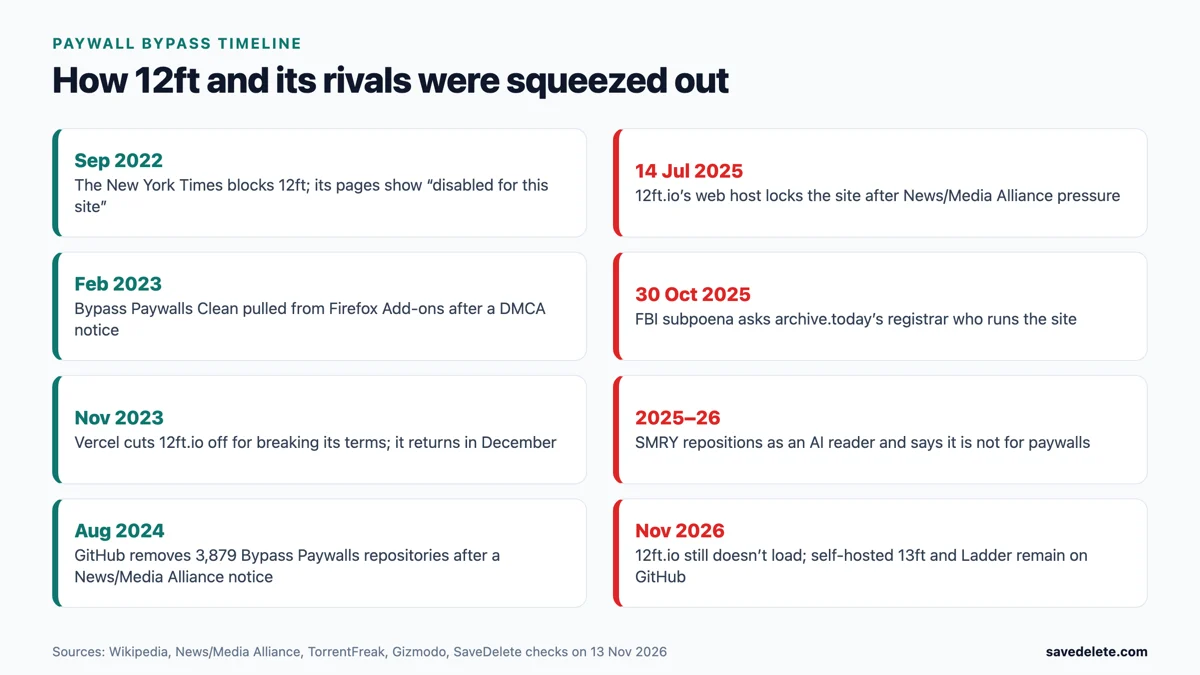
12ft.io, also called 12 Foot Ladder, was built by developer Thomas Millar. It fetched a page while presenting itself as a search-engine crawler, so sites that show Google their full articles handed the same text to 12ft. Big publishers pushed back early: The New York Times blocked it in September 2022, after which its pages on 12ft showed “disabled for this site”, and Bloomberg did the same, according to Wikipedia’s history of the site.
In November 2023 the hosting company Vercel cut the site off for breaking its terms of service; it came back the following month. The end came on 14 July 2025, when 12ft.io’s web host locked the site. The News/Media Alliance announced the takedown, called 12ft illegal circumvention technology, and said it would take similar action against other paywall bypass providers, as Nieman Lab reported. When we tried 12ft.io on 13 November 2026, it still didn’t load.
How 12ft Worked, and Why Its Replacements Fail on Some Sites
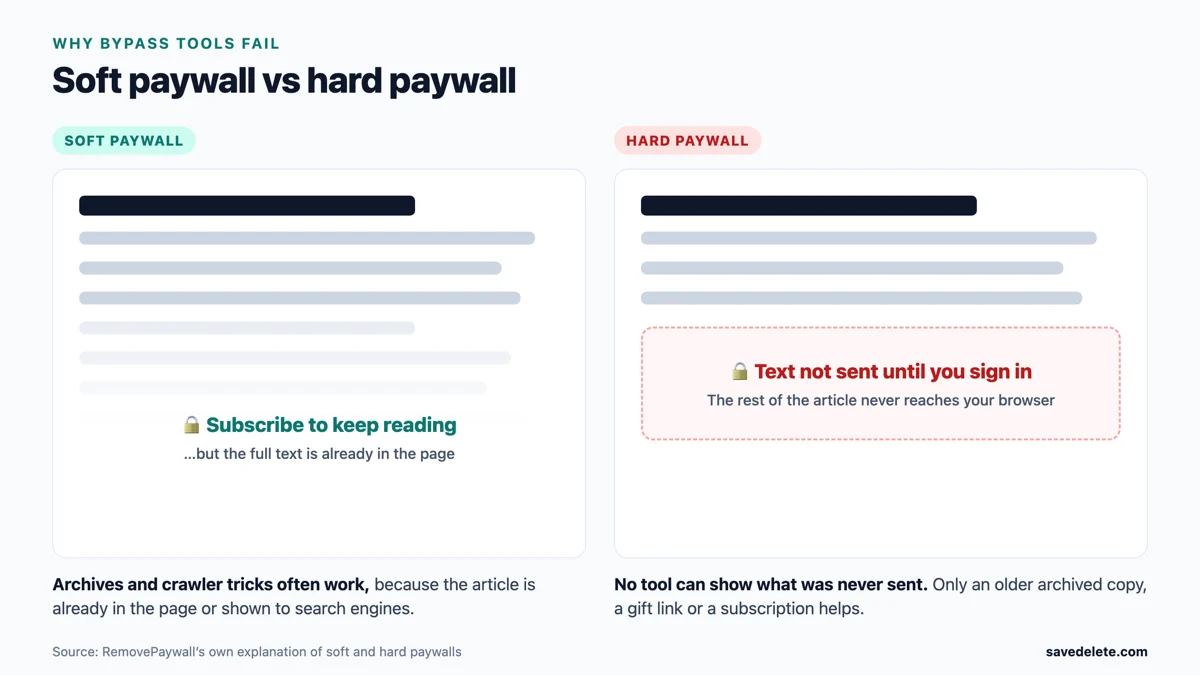
Every paywall bypass relies on one thing: the article text reaching you some other way. That is only possible on a soft paywall, where the publisher sends the full article and then covers it, or shows the full text to search engines so it can rank. On a hard paywall, the server never sends the article until you sign in, so there is nothing for a tool to uncover. RemovePaywall’s own help text makes the same distinction.
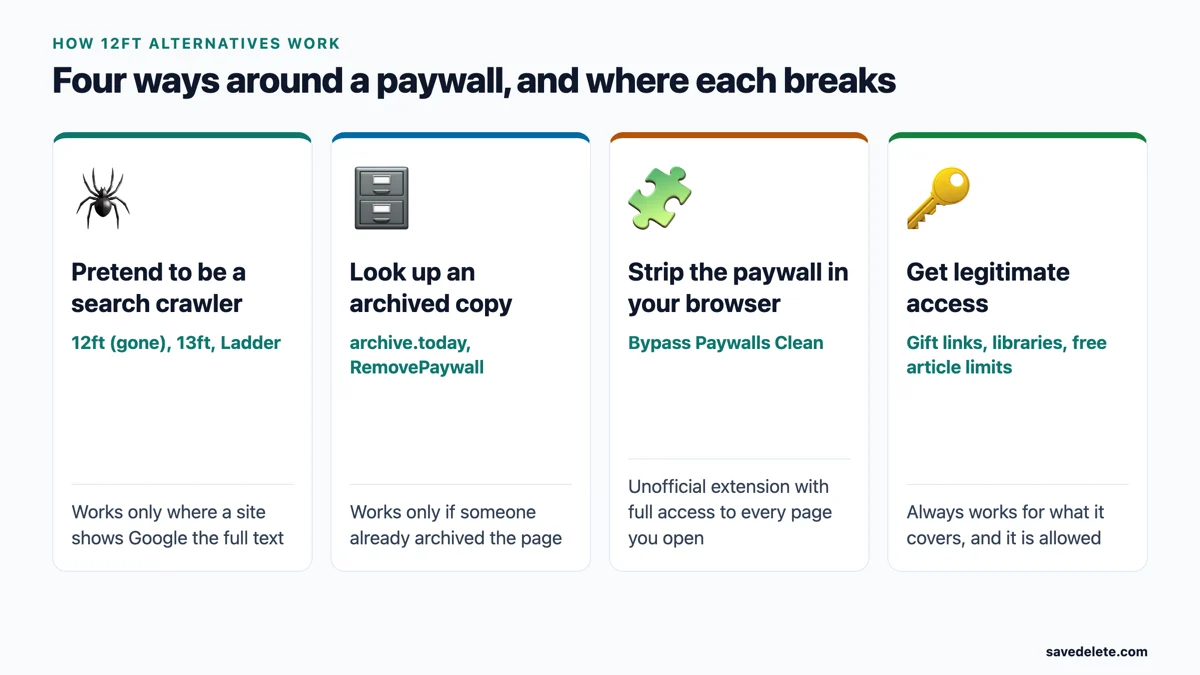
The alternatives use four approaches. Crawler tools copy 12ft’s trick of pretending to be Google. Archive tools look for a copy of the page someone saved earlier. Extensions hide the paywall inside your own browser. And legal routes, such as gift links and library access, give you a real copy of the article.
The Best 12ft Ladder Alternatives in 2026
Here is where each option stood when we checked on 13 November 2026, starting with the ones closest to how 12ft worked.
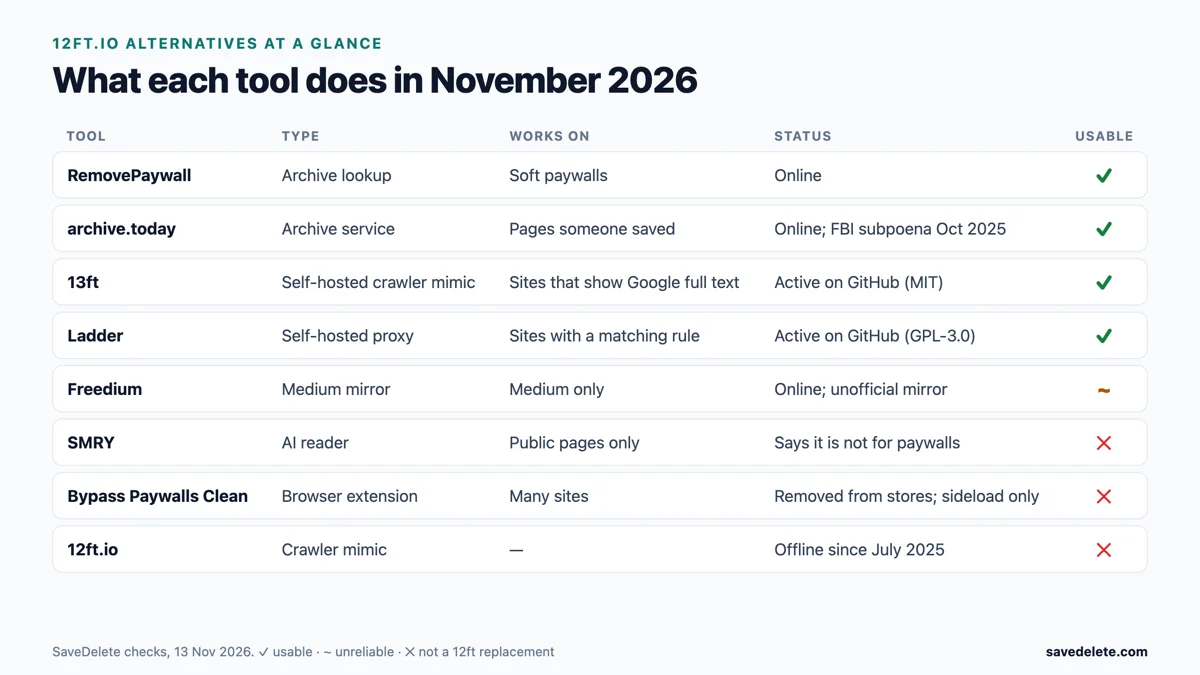
| Option | How it works | Best for | Main limit |
|---|---|---|---|
| RemovePaywall | Searches internet archives for a saved copy | Quick look at a soft-paywalled story | Fails on hard paywalls; ad-supported |
| archive.today | Shows snapshots that users saved | Widely shared news stories | Slow, CAPTCHAs, anonymous operator |
| 13ft | Self-hosted; poses as Google’s crawler | Technical users who want 12ft back | You run it yourself; many sites block it |
| Ladder | Self-hosted proxy with per-site rules | Tinkerers comfortable with Docker | Only as good as its rules |
| Freedium | Unofficial mirror of Medium stories | Medium only | Medium Friend Links do it legally |
| Library card (PressReader, Libby) | Licensed digital newspapers and magazines | Regular news reading, free | Titles depend on your library |
| Gift links and free limits | Publisher-approved free access | A specific article a friend can share | Needs a subscriber or a free-article allowance |
| SMRY | AI reader and summariser for public pages | Summaries of free articles and PDFs | Says it is not for paywalls |
1. RemovePaywall
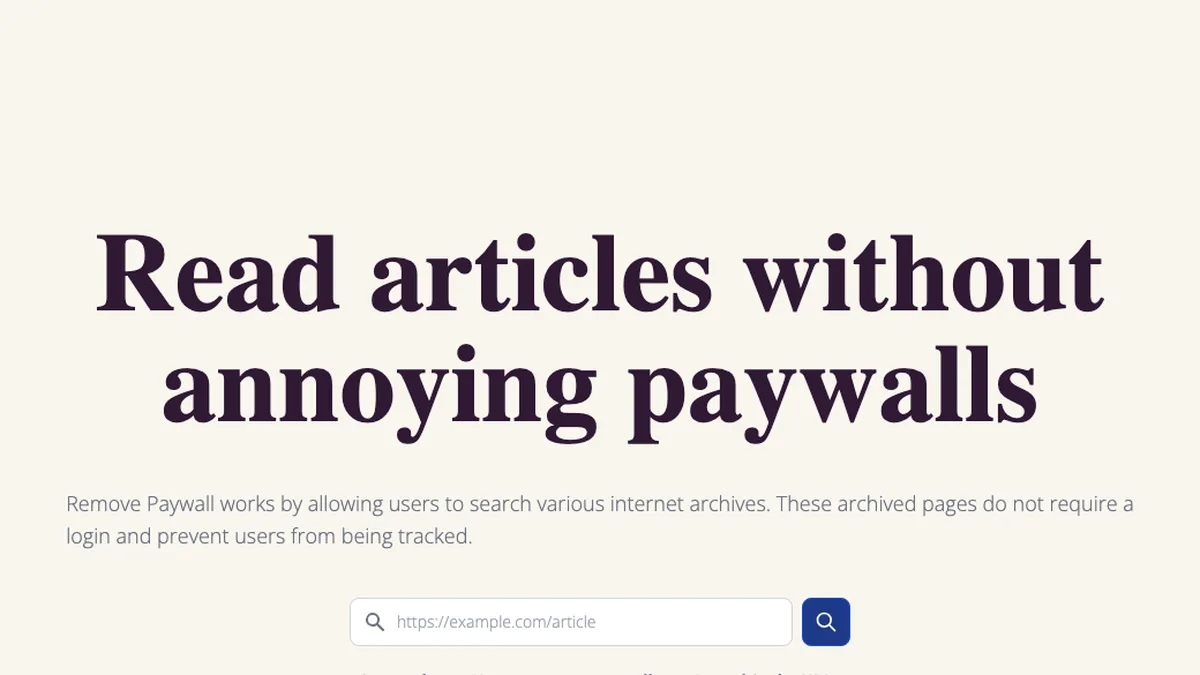
RemovePaywall is the closest thing to 12ft’s paste-a-link experience. You paste an article address and it searches internet archives for a saved copy, which it shows without a login. Its creator says it was tested on “a little over a hundred” news sites, and the site is clear about its limit: soft paywalls can usually be removed, hard paywalls generally can’t. It also offers a Chrome extension, a Firefox add-on and an iOS Shortcut. When we checked, the page carried display ads, and an archived copy is only as recent as the last time someone saved the page.
2. Archive.today (archive.ph, archive.is)
Archive.today is a web archive where anyone can save a snapshot of a page, and those snapshots often include the full text of news stories. It is the source many other tools draw on. It is also the most controversial: its operator has never been publicly identified, it often shows CAPTCHAs and can be slow, and on 30 October 2025 the FBI subpoenaed its domain registrar for information about who runs it, Gizmodo reported. It still worked when we checked, but it is not something to rely on.
3. 13ft (self-hosted)
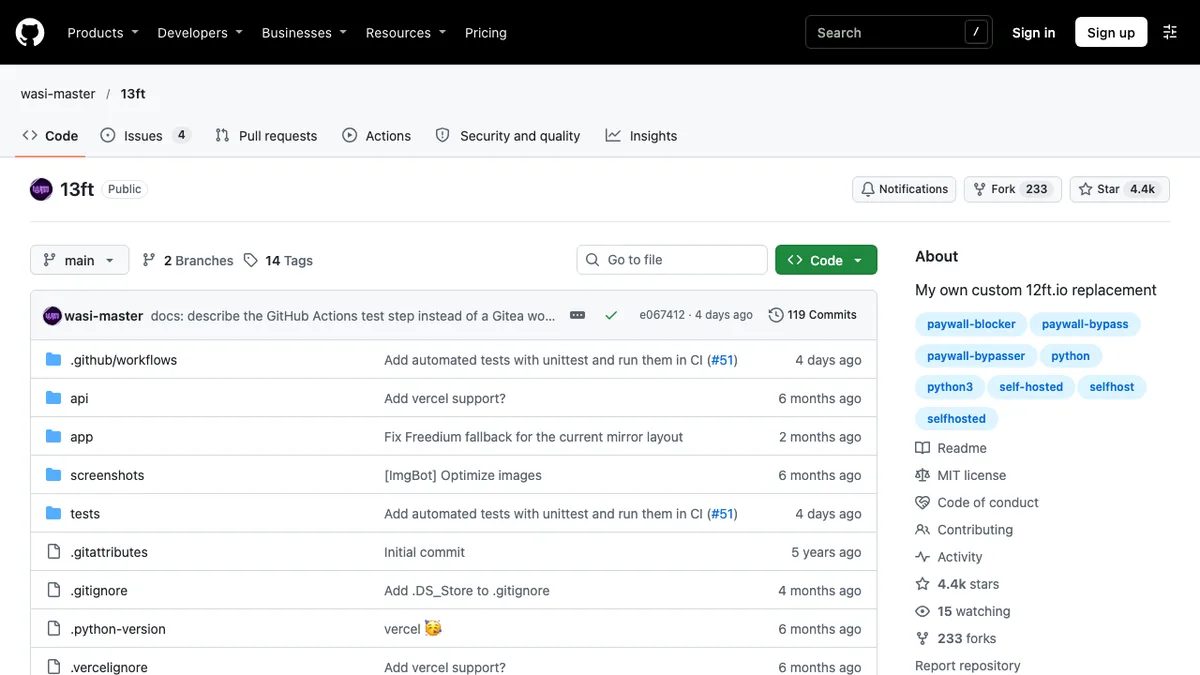
13ft is an open-source rebuild of 12ft that you run on your own computer or server. Like the original, it presents itself as Google’s crawler, so sites that show Google the full article send it to you, and it tries other methods when that fails. It is MIT-licensed, had about 4,400 stars on GitHub when we checked, was updated days earlier, and runs with Docker or plain Python. A spare home server or one of the boards in our list of Raspberry Pi Zero projects is enough to host it. Because it is your own copy, there is no site for anyone to take down, but publishers that block Google’s crawler identity will block it too.
4. Ladder (self-hosted)
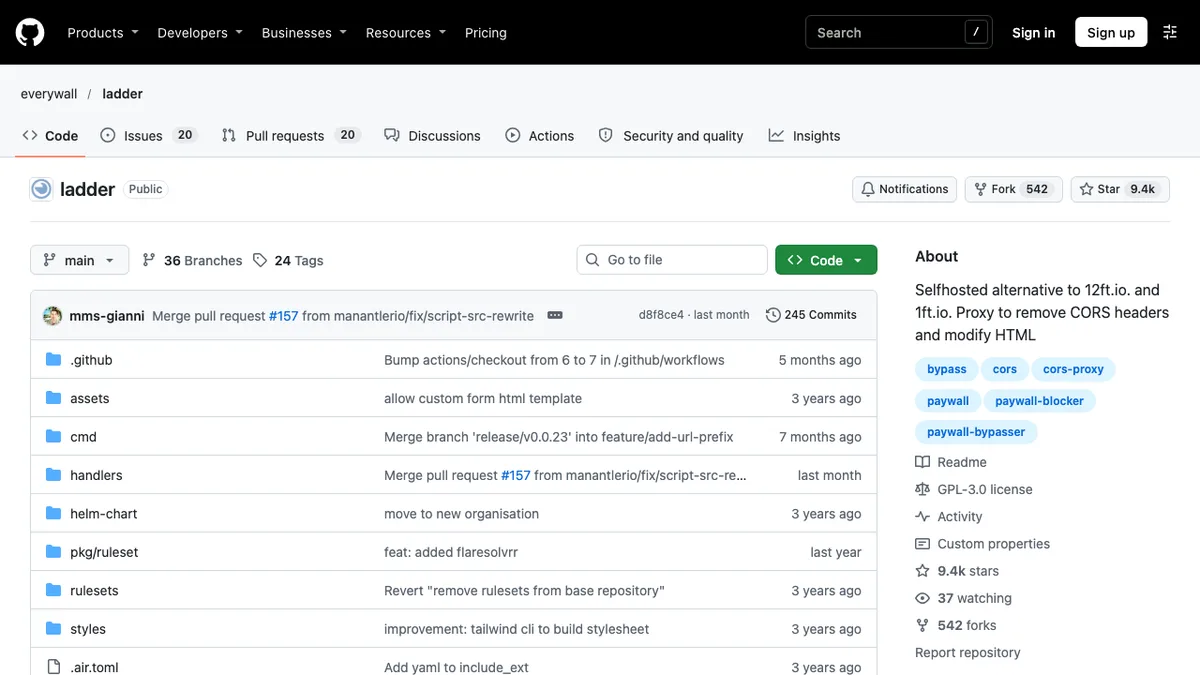
Ladder describes itself as a self-hosted alternative to 12ft.io and 1ft.io. It is a small proxy that rewrites pages using per-site rules, licensed under GPL-3.0, with about 9,400 GitHub stars when we checked. It suits people comfortable with Docker or a home server, and it works only as well as the rules written for each site.
5. Freedium (Medium only)
Freedium is an unofficial mirror that shows Medium’s member-only stories. It does nothing for news sites. For Medium there is a legitimate route that works just as fast: Medium’s Friend Links, which writers and “Friend of Medium” members can share, open a paywalled story to anyone, and Medium’s help centre says the writer still gets paid for that reading time.
6. Your library card: PressReader and Libby
If what you used 12ft for was reading the news every day, a library card is the most underrated alternative. Many public libraries give members free access to PressReader, which advertises more than 7,000 newspapers and magazines, and the Libby app carries digital magazines from participating libraries. Some libraries also offer free day passes to major newspapers. Availability depends on your library, so check its digital resources page.


7. Gift links and free article limits
Many publishers let subscribers share a free “gift” link to a single article; The New York Times explains its gift articles here, and recipients don’t need a subscription. If a friend subscribes, asking for a gift link is the fastest legal way to read one story. Metered sites also allow a few free articles a month, so save those for the stories that matter.
8. SMRY (now an AI reader, not a paywall tool)
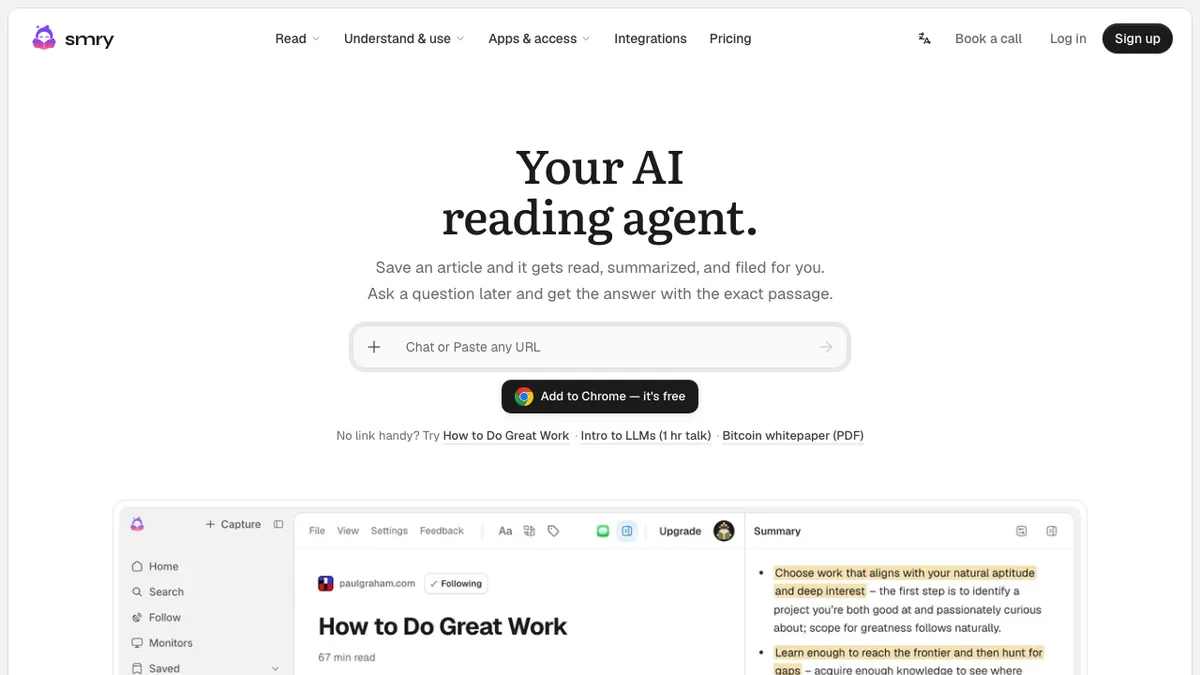
SMRY tops many 12ft alternative lists, but it has changed. Its site now presents it as an AI reading agent for public articles, PDFs, RSS feeds and YouTube transcripts, and it states plainly that it should not be used to get around a hard paywall, sign-in or subscription check. It is still handy for summarising free articles, much like the reading features in AI browsers such as ChatGPT Atlas, but it is no longer a 12ft replacement.
Why We Don’t Recommend Bypass Paywalls Clean
Bypass Paywalls Clean is a browser extension that strips paywalls on many sites. It has been removed from almost every official channel: from Firefox Add-ons in February 2023, from GitLab in April 2024, and in August 2024 GitHub took down 3,879 repositories carrying it after a News/Media Alliance notice, TorrentFreak reported. According to Wikipedia, it is now distributed from GitFlic, a Russian code-hosting site, and installing it means turning on developer mode and loading files by hand.
That is the problem. An extension that can rewrite news pages can read every page you open, including your email and bank. Extensions are a known privacy risk even from official stores, as the LinkedIn extension-scanning story showed, and sideloaded ones skip the store’s checks entirely. If you want extensions, pick them from our list of well-known Chrome extensions, keep your browser updated (our guide to what makes a browser secure explains why), and read up on how malware gets onto computers before loading anything unpacked.
Is Using a Paywall Bypass Legal?
It is a grey area, and not one courts have settled for readers. The News/Media Alliance calls tools like 12ft and Bypass Paywalls Clean illegal circumvention technology under US copyright law, and its notices have taken several of them offline. At the very least, using them breaks the terms of service of most news sites. This is not legal advice, but the practical risk falls mostly on the people who run the tools, not on readers.
There is also a plainer reason to think twice: paywalls pay for reporting. Ad revenue alone rarely covers it, which is why publishers are turning to subscriptions and AI licensing deals, and why even small sites now plan their costs carefully, as our guide to what small publishers should budget for shows.
Legal Ways to Read Paywalled Articles
Most of the time you don’t need a bypass at all. These six routes cover the majority of articles people used 12ft for.
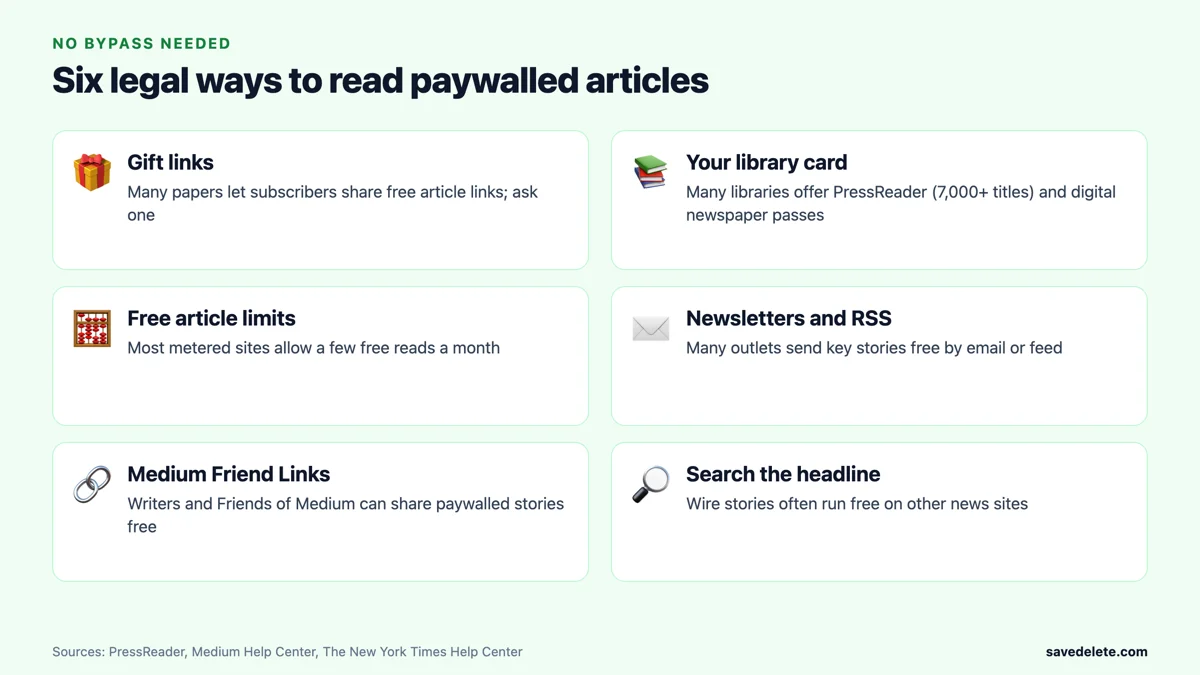
- Ask for a gift link from a friend who subscribes.
- Use your library card for PressReader, Libby magazines and newspaper passes.
- Use the free article allowance on metered sites for the stories that matter.
- Subscribe to free newsletters or feeds; many outlets send their key stories free, and our guide to getting RSS feeds shows how feed readers work.
- Use Medium Friend Links instead of Medium mirrors.
- Search the headline: wire stories from agencies often run free on other news sites.
Frequently Asked Questions
What happened to 12ft.io?
12ft.io went offline on 14 July 2025, when its web host locked the site after action by the News/Media Alliance, a trade group for news publishers. It still did not load when we checked on 13 November 2026.
Is 12ft Ladder coming back?
There is no sign of it. The original site remains offline, and the News/Media Alliance has said it will act against similar sites. Self-hosted rebuilds such as 13ft and Ladder are the nearest thing to it.
What is the best 12ft.io alternative in 2026?
For a quick paste-a-link tool, RemovePaywall works on soft paywalls. For a true 12ft replacement, the self-hosted 13ft project copies its method. For regular news reading, a library card with PressReader is the best legal option.
Does SMRY still bypass paywalls?
No. SMRY now describes itself as an AI reading agent for public articles, PDFs and feeds, and says it should not be used to get around hard paywalls, sign-ins or subscription checks.
What is 13ft?
13ft is an open-source, MIT-licensed rebuild of 12ft.io that you host yourself with Docker or Python. It presents itself as Google’s crawler, so sites that show search engines the full article send the text to you.
Is archive.today safe to use?
Reading saved pages is generally low risk, but the service is run anonymously, often shows CAPTCHAs, and its registrar received an FBI subpoena in October 2025 about who operates it, so it may not stay available.
Why don’t 12ft alternatives work on some sites?
Those sites use hard paywalls, which never send the article text until you sign in. No archive or crawler trick can show text that was never sent, unless someone saved an older copy.
Are paywall bypass tools legal?
Publishers argue they are illegal circumvention tools, and several have been taken down. Using one breaks most news sites’ terms of service. Gift links, library access and free article limits are the fully legal options.