Maryland Becomes First US State to Ban AI Grocery Surveillance Pricing
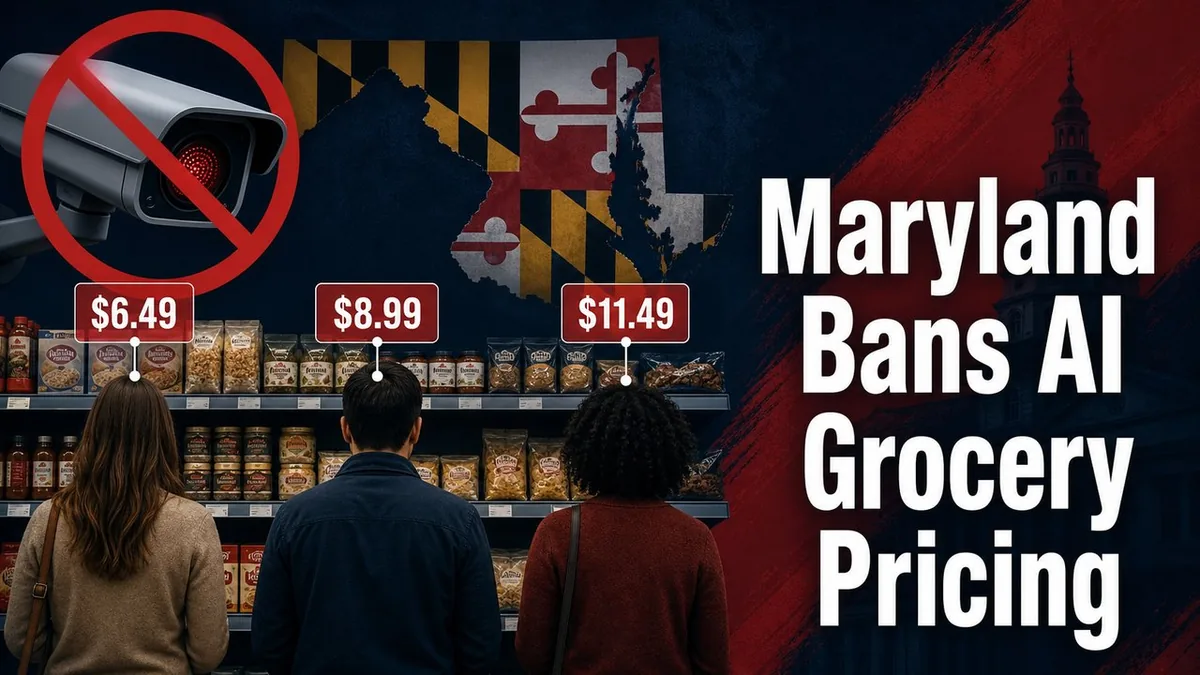
Maryland has become the first U.S. state to legally ban "surveillance pricing" — algorithm-driven dynamic pricing in grocery stores that uses individual consumer data to vary prices between customers. The law, signed by Governor Wes Moore last week, prohibits supermarkets and grocery retailers from charging different prices to different customers based on personal data including location history, purchase patterns, demographic information, or device identifiers. Critics — including consumer advocates and some legislators — argue the law contains significant carveouts that limit its practical effect.
The legislation responds to growing consumer concern about algorithmic pricing experiments by major grocery chains. Kroger, Walmart, and several smaller chains have piloted variable-pricing systems that use loyalty-program data, real-time inventory feedback, and demographic indicators to adjust prices for individual shoppers. The pricing variations have ranged from a few cents to several dollars on individual items, with the largest variations on high-margin items like produce, meat, and ready-to-eat foods.
What the Maryland law actually prohibits
The law's core prohibition is on varying prices based on individual consumer data — meaning a grocery store cannot charge customer A $3.99 for ground beef while charging customer B $4.49 for the same product based on data the store has collected about them individually. The law applies to in-store, online, and app-based grocery purchases.
The carveouts are where critics focus their concerns. The law explicitly permits: (1) loyalty program discounts available to all members on equal terms; (2) time-of-day or day-of-week pricing that doesn't vary by individual; (3) quantity discounts based on purchase volume; (4) regional or store-level pricing differences; and (5) promotional discounts targeted to demographic groups (e.g., senior citizen Tuesdays). The carveouts cover most of what major grocery chains were already doing, leading critics to argue that the law primarily prohibits the most aggressive personalization — which most chains had not yet deployed at scale anyway.
The broader regulatory context
Maryland's law is the first state-level legislation specifically targeting AI-driven dynamic pricing in retail, but other states are watching. California, New York, Washington, and Massachusetts all have similar bills in committee, with hearings scheduled in Q2 and Q3. The federal Federal Trade Commission has also opened an inquiry into surveillance pricing practices, with a request for industry comment that closed in March.
The regulatory pressure reflects a real concern. Personalized pricing has been studied extensively in academic literature, and the consensus finding is that without clear regulation, dynamic pricing systems tend to charge higher prices to customers with less price sensitivity — which often correlates with lower-income customers in the grocery context (less time to comparison shop, fewer loyalty program memberships, less data sophistication). The result is a regressive pricing pattern that political coalitions across the spectrum find troubling.
My Take
The law is well-intentioned but probably underwhelming in practice. The carveouts permit most of the dynamic-pricing experimentation grocery chains were doing, which means the law's main effect is preventing the most aggressive personalization rather than meaningfully constraining current practice. That's not nothing — it sets a regulatory anchor that chains have to design around — but it's also not the categorical ban consumer advocates wanted.
The broader question is whether any AI-pricing regulation can keep pace with the underlying technology. Pricing algorithms learn and adapt continuously; legislative frameworks are static. By the time Maryland's law takes effect in January 2027, the practices it bans will have evolved into different practices that may technically comply with the letter of the law while violating its spirit. Effective regulation probably requires ongoing oversight authority rather than static prohibition, but that's harder to legislate and politically difficult to advance.
For consumers, the practical near-term effect is small. Maryland's grocery prices are unlikely to change visibly because most chains weren't aggressively personalizing prices to individual customers anyway. The longer-term effect could be larger if other states follow suit and the regulatory framework genuinely constrains the next generation of pricing experiments.
What this means for retail AI deployment
Three implications. First, expect more state-level AI consumer protection laws over the next 18 months — California and New York will likely enact comparable or stronger versions; Washington and Massachusetts will follow with regional variations. Second, expect federal FTC action on surveillance pricing within 12 months, possibly including an industry-wide consent decree framework. Third, expect major grocery chains to pre-emptively standardize pricing practices across all U.S. operations to avoid having to maintain state-by-state variations; the strongest state-level rule will effectively become the national floor.
For broader AI deployment in retail, the takeaway is that algorithmic personalization is becoming politically constrained in consumer-facing contexts. The same algorithms that work fine in B2B SaaS pricing or financial services face increasing regulatory friction when applied to consumer goods. AI vendors selling to retail need to factor regulatory risk into product roadmaps, particularly for personalization features.
Frequently Asked Questions
What exactly does Maryland's law ban?
Charging different prices to different individual customers based on personal data (location history, purchase patterns, demographics, device identifiers). Loyalty program discounts, time-of-day pricing, and quantity discounts remain permitted as long as they're available on equal terms.
When does the law take effect?
January 1, 2027, with a transition period for grocery chains to update their pricing systems. Penalties for violations begin at $1,000 per incident with potential escalation for systemic violations.
Will my grocery prices change?
Probably not visibly. Most major grocery chains were not yet aggressively personalizing prices to individual customers, so the law's main effect is preventing future practices rather than rolling back current ones.
Are other states pursuing similar laws?
Yes. California, New York, Washington, and Massachusetts have comparable bills in committee. The federal FTC has also opened an inquiry. Expect significant regulatory activity over the next 12-18 months.
The Bottom Line
Maryland's surveillance-pricing ban is the first U.S. state law specifically targeting AI-driven retail pricing, but its carveouts limit immediate practical impact. The longer-term effect is establishing a regulatory anchor that other states and the FTC will build on. Expect significant retail AI regulatory activity over the next 18 months as the legal framework catches up to technological capability.
Related Articles
- 35% of New Websites Since ChatGPT Are AI-Generated
- OpenAI Staff Flag Violence-Reporting Gaps
- Anthropic Launches Claude Security in Public Beta