How to Write AI Music Prompts That Lead to Better Songs
Getting a better song from AI Song usually has less to do with luck than most beginners think. The real difference often comes from the prompt itself: how clearly it describes the sound, how well it matches the song idea, and how much room it leaves for the music to breathe.
A lot of first attempts fail for the same reason. The prompt is either too vague to guide the song or too crowded to hold a clear direction. A better prompt does not try to show off. It gives the song one strong center, then supports that center with a few useful details. That approach is especially helpful for anyone using AI tools for the first time and wondering why the result sounds random instead of intentional.
I. Why Most AI Music Prompts Fall Flat
Most weak prompts are overloaded. They ask for too many genres, too many emotions, and too many production ideas in one sentence. When a prompt says “sad but hopeful cinematic pop rock with EDM energy and deep storytelling,” the song has no obvious lane to follow. It may still generate something usable, but it often lacks shape.
The better approach is to choose one emotional direction and one musical direction first. If the song should feel intimate, let it stay intimate. If it should sound like soft indie pop, do not crowd it with trap drums, orchestral drama, and arena-rock language at the same time. Clear prompts usually sound better because they make fewer competing demands.
This matters for AI Music in a very practical way. The model can respond more consistently when the instructions point to one believable idea instead of five half-formed ones. In other words, clarity is not a style choice. It is part of the songwriting process.
II. What a Strong Prompt Really Needs
A good prompt does not need to be long. It needs to cover the details that actually shape a song: genre, mood, vocal feel, topic, and one or two sound cues. That is usually enough to turn a loose idea into something the music can follow.
For example, “warm acoustic folk, reflective mood, soft male vocal, about leaving home, with light piano” is much stronger than “a beautiful emotional song about memories and life.” The first version gives direction. The second only gives mood in a very general way. A useful prompt should sound more like a brief than a speech.
This is where AI Song Generator becomes much more effective. In Simple Mode, a song idea can be described in plain language. That makes it easy to test rough concepts without overthinking every line. When the idea starts to feel solid, the prompt can become more specific instead of more complicated.
An AI Music Generator usually responds best when the prompt answers these questions:
-
What style is the song in?
-
What mood should it carry?
-
What kind of voice fits it?
-
What is the song about?
-
What one detail gives the arrangement character?
When those points are clear, the result often sounds more focused from the start.
III. Use the Right Mode for the Right Stage
One of the most helpful parts of AI Song is that it does not force every idea into the same workflow. The writing process can begin in a lighter way, then move into a more controlled setup when the song needs more detail.
Simple Mode for Fast Idea Testing
Simple Mode works best when the song is still just a rough concept. It is useful for testing a mood, a tone, or a broad direction before spending time on lyrics or song structure. That makes it a good starting point for beginners who know how the song should feel but do not yet know what every line should say.
A short prompt often works better here than a packed one. “Moody synth-pop about a late-night train ride, soft female vocal, bittersweet feeling” gives enough direction to hear whether the idea has life. If it does, the next draft can become more precise.
Custom Mode for More Control
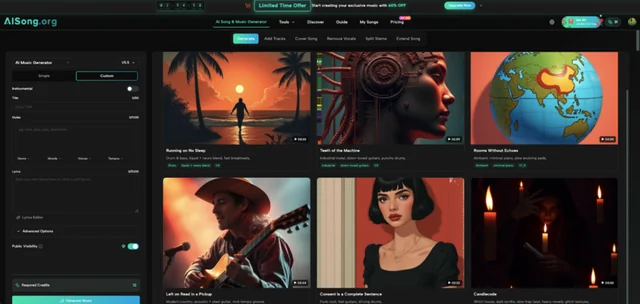
Custom Mode becomes more useful when the song needs structure. The interface separates the process into fields such as title, styles, and lyrics, and it also includes tools like the Lyrics Editor. There are also selectors for genre, moods, voices, and tempos, which helps keep the song organized instead of throwing every instruction into a single box.
This is the point where a rough draft can start behaving like an actual song. Instead of describing everything at once, each field can do one job. The title gives the song identity. The style field shapes the sound. The lyrics field focuses on words and phrasing. That cleaner split is one reason an AI Music Maker can produce stronger results when the idea is already partly formed.
IV. Write Lyrics That Sound Natural When Sung
Many beginners write lyrics that read like notes instead of lyrics. They explain too much, run too long, or try to be profound in every line. A song usually needs less explanation and more movement.
Short lines are easier to sing. Concrete images are easier to feel. A phrase like “coffee went cold beside the window” gives the listener a scene. A phrase like “the emotional burden of memory remains inside the heart” sounds stiff and heavy. One line opens space for melody. The other closes it.
Build Around a Chorus People Can Remember
The chorus should carry the clearest phrase in the song. It does not need many words, but it does need a line that lands quickly. Repetition helps, especially when the central thought is strong enough to bear it.
A useful rule is simple: if the chorus cannot be remembered after one read, it is probably trying to do too much. The best choruses tend to be emotionally direct, rhythmically clean, and easy to return to.
Use Structure to Help the Song Breathe
Structured lyrics usually lead to better results than one long block of text. Sections such as Intro, Verse, Chorus, Bridge, and Outro give the song a sense of movement. They also make it easier to control pacing and emotional lift.
That is why structure matters so much in AI Music. The verse can move the story forward, the chorus can carry the main hook, and the bridge can break the pattern at the right moment. Even simple lyrics often sound more complete when those parts are clearly separated.
V. Small Settings Can Change the Result a Lot
Better prompting is not only about writing better sentences. It is also about using the available controls well. In Custom Mode, the options around style, voice, tempo, and genre can sharpen the result without making the prompt longer.
The Instrumental switch is a good example. If vocals are not needed, turning on instrumental makes the intention clear right away. The same is true for style and mood selectors. Instead of stuffing those details into one paragraph, they can be assigned more directly, which helps the song stay consistent.
This is where AI Music Maker tools become more useful than many beginners expect. A song does not always need more text. Sometimes it just needs cleaner choices. A stronger mood selection, a better tempo direction, or a more suitable voice can do more than another ten adjectives.
VI. Revise the Song Without Losing the Idea
The first version of a song is rarely the final one. What matters is knowing how to improve it without breaking what already works. Many beginners make the mistake of rewriting the whole prompt after every weak result. That often creates more confusion, not better music.
Regenerate Before Rewriting Everything
When the core idea is right but the result feels off, regeneration is often the smarter move. It allows the same idea to be tried again from a slightly different angle. That is useful when the style and lyrics are mostly working, but the melody, pacing, or overall feel is not there yet.
A smart revision process usually changes one thing at a time:
-
Tighten the chorus
-
Simplify the style line
-
Remove conflicting genre terms
-
Adjust the vocal feel
-
Add one clearer sound cue
That method keeps the song stable while still moving it forward.
Keep the Parts That Already Work
One of the easiest ways to improve a weak draft is to stop treating every version as a total reset. If the style feels right, keep it. If the chorus is strong, do not throw it away just because the verse is weak. Reusing the best parts is often what turns a decent attempt into a good song.
This is also where an AI Song Maker becomes much more practical for beginners. The goal is not endless generation. The goal is to recognize what is already working, preserve it, and improve the parts that missed the mark.
VII. Conclusion
Good prompts are not impressive because they are long. They are effective because they are clear. A strong result usually comes from one solid idea, one believable mood, lyrics that are easy to sing, and revisions that stay focused instead of chaotic.
That is why AI Song works best as a songwriting tool rather than a shortcut. When the prompt is clean, the mode fits the task, and the structure supports the hook, an AI Music Generator is far more likely to produce something catchy, usable, and worth keeping.