Government Approves Massive MSP Hike for Kharif Crops (2026-27): What It Means for Indian Farmers
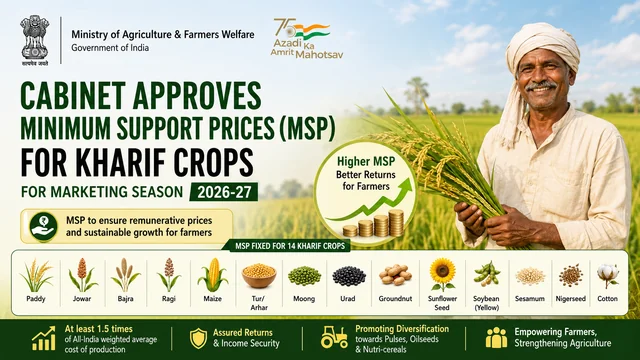
In a significant boost for the Indian agricultural sector, the Cabinet Committee on Economic Affairs (CCEA), chaired by Prime Minister Shri Narendra Modi, has officially approved an increase in the Minimum Support Prices (MSP) for 14 Kharif crops for the upcoming Marketing Season 2026-27.
This strategic move is designed to ensure that growers receive remunerative prices for their hard-earned produce, safeguarding farmer incomes across the country.
Here’s a detailed breakdown of what this announcement means for Indian agriculture.
🌾 Fulfilling the 1.5x Formula Promise
The latest MSP hike is directly in line with the landmark announcement made in the Union Budget 2018-19. That budget set a policy goal of fixing the MSP at a level of at least 1.5 times the All-India weighted average cost of production.
When we look at the estimated margins farmers will make over their cost of production, the numbers are highly encouraging:
📈 Expected Farmer Margins
| Crop | Estimated Margin Over Cost |
|---|---|
| Moong | 61% |
| Bajra | 56% |
| Maize | 56% |
| Tur/Arhar | 54% |
| Other Approved Kharif Crops | At least 50% |
These margins indicate a strong effort by the government to improve profitability for farmers and reduce financial stress in the agricultural sector.
🚜 Top Crops Securing the Highest Absolute MSP Increases
To boost specific sectors, certain crops have seen substantial absolute increases in MSP compared to the previous year.
💰 Highest MSP Hikes for 2026-27
| Crop | MSP Increase |
|---|---|
| 🌻 Sunflower Seed | Rs. 622 per quintal |
| 🧵 Cotton | Rs. 557 per quintal |
| 🌱 Nigerseed | Rs. 515 per quintal |
| 🌾 Sesamum | Rs. 500 per quintal |
These increases are expected to encourage farmers to diversify cultivation patterns and move toward higher-value crops.
🌱 A Push Beyond Cereals: Nutri-Cereals and Oilseeds
If you look closely at the crops receiving the highest percentage margins and absolute increases, a clear policy direction emerges.
In recent years, the Government has actively promoted the cultivation of crops other than standard cereals. By offering a higher MSP, there is a deliberate push to encourage farmers to grow:
-
Pulses
-
Oilseeds
-
Nutri-cereals (popularly known as "Shree Anna")
This strategy supports:
-
Better nutritional security
-
Climate-resilient farming
-
Reduced dependence on traditional cereal crops
-
Improved farmer incomes through crop diversification
📊 Understanding the “Cost of Production”
It is important to understand what the government considers when calculating the “cost” to ensure a 50%+ margin.
The calculation is highly comprehensive and includes:
✅ Included Cost Components
-
Paid-out costs incurred from hired human labour, as well as bullock and machine labour
-
Rent paid for leased-in land
-
Expenses related to material inputs, including:
-
Seeds
-
Fertilizers
-
Manures
-
Irrigation charges
-
-
Depreciation on farm implements and buildings
-
Interest on working capital
-
Diesel or electricity required to operate pump sets
-
Miscellaneous expenses
-
Imputed value of family labour
Note: Cost data are not separately compiled for:
Paddy Grade A
Jowar Maldandi
Long Staple Cotton
📈 A Decade of Growth: Procurement and Payments on the Rise
To understand the impact of the MSP ecosystem, the government also released comparative data highlighting the massive growth in crop procurement and direct financial support to farmers over the last decade.
🌾 Surge in Procurement Volumes
Procurement Growth Highlights
-
Between 2014-15 and 2025-26, procurement of the 14 Kharif crops stood at 8746 Lakh Metric Tonnes (LMT).
-
This is nearly double the 4679 LMT procured during the earlier period of 2004-05 to 2013-14.
-
Paddy procurement alone reached 8418 LMT during the 2014-15 to 2025-26 period, up from 4590 LMT in the 2004-05 to 2013-14 period.
📌 What This Means
The steady rise in procurement indicates:
-
Greater government intervention in agricultural markets
-
Improved support mechanisms for farmers
-
Better procurement infrastructure
-
Enhanced food security reserves
💵 Massive Increases in Direct Payments to Farmers
The financial scale of MSP procurement has expanded dramatically over the years.
Direct MSP Payments
| Period | MSP Amount Paid |
|---|---|
| 2014-15 to 2025-26 | Rs. 18.99 Lakh Crores |
| 2004-05 to 2013-14 | Rs. 4.75 Lakh Crore |
Paddy Farmers Specifically
| Period | Amount Paid to Paddy Farmers |
|---|---|
| 2014-15 to 2025-26 | Rs. 16.08 Lakh Crores |
| 2004-05 to 2013-14 | Rs. 4.44 Lakh Crore |
This sharp increase reflects the growing scale of agricultural support being extended to farmers across India.
✅ Conclusion
The announcement of the MSP for the 2026-27 Kharif Marketing Season reinforces the safety net provided to Indian farmers.
By guaranteeing a minimum 50% return over comprehensive production costs and heavily promoting diverse, climate-resilient crops like pulses and Shree Anna, the agricultural framework is being strengthened to support:
-
Rural prosperity
-
Farmer income security
-
Sustainable farming practices
-
National food security
The move is expected to play a crucial role in shaping India’s agricultural economy while encouraging farmers to adopt more diversified and resilient cropping patterns.