Unveiling the Truth: How India is Leading the Global Textile Recycling Revolution
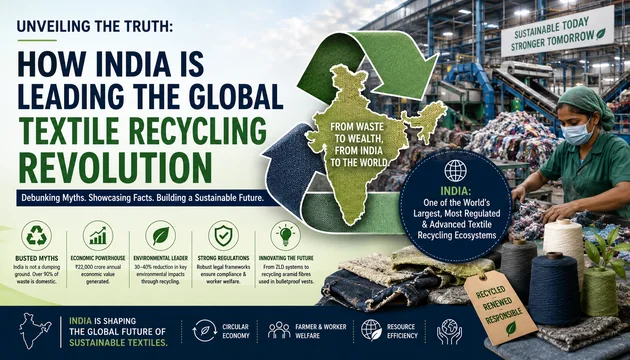
Recently, certain international media reports painted a grim picture of India’s textile recycling hubs, particularly focusing on clusters like Panipat, and labeled the sector as environmentally negligent and structurally exploitative.
However, a closer look at the data — along with a strong rebuttal from the Ministry of Textiles — reveals a very different reality.
Far from being a chaotic dumping ground, India possesses one of the world's largest, most sophisticated, and heavily regulated textile recovery and recycling networks.
In this article, we take a deep dive into the reality of India's textile recycling ecosystem, debunk international myths, and highlight the nation’s growing leadership in the global circular economy movement.
❌ Busted: The “Dumping Ground” Myth
A common narrative pushed by sections of Western media is that India primarily acts as a dumping ground for Western fast-fashion waste.
But the data tells a completely different story.
According to the Ministry of Textiles' “Mapping of Textile Waste Value Chain in India” study:
-
India manages approximately 7.8 million tonnes of textile waste annually.
-
More than 90% of this waste comes from:
-
Domestic pre-consumer waste (factory scrap)
-
Domestic post-consumer waste
-
-
Imported post-consumer waste accounts for only 7% of the total volume.
Even this small imported fraction is strictly regulated under the:
Hazardous and Other Wastes Rules, 2016
The imported material primarily enters highly formalized sorting and recycling ecosystems.
🇮🇳 India’s Circular Economy Strength
India is actually a global leader in material circularity.
An impressive:
♻️ 97% of domestic pre-consumer textile waste is successfully recycled.
This demonstrates a highly efficient reuse and recovery ecosystem rather than uncontrolled dumping.
💰 An Economic and Environmental Powerhouse
Textile recycling in India is not just about waste management.
It is a major contributor to:
-
Resource efficiency
-
Employment generation
-
Environmental sustainability
-
Circular manufacturing
According to a FICCI report:
📈 India’s textile waste ecosystem generates approximately ₹22,000 crore annually.
🌱 Massive Environmental Benefits
The environmental gains are equally significant.
Rigorous Life Cycle Assessment (LCA) studies conducted by researchers at IIT Delhi, using field data directly from the Panipat recycling cluster, show that India’s textile recycling ecosystem helps mitigate:
-
Greenhouse gas emissions
-
Acid rain potential
-
Fossil fuel depletion
📊 Environmental Impact Reduction
Compared to virgin fibre production, textile recycling in India reduces key environmental impacts by:
✅ 30%–40%
Unlike several countries where textile waste ends up in landfills, a substantial proportion of India’s textile waste is:
-
Recovered
-
Repurposed
-
Recycled into new products
⚖️ Strong Regulatory Frameworks and Worker Welfare
Claims that India’s textile recycling industry operates without oversight ignore the extensive legal and regulatory systems already in place.
Textile processing units are regulated under:
-
The Water Act, 1974
-
The Air Act, 1981
These laws require:
✅ Mandatory operational consent from State Pollution Control Boards.
🏛️ Active Enforcement Mechanisms
Authorities like the:
⚖️ National Green Tribunal (NGT)
actively initiate enforcement actions against non-compliant units.
This clearly indicates that India has:
-
A functioning regulatory ecosystem
-
Active environmental oversight
-
Legal accountability mechanisms
👷 Worker Welfare and Labour Protection
Worker welfare is also governed through evolving labour reforms and legal protections.
Key frameworks include:
-
Occupational Safety, Health and Working Conditions Code (2020)
-
Code on Social Security (2020)
These ensure:
-
Workplace safety
-
Health standards
-
Social protection coverage
-
Labour rights compliance
🚀 Pioneering the Future: From Zero-Liquid Discharge to Bulletproof Vests
India’s textile recycling industry is rapidly evolving beyond conventional recycling practices.
The sector is now embracing:
-
Advanced sustainability systems
-
Renewable energy integration
-
High-value technical textile recycling
-
Innovative material recovery technologies
💧 Sustainable Infrastructure
Clusters like Tiruppur are globally recognized for their near-universal adoption of:
🌊 Zero-Liquid Discharge (ZLD) Systems
These systems in dyeing and processing units demonstrate India’s capability to implement environmental standards at industrial scale.
Across states such as:
-
Tamil Nadu
-
Gujarat
-
Haryana
industries are increasingly integrating:
-
Renewable energy
-
Advanced water recycling systems
-
Dust extraction technologies
🛡️ High-Value Technical Textile Recycling
India is also making breakthroughs in recycling materials that many countries still:
-
Incinerate
-
Dump into landfills
The:
🧪 Atal Centre of Textile Recycling and Sustainability (ACTRS) at IIT Delhi
has successfully developed and transferred a first-of-its-kind process for recycling:
🔬 High-performance aramid fibre waste
These materials are commonly used in:
-
Bulletproof vests
-
Military helmets
-
Armoured vehicle components
This innovation marks a major leap toward advanced circular manufacturing in technical textiles.
✅ Conclusion
While no industrial ecosystem is completely free of isolated compliance issues, portraying India’s entire textile recycling sector as structurally flawed is highly misleading.
In reality, the industry is rapidly transitioning toward:
-
Cutting-edge chemical recycling
-
Enhanced formalization
-
High environmental compliance
-
Sustainable circular manufacturing
India is not merely managing textile waste.
🇮🇳 It is actively shaping the global future of sustainable and circular textile economies.
📚 Sources & References
-
Press Information Bureau (PIB) Delhi
Rebuttal on Recent Media Report on Textile Recycling in India
(Ministry of Textiles, May 14, 2026)