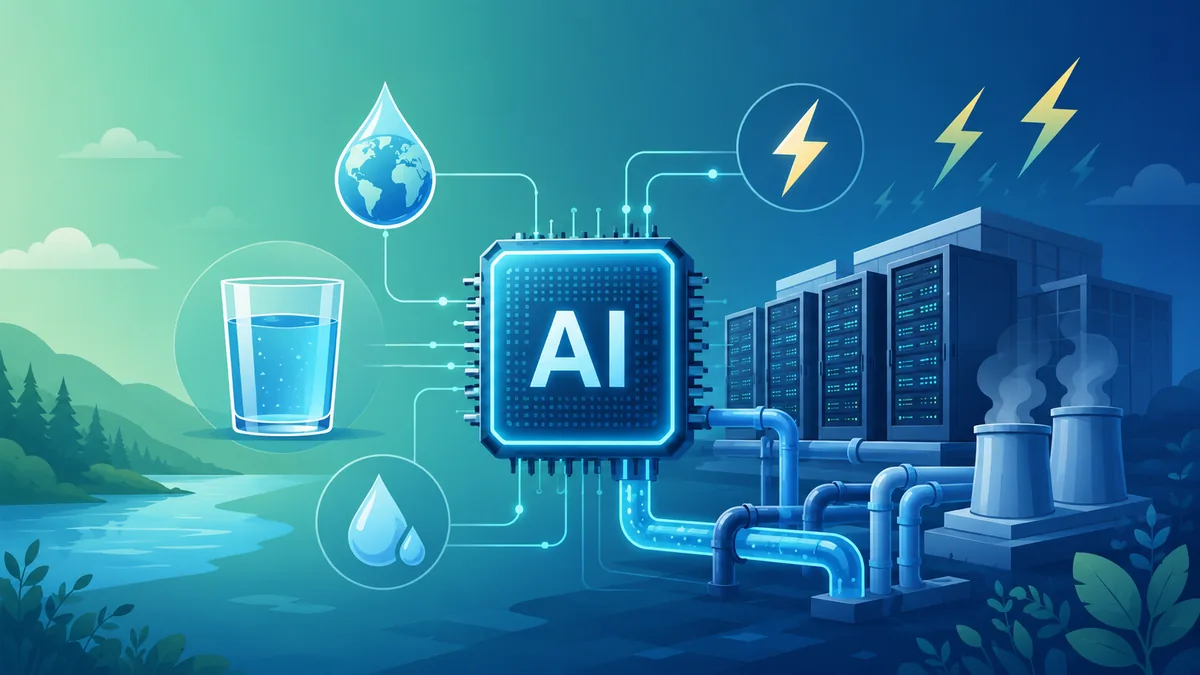
Every time you ask an AI a question, somewhere a data center heats up — and to cool it down, it often uses water. As AI use has exploded, so has scrutiny of its environmental cost. A viral claim that a short chatbot reply "drinks a bottle of water" has collided with industry figures suggesting each query uses barely a few drops. So which is it?
The honest answer: it depends entirely on what you count. Let's separate the hype from the data and look at AI's real water — and energy — footprint in 2026.
The Question Everyone's Asking
AI's resource use has become a mainstream concern because the scale is genuinely large and growing fast. Data centers are being built across dozens of states, some in water-stressed regions, and communities are starting to ask what these facilities cost in water and power. The problem is that public estimates of "how much water does AI use" span three orders of magnitude — which is exactly why the topic is so confusing.
How Much Per Query? The Big Disagreement
Here's the range of published estimates for the water used by a single ChatGPT-style query:
| Source | Estimate per query | What it counts |
|---|---|---|
| OpenAI (Sam Altman) | ~0.3 ml | Direct on-site cooling only |
| NIAIS report | ~5 ml | Operational estimate |
| UC Riverside | ~10–50 ml | Direct + indirect (electricity) |
| UC Riverside (100-word reply) | ~500 ml (a water bottle) | Longer response, full footprint |
That's the crux of the "bottle of water" debate. A short query counting only direct cooling really is a tiny fraction of a teaspoon. A longer reply, measured across the entire system including the water used to make its electricity, can approach a standard bottle. Both can be "true" — they're just measuring different things.
The gap between "a few drops" and "a bottle of water" per AI answer isn't a lie — it's the difference between counting only the data center's cooling and counting the power plant behind it too.
Why AI Needs Water in the First Place
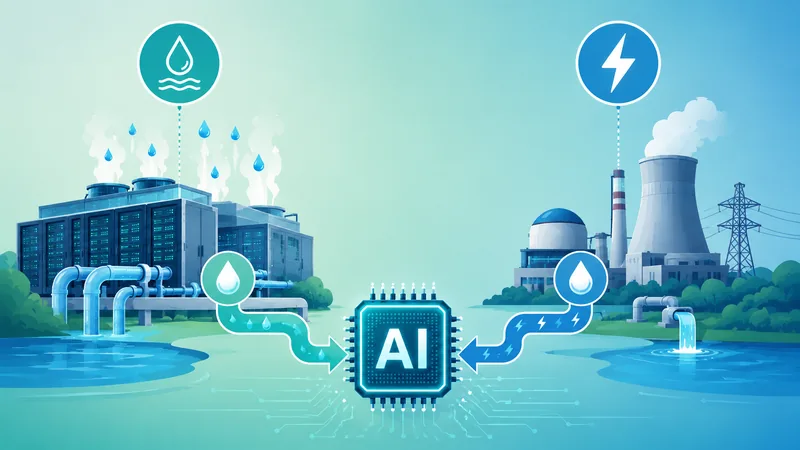
AI consumes water through two distinct channels:
- Direct (cooling). AI servers run hot, and many data centers use evaporative cooling — evaporating water to carry heat away, much like sweating. That water is literally lost to the air.
- Indirect (electricity). The power that runs the servers is generated at plants that often use enormous amounts of water themselves (for steam turbines and cooling). This indirect "embodied" water is usually the larger share, and it's what many headline figures leave out.
There's also a one-time cost: training a model. Training GPT-3 alone was estimated to consume around 700,000 litres of water, and training a frontier model like GPT-5 has been projected to require orders of magnitude more.
The Big Picture: Data Centers
Zoom out from a single query and the aggregate numbers are what matter. A typical data center can use about 300,000 gallons of water a day, and the largest facilities up to 5 million gallons a day — comparable to a small town.
| Metric | Figure |
|---|---|
| Typical data center | ~300,000 gallons/day |
| Large data center | up to ~5 million gallons/day |
| US direct data center water use | ~17 billion gallons/year (~0.3% of public supply) |
| AI share of global data center water (2025) | ~20% (~200 billion gallons) |
| Projected by 2030 | ~400–600 billion gallons |
| Google water use (2023) | 5+ billion gallons; 31% from water-scarce areas |
The concern isn't just the total — it's where the water is drawn. When data centers cluster in already water-stressed regions like parts of Texas or the US Southwest, even a modest national percentage can strain local supplies.
Don't Forget Energy
Water and electricity are two sides of the same coin. Over 4,500 active US data centers consume roughly 176 TWh a year — about 4.4% of all US electricity — with hundreds more under construction. More electricity means more water (to generate it) and, in many cases, more cooling. It also feeds rising power bills and grid strain in some regions.
This is the flip side of the AI price war: as AI gets cheaper and more useful, people use vastly more of it, and total resource consumption climbs even as each query gets more efficient — the same "Jevons paradox" dynamic driving up companies' AI bills.
What's Being Done
The footprint is real, but it's not static — and a lot of work is going into shrinking it:
- Closed-loop and zero-evaporation cooling. Microsoft has started building data centers that recirculate coolant with little or no water evaporation, and cut potable water use by 97% at one facility.
- Water replenishment. Google and others fund projects to return water to stressed watersheds, aiming to replenish more than they consume.
- Smarter siting and timing. Building in cooler climates, using recycled or non-potable water, and scheduling heavy workloads for cooler hours all reduce evaporation.
- Smaller, cheaper models. The shift toward efficient small models for routine tasks (instead of giant ones for everything) cuts compute — and therefore water and power — per task.
Frequently Asked Questions
How much water does one ChatGPT query use?
Estimates vary widely depending on what's counted. OpenAI's Sam Altman has said an average query uses about 0.3 ml of water, counting only direct on-site cooling. Independent researchers at UC Riverside estimate far more — on the order of 10 to 50 ml per prompt, and roughly 500 ml (about a standard water bottle) for a longer 100-word response — because they also include the water used to generate the electricity the data center consumes.
Why do estimates of AI water use vary so much?
The biggest reason is scope. "Direct" water use counts only what evaporates in a data center's cooling system. "Indirect" water use also counts the water consumed by power plants to generate the electricity those data centers run on, which is often far larger. Numbers also depend on the model, the prompt length, the local climate, and how a given data center is cooled — so a single headline figure can be misleading.
Why does AI need water at all?
Two reasons. First, the servers running AI generate enormous heat, and many data centers use evaporative cooling — literally evaporating water to keep chips from overheating. Second, the electricity powering those servers is often produced at power plants that themselves consume large amounts of water. So AI "drinks" water both directly (cooling) and indirectly (electricity generation).
How much water do data centers use overall?
A typical data center can use around 300,000 gallons of water a day, and the largest can use up to 5 million gallons a day. Direct US data center water use is roughly 17 billion gallons a year. Analysts estimate AI accounts for about 20% of global data center water use (~200 billion gallons in 2025), potentially rising toward 400–600 billion gallons by 2030 as demand grows.
What is being done to reduce AI's water use?
Tech companies are shifting to closed-loop and zero-water-evaporation cooling, locating data centers in cooler climates, using recycled or non-potable water, and timing heavy workloads for cooler hours. Microsoft has begun building zero-water-evaporation data centers and cut potable water use by 97% at one site, while Google has invested in water-replenishment projects. Cheaper, smaller AI models that use less compute per task also help reduce the overall footprint.
Final Thoughts
AI's water footprint is neither a myth nor an apocalypse — it's a real, growing cost that's often misrepresented in both directions. A single short query is genuinely tiny; billions of them, plus model training, plus the power behind it all, add up to a serious resource demand concentrated in specific places. The most useful thing you can do as a reader is treat any single "X ml per query" headline with skepticism and ask what it actually measures.
The encouraging part is that efficiency is improving fast — in cooling, in siting, and in the models themselves. We'll keep covering the real-world impact of AI alongside the technology. For more, see our explainers on the 2026 AI price war and agentic AI.