Best Web Analytics Tools in 2026: GA4, Clarity, Plausible, Matomo & More

Tracking who visits your website, where they come from and what they do used to mean one answer: Google Analytics. In 2026 there's more choice. Google replaced Universal Analytics with GA4 in 2023, Microsoft's free Clarity gives everyone heatmaps and session replay, and privacy-first tools like Plausible, Fathom and Umami now cover most small sites without cookies. This guide compares the 10 best web analytics tools for 2026, with their real free plans and starting prices from each vendor's pricing page, plus what changed this year.
Best web analytics tools in 2026 (at a glance)
| Tool | Free plan | Entry paid plan | Best for | Cookies |
|---|---|---|---|---|
| Google Analytics 4 (GA4) | Free | Analytics 360: price on request | Most sites, Google Ads users | Uses cookies (consent mode) |
| Microsoft Clarity | Free forever | None | Heatmaps and session replay | Uses cookies; consent enforced in EEA/UK/CH |
| Plausible Analytics | 30-day trial | $9/month (10k pageviews) | Privacy-first simple stats | No cookies |
| Fathom Analytics | 7-day trial | $15/month (100k pageviews) | Many sites on one bill | No cookies |
| Matomo | Free self-hosted | Cloud from 50,000 hits/month | Full data ownership | Configurable |
| Cloudflare Web Analytics | Free | None | Free, light stats | No cookies |
| Umami | Free self-hosted or Hobby cloud | $20/month (1M events) | Open-source, self-hosted | No cookies |
| PostHog | 1M events + 5K recordings/month | Usage-based | All-in-one product analytics | Optional cookieless mode |
| Mixpanel | 1M events/month | Growth from $0, usage-based | Product funnels and retention | Uses cookies |
| Amplitude | 2M events/month | Plus from $0, usage-based | Product analytics at scale | Uses cookies |
Prices are from each vendor’s pricing page on November 23, 2026; cookie behaviour is as each vendor describes it.
1. Google Analytics 4: still the default for most sites
Google Analytics 4 is free: Google says it gives businesses its measurement tools free of charge, and its terms set no hit cap for GA4. Data is event-based, so any interaction can be captured as an event, and it connects to Google Ads, Search Console and BigQuery. Free properties keep user-level data for 2 or 14 months (26, 38 or 50 months is only on Analytics 360), and the daily BigQuery export is capped at 1 million events, though streaming export has no event limit. GA4 does have a bounce rate metric, the share of sessions that weren't engaged, but most reports don't show it until you add it, and Google says IP masking isn't needed because GA4 doesn't log or store IP addresses.
Three 2026 updates are worth knowing: since May 13, 2026, GA4 sorts traffic from AI assistants such as ChatGPT, Gemini and Claude into a new AI Assistant channel; Dashboards arrived on September 9, 2026; and Data Manager launched in beta on November 6, 2026. The paid tier, Analytics 360, has no published price.
2. Microsoft Clarity: free heatmaps and session replay
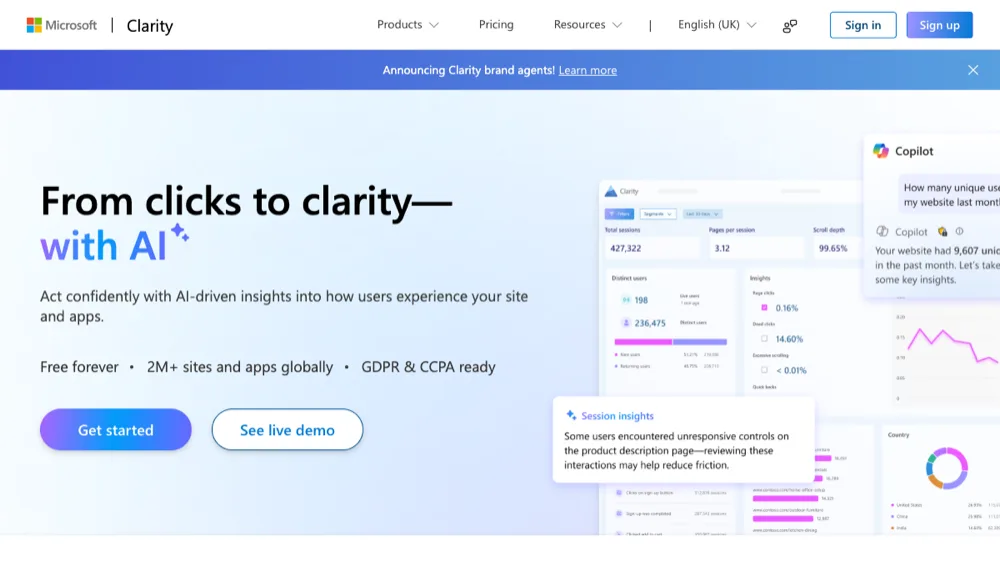
If you've wondered what Microsoft's analytics tool is, it's Microsoft Clarity. Microsoft says it's free forever with no traffic limits; its pricing page explains that Microsoft uses the anonymous behaviour data to improve the machine-learning models behind its products. Clarity shows what visitors do rather than how many came: session recordings, click and scroll heatmaps, and rage-click and dead-click insights, and it integrates with GA4. Its documentation says it records up to 100,000 sessions per project per day, each heatmap is limited to 100,000 page views, and recordings are kept for 30 days (favorites and a random sample for up to 9 months).
Clarity isn't cookie-free: it normally sets first-party cookies (_clck, _clsk) and third-party ones such as MUID. Since October 31, 2025, it enforces consent signals for visits from the EEA, the UK and Switzerland, with Consent Mode on by default there, and without consent it can't follow a visitor's journey across pages.
3. Plausible Analytics: the privacy-first favourite
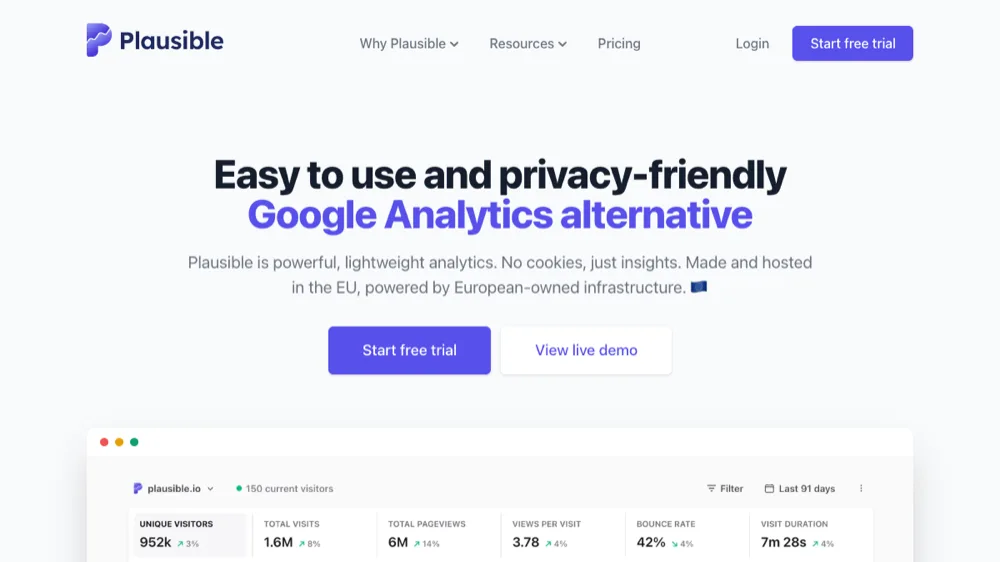
Plausible says it uses no cookies and no persistent identifiers, and that sites using it don't need cookie banners or GDPR consent. Its Starter plan is $9 a month for up to 10k monthly pageviews (not visitors) with no data retention limit, after a 30-day free trial with no card. Plausible says its script is 2.5KB, and it stores visitor data on Hetzner servers in Falkenstein, Germany. If you'd rather run it yourself, Plausible Community Edition is a free, self-hosted AGPL release.
4. Fathom Analytics: simple stats for many sites
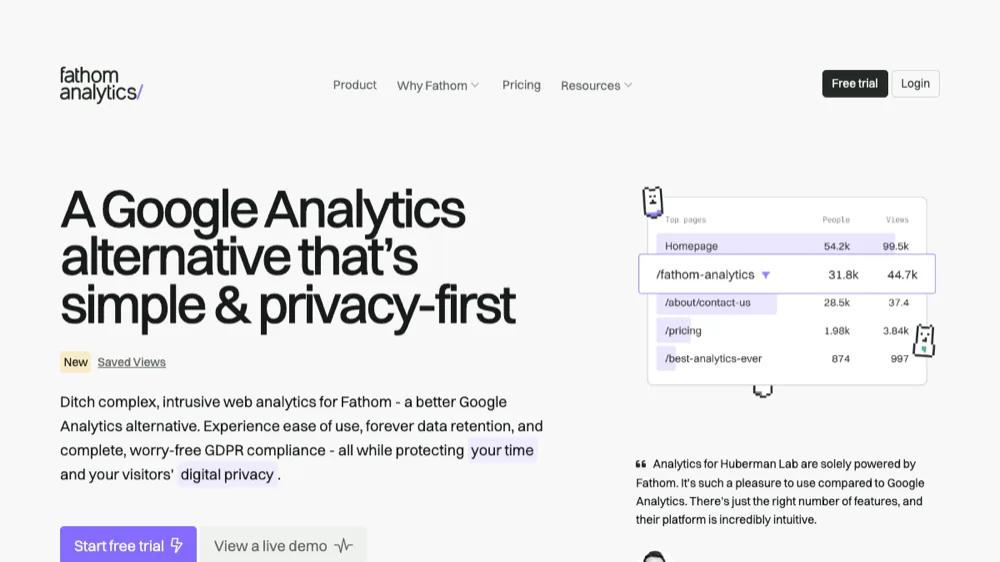
Fathom Analytics covers the same ground as Plausible with a polished dashboard. Its cheapest plan is $15 a month for up to 100,000 monthly pageviews and includes 50 sites, with more in packs of 50 for $10 a month, which suits agencies and people with many small sites. There's no free plan, only a 7-day trial that needs a card. Fathom, a Canadian company, says it uses no cookies; it processes EU visitors' data in the EU and anonymizes it before sending it to the US, and keeps your data for as long as you're a customer. Fathom itself cautions that being cookie-free doesn't automatically put analytics outside every country's device-access consent rules.
5. Matomo: full data ownership
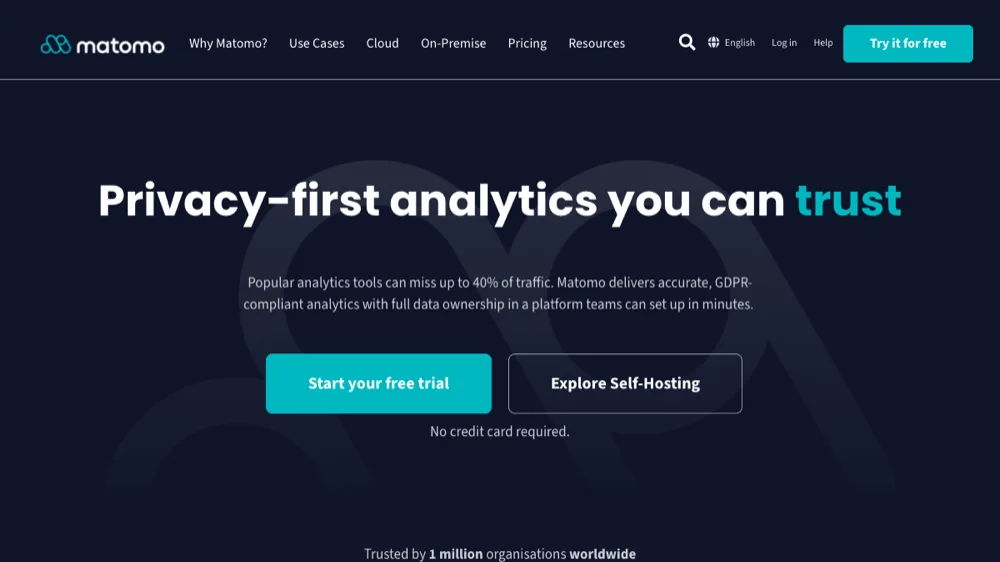
Matomo grew out of Piwik, started in 2007, and took the Matomo name in 2018. The On-Premise Community edition is free forever with unlimited users and hits under the GPL v3, and needs PHP 8.1+ with MySQL 8.0+ or MariaDB 10.6+. Matomo Cloud starts with a 50,000-hits-a-month plan priced in your local currency, stores data in Frankfurt, Germany, keeps raw data for 24 months on the Business plan and has a free trial with no card. Note that on the self-hosted version, heatmaps and session recording are a paid add-on bundle rather than part of the free edition.
6. Cloudflare Web Analytics: free and light
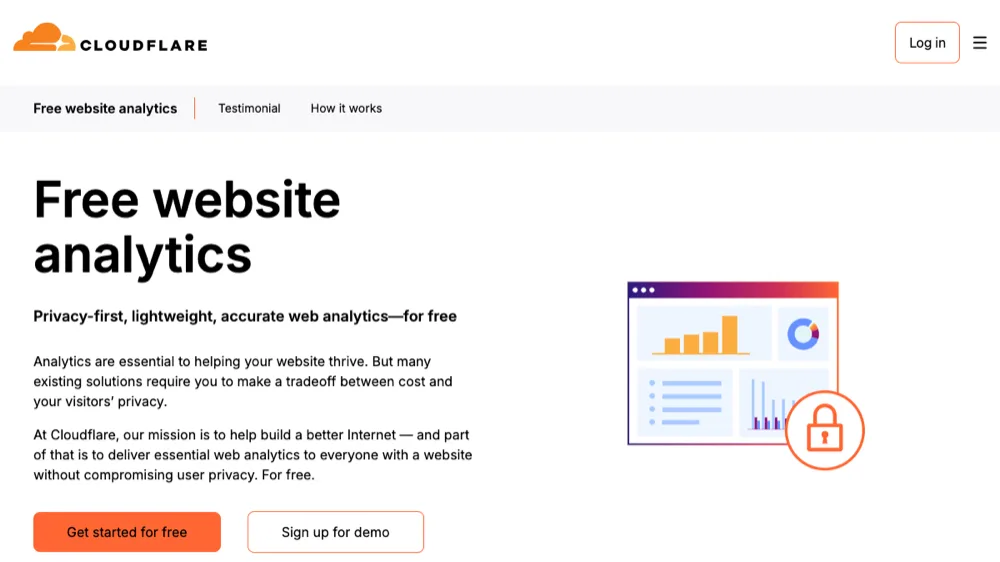
Cloudflare Web Analytics is free and uses no cookies or localStorage. It collects data with a small JavaScript beacon, which Cloudflare injects automatically on sites it proxies, and Cloudflare says it only displays client-side analytics. You don't need Cloudflare's proxy to use it: it works without changing your DNS, for up to 10 non-proxied sites. You can view the previous six months, and after 7 days the data is aggregated to a roughly 10% sample, so treat it as a light dashboard, not a full analytics suite.
7. Umami: open-source and simple
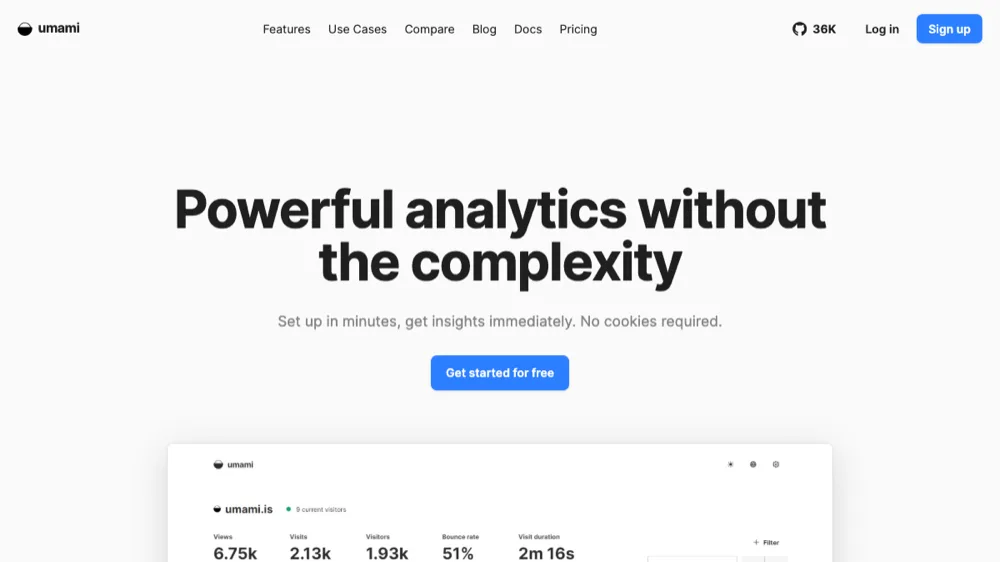
Umami is an MIT-licensed open-source alternative to Plausible that works without cookies. You can self-host it for free (it needs Node.js 20.19+ and a PostgreSQL 12.14+ database), or use Umami Cloud: the free Hobby plan covers up to 100K events a month with 6 months of data, and Pro costs $20 a month for 1 million events and 2 years of data.
8. PostHog: all-in-one product analytics
PostHog bundles web and product analytics, session replay, feature flags, experiments, surveys and heatmaps. Every month the free tier includes 1M analytics events, 5K session recordings, 1M feature flag requests and 1500 survey responses, and PostHog says 97% of companies use it for free; beyond that you pay only for what you use. Free plans keep events for 1 year and recordings for 1 month. It has an optional cookieless mode for web analytics, and a free MIT-licensed self-hosted version that PostHog says is officially unsupported.
9. Mixpanel: product funnels and retention
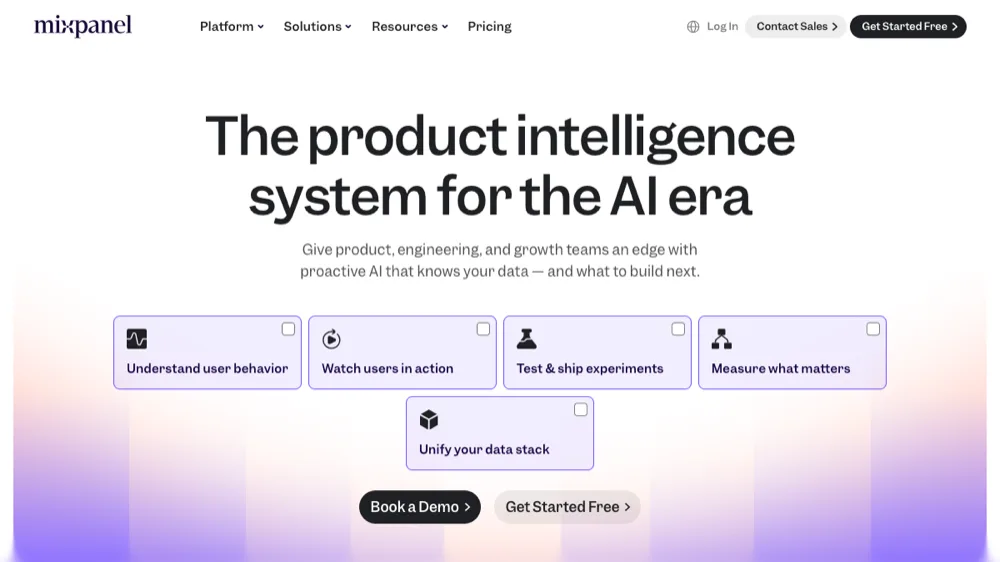
Mixpanel answers "what do users do inside the product". Its Free plan includes up to 1M events a month, unlimited seats, funnels and retention analysis, and 10K session replays. The Growth plan starts at $0 with the first 1M events included, and 1.5M events a month costs $100 a month billed yearly. Its JavaScript SDK uses a cookie that lasts 365 days by default, so plan for consent in the EU. Use it alongside a web analytics tool rather than instead of one.
10. Amplitude: product analytics at scale
Amplitude is Mixpanel's main rival for product analytics, with a more generous free tier: its Free plan includes 2M events a month, and Plus starts at $0 with the first 2M events a month free. Pick it if your team needs product analytics at scale and wants room to grow on the free plan.
Best lightweight analytics tools (simple website statistics trackers)
If you just want a lightweight website statistics tracker that shows visitors, top pages, referrers and countries without slowing your pages, skip GA4's complexity. Plausible's script is 2.5KB and GoatCounter's adds about 3.5KB; Cloudflare Web Analytics is free and needs only a small beacon; and Umami and Pirsch track pageviews without cookies. These lightweight analytics tools give you the simple traffic stats most blogs and small business sites need on one dashboard.
Other tools worth a look
- Simple Analytics: privacy-first, with a free plan for hobby sites that keeps 1 month of history.
- Pirsch: cookie-free analytics from $6 a month for 10,000 monthly page views.
- GoatCounter: free for reasonable public use, with a script that adds about 3.5KB.
- Contentsquare: now home to Hotjar and Heap, with a Free plan for 200k monthly sessions.
- Vercel Web Analytics: 50,000 events a month on Vercel's free Hobby plan, then $0.03 per 1K events on Pro.
- Statcounter: its Basic plan is free forever.
- Clicky: still actively developed; it announced an MCP server and agent-ready support on November 19, 2026.
Tools that changed or closed
- Universal Analytics, the original Google Analytics, stopped processing hits on July 1, 2023, and from the week of July 1, 2024 its data became inaccessible.
- Hotjar no longer accepts new accounts; new users sign up on Contentsquare.
- Heap is now part of Contentsquare.
- Piwik is now Matomo.
How to pick
- Default for most sites: GA4 (free, with Google Ads and Search Console integration) plus Microsoft Clarity (free heatmaps and session replay).
- Privacy-first, simple stats: Plausible or Fathom; Umami or GoatCounter if you want it free.
- Full data ownership: self-hosted Matomo, Umami or Plausible Community Edition.
- Product and SaaS analytics: PostHog, Mixpanel or Amplitude, alongside a web analytics tool.
- Zero cost, minimal setup: Cloudflare Web Analytics.
Frequently asked questions
Is GA4 free or paid?
GA4 is free: Google says Google Analytics gives businesses its measurement tools free of charge, and its terms set no hit cap. The paid version, Analytics 360, adds longer data retention (26, 38 or 50 months) and higher limits, and Google publishes no price for it.
What is the Microsoft analytics tool?
Microsoft's web analytics tool is Microsoft Clarity. It's free forever with no traffic limits, and it records sessions and builds click and scroll heatmaps so you can see how visitors use your pages. It integrates with GA4, and since October 31, 2025 it enforces consent for visitors from the EEA, the UK and Switzerland.
What are the top 5 web analytics tools?
For most sites in 2026: Google Analytics 4 (free, the default), Microsoft Clarity (free heatmaps and session replay), Plausible ($9 a month, cookie-free), Matomo (free self-hosted, full data ownership) and PostHog (free tier with 1M events and 5K recordings a month).
Do I need a cookie consent banner for these tools?
It depends on the tool and the country. Plausible, Fathom, Umami and Cloudflare Web Analytics say they use no cookies, and Plausible says sites using it don't need a banner. GA4, Clarity and Mixpanel use cookies, so EU and UK visitors need to consent; Google's EU user consent policy covers the EEA, the UK and Switzerland. Even cookie-free tools aren't automatically exempt everywhere: Matomo says strict ePrivacy laws can require consent, while France's CNIL exempts audience measurement that produces only anonymous statistics.
How do I create a Google Analytics account?
Sign in at analytics.google.com with a Google account, create an account and a GA4 property, add a web data stream for your site, then install the Google tag on every page (directly, through Google Tag Manager or through your CMS's plugin). Data starts appearing in the Realtime report once the tag is live.
What replaced Universal Analytics?
Google Analytics 4. Standard Universal Analytics properties stopped processing hits on July 1, 2023, and from the week of July 1, 2024 their data became inaccessible. GA4 uses an event-based model, so old reports had to be rebuilt.
Is Google Analytics legal under GDPR?
Many EU sites use it with visitor consent. The EU-US Data Privacy Framework, adopted on July 10, 2023, covers data transfers to the US, and on September 3, 2025 the EU General Court dismissed a challenge to it. Google's EU user consent policy still requires consent from visitors in the EEA, the UK and Switzerland.
Can I use more than one analytics tool on the same site?
Yes, and it's common: many teams run GA4 for traffic and acquisition, Microsoft Clarity for heatmaps and session replay, and PostHog or Mixpanel for in-product events. Check that each one is covered by your consent banner.
For more growth and SEO guides, see our 12 free keyword research tools, Google Search Console tips for new bloggers, the best SEO tools, and how to create high-quality SEO content that drives traffic.