Diabetic Retinopathy Monitoring During Semaglutide Treatment: An Old Phenomenon in a New Context
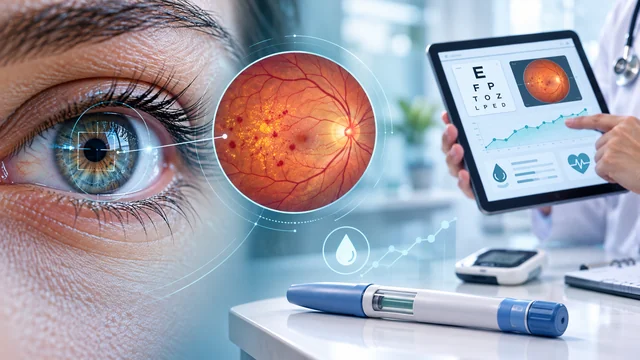
In a cardiovascular outcomes trial running over 104 weeks, participants receiving semaglutide showed a significantly higher risk of diabetic retinopathy complications, including vitreous haemorrhage, blindness or the need for procedural treatment, with a hazard ratio of 1.76 against placebo. A meta-analysis of 13 randomised controlled trials covering several agents in the class found an association with rapid worsening of diabetic retinopathy in type 2 diabetes, with an odds ratio of 1.23, a relative increase of roughly 23 percent.
Those findings are real and they are specific. They apply to people who have diabetic retinopathy, and the mechanism implicated is not thought to be the drug acting on the retina.
Early worsening predates this drug class by decades
The phenomenon at issue is early worsening of retinopathy following rapid improvement in glycaemic control, and it has been documented since the landmark intensive-control trials of the 1980s and 1990s. Rapid correction of long-standing hyperglycaemia can precipitate transient progression of existing retinopathy, with the mechanism thought to involve haemodynamic and growth-factor changes in a retinal vasculature that had adapted to a chronically high glucose environment.
The clinical lesson from that older literature was not that intensive control is harmful. Intensive control produces substantial long-term reduction in retinopathy progression. The lesson was that the benefit is preceded by a window of risk in patients who already have significant retinal disease, and that the window is manageable if it is anticipated.
A drug class that produces large and relatively rapid improvements in glycaemia in people with established diabetes would be expected to reproduce that pattern. The trial findings are consistent with it.
Why this matters differently in weight management
The global GLP-1 telehealth platforms market is valued at roughly 0.76 billion US dollars in 2026 and projected to reach 2.12 billion by 2033, a compound annual growth rate near 15.7 percent. A large proportion of that volume is weight management in people without diabetes, which is a different risk population from the diabetes trials where the retinopathy signal was identified.
Someone without diabetes does not have diabetic retinopathy, and a mechanism that depends on rapid correction of chronic hyperglycaemia does not operate in a normoglycaemic person. The relevance of the signal is therefore concentrated in a specific and identifiable subgroup: patients with type 2 diabetes, particularly those with longer disease duration, higher baseline glycated haemoglobin and pre-existing retinopathy.
The group most often missed
The practical gap is patients who have diabetes and do not know the state of their retinas. Diabetic retinopathy is asymptomatic until it is advanced, which is the entire reason screening programmes exist. A patient entering weight management with undiagnosed retinopathy and an elevated glycated haemoglobin is in the subgroup the trials identified, and nothing about their presentation will reveal that unless someone asks about their last retinal examination.
This is a more significant practical issue in remote care, where the intake assessment is a questionnaire and a conversation rather than a records review. Coverage friction compounds it: with 62.4 percent of weight-loss GLP-1 pharmacy claims rejected between January 2021 and October 2024, many patients arrive through routes that bypass their usual medical records.
What proportionate monitoring looks like
Ophthalmological guidance in this area has converged on a reasonably consistent position. For patients with diabetes, retinal status should be established before or around initiation rather than assumed, and patients with existing retinopathy warrant closer follow-up through the period of most rapid glycaemic improvement. Where retinopathy is significant, a slower pace of glycaemic correction is a recognised mitigation, which makes this another instance where the rate of change is the variable to manage rather than the destination.
Patients without diabetes do not require retinal monitoring on this basis. Extending surveillance to them adds cost and anxiety without addressing the mechanism in question, and it dilutes attention from the group where it matters.
Symptoms that warrant prompt assessment
Independently of scheduled screening, certain visual symptoms require prompt ophthalmological assessment in anyone with diabetes: new floaters, a sudden increase in floaters, loss of vision whether partial or complete, distortion of straight lines, or a dark area in the field of vision. These are the presentations of vitreous haemorrhage and macular involvement, and they are time-sensitive in a way that scheduled screening is not.
How this works in practice
Translating the evidence into a workflow requires two pieces of information at intake: whether the patient has diabetes or significantly elevated glycated haemoglobin, and when they last had a dilated retinal examination or retinal photography. Those two answers sort patients into the group that needs retinal status established before rapid glycaemic improvement and the much larger group that does not.
Programmes that run a structured clinical intake rather than a product-selection flow are positioned to capture this. The TrimRx weight loss program operates a clinician-led telehealth model in which medical history is reviewed by a prescribing clinician before treatment is initiated, which is the point at which a diabetes history and a retinal screening gap can actually change a decision. The value is not in adding a test for everyone. It is in identifying the minority for whom the question is live.
Where that minority is identified, the management is coordination rather than complexity: establish retinal status, involve ophthalmology where retinopathy is present, and treat the pace of glycaemic correction as adjustable.
Reading the trial findings in proportion
Two errors are available here and they are symmetrical. One is to dismiss a hazard ratio of 1.76 for sight-threatening complications as a statistical artefact, when it emerged from a randomised trial in exactly the population where the mechanism predicts it. The other is to generalise a finding from long-duration type 2 diabetes with established retinopathy to a normoglycaemic adult seeking weight management, and to generate monitoring burden and alarm that the evidence does not support.
The signal is narrow, mechanistically coherent, consistent with four decades of prior observation about intensive glycaemic control, and addressable by asking two questions at intake.
A known risk with a known answer
Early worsening of retinopathy is among the few risks in this field where the mechanism, the affected population and the mitigation were all established before the drug class existed. What the current evidence adds is a reminder that the old lesson applies to any intervention capable of improving glycaemia quickly.
The failure mode is not the risk itself but the intake process that does not ask about retinal screening, because a patient in that subgroup looks identical to everyone else until their vision changes.
This article is general information about clinical research and treatment practice. It is not medical advice. Decisions about prescription medication, eye screening or the investigation of visual symptoms should be made with a qualified clinician.