When the Paralegal Catches What the Radar Log Missed
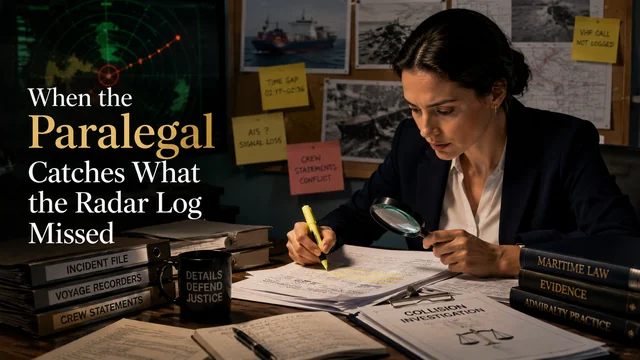
A courtroom outcome often gets credited to the attorney standing at the podium, but the difference between a case that falls apart and one that holds together frequently traces back to someone who never says a word in front of the judge. In traffic defense practices, that person is usually a paralegal, a legal assistant, or an investigator who spent hours cross-checking calibration records, timestamps, and officer notes long before anyone walked into a hearing. Their work rarely appears in the transcript, yet it shapes almost everything that happens there.
The Invisible Layer Beneath Every Case
Traffic law moves fast. Citations pile up, deadlines are unforgiving, and courts expect filings to be exact down to the date format. Behind every attorney managing a full docket of these cases sits a support team responsible for gathering evidence, requesting maintenance logs on speed detection equipment, and confirming that an officer's certification was current on the date of the stop. When that groundwork is sloppy, even a skilled advocate walks into court with a weaker hand. When it is meticulous, the attorney can build an argument on details that the prosecution never anticipated being challenged.
This is where craftsmanship becomes visible, not in dramatic courtroom moments but in the quiet accumulation of accuracy. A legal assistant who notices that a radar unit's calibration certificate expired eleven days before a citation was issued has just handed the defense a foundation. A paralegal who catches a discrepancy between the time listed on a citation and the time logged in dispatch records has done the same. These are not glamorous discoveries, but they are the difference between a case built on assumption and one built on proof.
Why the Support Role Gets Overlooked
Legal support staff rarely receive public credit because their contributions are structural rather than performative. Nobody applauds a well-organized case file. Yet the profession that trains and employs these workers is substantial and growing, and the Bureau of Labor Statistics tracks employment trends among paralegals and legal assistants as a distinct occupational category, reflecting how central this work has become to modern legal practice. In firms handling high volumes of traffic citations, that support staff often determines whether a case moves efficiently through the system or stalls under avoidable errors.
The overlooked nature of the role is partly a matter of visibility. Clients see the attorney who negotiates on their behalf or argues before a judge. They rarely see the person who spent an afternoon requesting body camera footage from a police department, following up when the request was ignored, and then reviewing hours of footage frame by frame to locate the ten seconds that mattered. That labor happens off camera, literally and figuratively, but it is often what separates a case resolved favorably from one that drags on without resolution.
Where Precision Becomes Strategy
Excellent traffic defense work is rarely about a single dramatic argument. It is about the compounding effect of small, correct decisions made early. Consider a driver contesting a citation for running a red light based on a camera system. The attorney's strategy depends entirely on whether the support team obtained the full technical specifications for that intersection's signal timing, cross-referenced them against state standards, and identified any gap between how the system is supposed to function and how it actually performed that day. Without that groundwork, the attorney is arguing from instinct. With it, the attorney is arguing from evidence.
This same pattern holds across a wide range of citations, from speeding to improper lane changes to more serious moving violations. A driver who searches for a traffic lawyer after receiving a citation is usually focused on finding someone who can speak persuasively in court, and rightly so. But the persuasive argument is only as strong as the file supporting it, and that file is typically assembled by a team working well before any hearing date arrives. The attorney who succeeds consistently is often the one who has built a support system capable of doing this preparation at a high standard, case after case, without shortcuts.
The Coordination Nobody Sees
Beyond the paralegals and legal assistants, traffic defense firms rely on court runners, records clerks, and scheduling coordinators who keep the mechanical side of the process moving. Someone has to confirm that a continuance request was filed correctly, that a client's court date was recalculated after a delay, that a subpoena for equipment maintenance records reached the right department within the right window. These tasks are procedural rather than strategic, but procedural failures can undo strategic advantages just as easily as a weak argument can.
Excellent firms treat this coordination as a craft in its own right, not as an afterthought. They build systems that catch errors before they become problems, cross-check filings against court calendars, and maintain relationships with clerks and records departments that make routine requests move faster. Adequate firms often lack this infrastructure, relying instead on individual effort that varies from case to case. The gap between the two approaches is rarely obvious to a client until something goes wrong, which is precisely why the strong version of this work is so easy to overlook when it functions properly.
What Separates the Two Standards
The distinction between adequate and excellent traffic defense work ultimately comes down to whether the support structure behind the attorney is treated as essential or incidental. Firms that invest in training their legal assistants to understand technical evidence, that give paralegals real ownership over case preparation, and that build reliable systems for records requests tend to produce consistently stronger outcomes. Firms that treat support roles as purely administrative tend to see more inconsistency, because the quality of each case depends heavily on which attorney happens to be handling it that week.
None of this diminishes the skill required to argue a case persuasively in front of a judge. It simply widens the picture of where that skill comes from. The strongest courtroom performances are built on foundations laid by people whose names rarely appear anywhere in the case file's public record, but whose attention to detail determines what arguments are even available to make.
The next time a traffic citation gets resolved favorably, it is worth remembering that the moment in court was likely the shortest part of the process. The longer, quieter work happened earlier, in the hands of people whose job was to notice what everyone else might have missed.