Steep Roofs in the Mountains, Flat Roofs in the Plains — How Regional Craftsmanship Shapes Every Roof
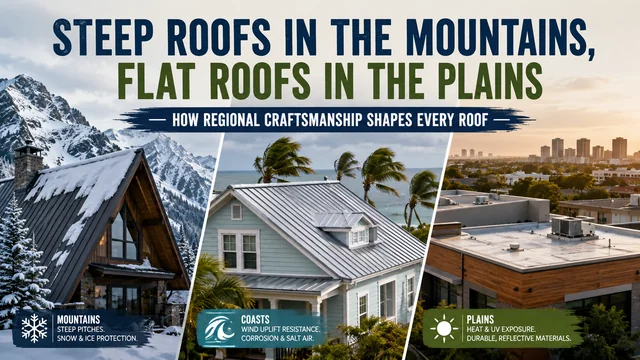
Ask a roofer in coastal Florida what separates a good roof from a great one, and the answer will sound nothing like what you would hear from a roofer working the snow country of northern Minnesota. Both are talking about excellence, but the materials, techniques, and priorities that define it shift with the climate overhead. Craftsmanship in roofing has never been a single standard applied uniformly across the country. It is a set of principles interpreted through local weather, local building traditions, and decades of hard-won regional experience.
Why Climate Rewrites the Rulebook
A roof in Arizona faces a different set of demands than one in Vermont, and the difference goes far beyond aesthetics. Intense sun and extreme heat cycles cause materials to expand and contract in ways that shorten the lifespan of poorly chosen shingles, so desert-region installers lean on reflective coatings and materials engineered to resist UV degradation. In the upper Midwest and Northeast, the enemy is ice, and the craftsmanship conversation centers on ice and water shield membranes, proper attic ventilation to prevent ice damming, and steep pitches that shed snow before it accumulates into dangerous loads. Along the Gulf Coast and Atlantic seaboard, wind uplift resistance and fastening patterns become the defining skill, since a roof that survives one hurricane season and fails the next was never built to the standard the region actually requires. Excellent work, in every case, means understanding what the sky above a specific address will demand over the next twenty years, not simply installing a product according to a generic instruction sheet.
Regional Materials, Regional Instincts
Walk through older neighborhoods in different parts of the country and the rooflines themselves tell a story. Clay tile dominates in the Southwest and parts of the South, chosen for its heat resistance and centuries-long track record in hot, dry climates. Slate persists in parts of New England, prized for durability against harsh winters even though it demands specialized installation knowledge that fewer contractors carry with each passing generation. Wood shake, once common in the Pacific Northwest, has given way in many areas to metal and composite products that better resist the region's persistent moisture. Craftsmen who work primarily in one region develop an instinct for these materials that goes beyond manufacturer specifications. They know how a particular clay tile behaves after a decade of freeze-thaw cycles it was never quite designed for, or how a metal panel system performs against the salt air a few miles inland from where it performs beautifully on the coast. That accumulated, hyperlocal judgment is a form of craftsmanship that cannot be taught from a national training manual alone.
The Hidden Work That Separates Good From Great
Most homeowners judge a roof by what they can see from the curb, but the difference between adequate and excellent work usually lives in details nobody notices until something goes wrong. Flashing around chimneys and skylights, the sequencing of underlayment layers, the placement of ventilation intake and exhaust, the fastening schedule matched to local wind ratings, these are the elements that separate a roof that merely looks finished from one that performs for its full expected lifespan. In hail-prone regions of the Midwest, skilled installers pay particular attention to impact-resistant shingle ratings and the underlying decking condition, because a roof that survives a storm cosmetically intact but suffers unseen mat fracturing will fail years earlier than expected. In humid Southern climates, proper attic ventilation prevents moisture buildup that can rot decking from the inside, a problem that has nothing to do with the shingles themselves. Craftsmanship, in other words, is disproportionately invisible, and the regions with the harshest climates tend to produce the most rigorous attention to these unseen fundamentals because the consequences of skipping them show up faster and more visibly.
How Local Codes Reflect Local Lessons
Building codes for roofing are not written in a vacuum. They evolve from decades of regional experience, often written in direct response to failures that revealed a gap between common practice and what a given climate truly requires. Coastal counties have tightened wind uplift and fastening requirements after successive storm seasons exposed weaknesses in older installation standards. Mountain communities with heavy snow loads maintain structural requirements calibrated to loads that would be unnecessary two states south. This is one reason why roofing companies operating across multiple states often maintain region-specific training programs rather than applying a single national protocol everywhere, since the code minimums and the craftsmanship expectations built on top of them genuinely differ by geography. The Occupational Safety and Health Administration oversees the workplace safety standards that apply to roofing crews nationwide, but the technical building requirements layered on top of that safety foundation are shaped locally, refined by regions that have learned through direct experience what their particular climate can and cannot forgive.
Skill That Travels, Judgment That Stays Local
None of this means the fundamentals of the trade are regional. Proper flashing technique, careful attention to fastening patterns, and a disciplined approach to sequencing work in the correct order apply everywhere a roof is built. What changes is judgment, the accumulated sense of which risks matter most in a given place and how much margin to build into a job to account for local conditions. A crew that has spent fifteen years working through Rocky Mountain winters develops a different intuition about snow load and ice management than a crew that has spent that same fifteen years managing salt air corrosion on the Outer Banks. Both crews can be equally skilled, equally committed to excellent work, and equally proud of their craft, while approaching a roof with entirely different priorities shaped by geography. Recognizing this regional dimension of craftsmanship helps homeowners understand why a recommendation that makes sense in one climate might be entirely wrong in another, and why local experience carries real weight when evaluating the quality of roofing work.
The roof over any home is ultimately a response to the specific weather it must withstand, built by people who have learned, often through years of direct regional experience, exactly what that weather demands. That regional knowledge, layered on top of universal fundamentals of the trade, is what turns a merely adequate installation into one that quietly performs for decades. Understanding this distinction gives homeowners a better lens for judging the work being done above their own heads, wherever they happen to live.