SIP Panel Manufacturing Equipment: Inside Gluestream's Production Lines
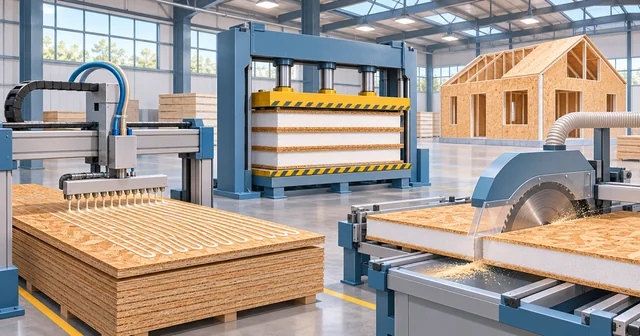
Structural insulated panels, or SIPs, have been used in construction since the middle of the last century, but the way they are made has changed a great deal. A SIP is a sandwich: two rigid skins, usually oriented strand board (OSB), magnesium oxide board or gypsum fibre board, bonded to a foam core of expanded polystyrene (EPS) or polyurethane. The quality of that bond decides whether a wall panel carries its load for decades or starts to delaminate, so the machinery that spreads the glue, presses the stack and cuts the finished panel matters as much as the materials themselves.
Gluestream is one of the companies that builds that machinery. Headquartered in Nitra, Slovakia, with an office in Tallahassee, Florida, and representative offices in Poland and Spain, it designs and produces adhesive-application equipment and complete production lines for SIPs and other sandwich panels. Its sales geography lists SIP machinery customers from Canada and the United States to Argentina, Chile, South Africa, the UK, China, Mongolia and Australia, which puts its equipment on every inhabited continent.
What a SIP factory actually needs
SIP Equipment from Gluestream is sold as a set rather than as single machines, because a panel passes through several stations before it leaves the factory. The company groups a standard set into three parts:
- Laminating and pressing machinery that applies polyurethane (PUR) adhesive to the skins and holds the stack under pressure while the glue cures.
- Cutting and grooving machinery that turns standard boards into wall, roof and floor elements and mills the grooves that take the connecting timbers.
- Auxiliary equipment such as vacuum lifters, core cutters, crushers for offcuts, and packing, marking and measuring tools.
Each set is offered at different levels of automation, with the price scaling accordingly, so a small start-up and a high-volume plant can begin from the same process and grow into larger lines later.
From house plan to packed kit
A SIP line does not start at the glue machine. Gluestream describes the process as beginning with the house design: the gluing, cutting and assembly plans, and the choice of connection elements to suit the load on each wall, roof or floor panel. Then come material preparation and quality control, bonding, cutting, grooving the core for the connections, and finally marking each panel against the cutting plan and packing the kit for delivery. The house can then be assembled inside the factory or directly on the building site, depending on the project.
The materials are specified to European standards: OSB/3 skins (EN 300), C24 structural timber (EN 338), EPS-75 or better for the core (EN 13163) and one-component PUR glue tested to EN 15425. Gluestream holds a European Technical Assessment for its SIP building technology, ETA 22/0058, and says it helps customers certify their own factories, which matters for anyone who plans to sell panels into regulated building markets.
Gluing and pressing: the heart of the line
The company recommends two types of glue: one-component PUR, which cures at room temperature by reacting with moisture in the air, and two-component PUR, which is also cold-curing. With one-component glue, the capacity of a line comes down to two numbers. The open joint time is how long the glued boards can stay open while a stack is assembled in the press; the pressing time is how long the stack must then stay under pressure. In Gluestream's own worked example at 20–25 °C, assembling nine 170 mm panels in a press takes 10–15 minutes, so the glue needs about 15 minutes of open time, and pressing takes roughly 40 minutes.
The lines built around that cycle range from a single press to fully automatic plants:
| Line | Set-up | Stated capacity per shift | Crew |
|---|---|---|---|
| SPL-1 / SPL-2 | Stationary glue portal with an automatically lifted head, a pump station, a movable carriage and one (SPL-1) or two (SPL-2) portal presses | Up to 100 boards (SPL-2) | 2 people, one of them also driving the forklift |
| SPL-9 | Semi-automatic 1-C PUR glue applicator on a fixed or movable platform, with several C-type presses | About 209 boards with four presses (261 in theory, with a 0.8 real-world factor) | 2 operators and a forklift driver |
| SPL-10M | Movable glue portal, roller conveyor, distribution platform and one to six portal presses | 50–250 boards, depending on the number of presses | 2 people, one of them also driving the forklift |
| ASPL 3.1.BFT | Fully automatic SIP lamination line | Not listed on the website | Not listed |
The SPL-10M can also become part of a fully automatic line with four presses and an automatic assembling portal. For manufacturers who want to move even more work into the factory, Gluestream builds Jumbo SIP lines for big-format panels that leave the plant as finished walls, roofs or floors, along with flipping and tilting tables, conveyors and manipulators for assembling them.
Cutting, grooving and preparing the core
Once the panels are glued, they are cut to the plan. The universal FPS-900 panel saw uses a 900 mm blade, cuts panels up to 300 mm thick at 90 degrees and up to 250 mm at 45 degrees (270 mm as an option), and measures length automatically. It comes in two versions: the FPS-900.BC.AM, with a belt conveyor that feeds and positions the panel, and the FPS-900.ST.AM, with a stainless-steel table where the operator pushes the panel against a measuring beam. Gluestream puts its output at 50–70 boards per shift with one or two operators.
The FPS-400 grooving machine then mills the connection grooves into EPS, polyurethane or PIR cores. Its cutter sets are made to each customer's joint design, and the board is held by pneumatic clamps while the cutting head runs along precision guides.
One detail shows how carefully the process is worked out. Gluestream cuts its own EPS boards from blocks, because many suppliers cannot guarantee the thickness tolerance. The core must be exactly the thickness of the connecting timber plus 2 mm, so a 140 mm timber needs a 142 mm core. Hot-wire CNC cutters handle EPS and XPS, while carbon-wire CNC machines can also slice PUR/PIR foam, stone wool, mineral wool and wood wool boards.
Beyond houses: caravans, truck bodies and composite panels
The same gluing know-how runs through Gluestream's other lines. It supplies two- and three-component PUR adhesive machines with vacuum or pneumatic presses for the GRP/FRP body panels used in caravans and refrigerated truck bodies, together with automatic cutting machines for the fibreglass sheets. Its GFK lines make composite sandwich panels with skins of glass-fibre reinforced plastic, rigid PVC, HPL, aluminium or steel around cores of XPS, EPS, PU foam or honeycomb, used for wall and door panels, clean rooms, bathroom modules and boat building.
The range also covers formed-in-place foam gasket (FIPFG) machines that seal electrical cabinet doors, PUR hot-melt flat lamination, and gluing equipment for glued laminated timber (glulam) and cross-laminated timber (CLT).
Support after installation
For a buyer, the machine is only half of the decision; keeping it running far from the manufacturer is the other half. Gluestream says most of its machines include an internet module for remote diagnostics, offers 24/7 online technical support, and backs its equipment with a 24-month warranty against defective parts, materials and workmanship. It also keeps some machinery in stock for quick shipment.
Who this suits
SIP construction appeals for many of the same reasons as other prefab houses: panels made in a controlled factory go up quickly on site, insulate well and waste less material than building from loose parts. For a builder or investor thinking about making panels rather than buying them, the useful thing about a supplier like Gluestream is that it covers the whole chain, from glue choice and certification to saws, grooving machines and packing, and lets production start small with one or two presses before moving to automated lines. As with any capital purchase, ask for capacity figures based on your own panel sizes, glue and shift pattern before deciding which line fits.