Nvidia RTX Spark Laptops: What Arm Changes for Windows PCs
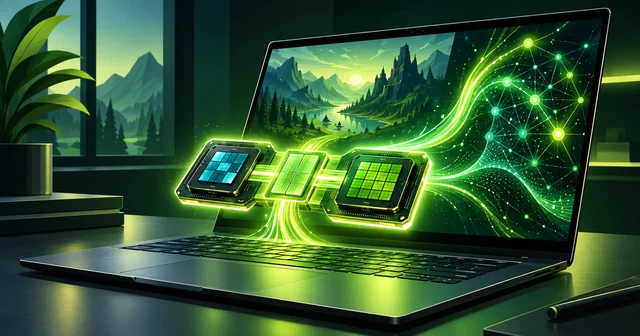
Nvidia's RTX Spark puts an Arm processor, a Blackwell graphics chip and up to 128GB of shared memory in one package, and Windows laptops built on it ship on October 16 from $2,599. For buyers, that means desktop-class graphics and large local AI models in a thin laptop, with app and game compatibility as the main open question.
What Happened
At a Windows and Surface event in San Francisco on October 7, 2026, Microsoft opened preorders for the Surface Laptop Ultra, the first Surface built on Nvidia's RTX Spark chip. Microsoft's Surface Laptop Ultra product page lists a starting price of $2,599.99. Windows Central and Tom's Hardware reported that shipments begin on October 16, and that the same date applies to RTX Spark laptops from ASUS, Dell, HP and Lenovo, whose preorders opened the same day.
The chip itself is not new. Nvidia CEO Jensen Huang introduced RTX Spark at Computex in Taipei on May 31, 2026, and Microsoft published a companion post on its Windows Experience Blog the same day describing the Windows changes built for it. What changed on October 7 is that the hardware now has prices, configurations and a ship date.
According to Nvidia's Computex announcement, the top RTX Spark configuration combines a Blackwell RTX GPU with 6,144 CUDA cores and fifth-generation Tensor Cores, a 20-core Nvidia Grace CPU, up to 128GB of unified memory and up to 1 petaflop of AI compute. Nvidia says laptops can be as slim as 14 millimeters and as light as 3 pounds, in 14- to 16-inch sizes. Reports from the launch said the Arm CPU was developed with MediaTek.
Pricing reported by Windows Central and Tom's Hardware spans a wide range:
- Microsoft Surface Laptop Ultra: from $2,599.99 with an 18-core CPU, a 5,120-core GPU, 24GB of memory and 512GB of storage. The full 20-core, 6,144-core chip with 128GB and 1TB costs $5,899.99. Eight configurations are offered.
- ASUS ProArt P14 and P16: from $2,599.99 and $2,799.99. A P16 with 128GB of memory reaches $6,999.99.
- HP OmniBook X 14 and OmniBook Ultra 16: from $2,999.99 and $3,199.99.
- Lenovo Yoga 9n: from $3,099.99.
- Dell XPS 16: from $3,799.99 with a 3.2K OLED display.
Nvidia says MSI is also a launch partner, with Acer and GIGABYTE models to follow.
Why It Matters
For two decades, a Windows laptop that could play demanding games or run serious graphics work meant an Intel or AMD processor paired with a separate Nvidia graphics chip. That design is powerful, but it is thick, hot and hard on batteries, because the CPU and GPU each have their own memory and power budget.
Arm-based Windows laptops, led so far by Qualcomm's Snapdragon chips, went the other way: excellent battery life, but modest graphics. Our look at how Qualcomm's Snapdragon X2 Plus raised the bar for Windows on Arm covers that trade-off. RTX Spark is the first attempt to give an Arm Windows laptop a graphics chip in the same class as a mid-range desktop card.
It also matters for local AI. With up to 128GB of memory that both the CPU and GPU can use, an RTX Spark laptop can hold language models far larger than a typical gaming laptop's 8GB or 12GB of graphics memory allows. Microsoft's product page says the Surface Laptop Ultra can run models of up to 120 billion parameters using CUDA acceleration. That is the same pitch Apple has made with its high-memory MacBook Pro machines, which we covered in our MacBook Pro M5 Max review, now arriving on Windows with Nvidia's software stack.
Finally, it changes the competitive map. Nvidia now sells a complete laptop processor, competing directly with Intel, AMD, Qualcomm and Apple rather than supplying a graphics chip that sits alongside one of them.
How It Works
One package, one pool of memory
RTX Spark joins its CPU and GPU with NVLink-C2C, Nvidia's chip-to-chip link from its data center products. Both sides read and write the same unified memory, so a game texture or a model's weights do not have to be copied from system RAM into separate graphics memory. That saves time and power, and it lets the GPU use most of the memory for a large AI model when needed. The cost is flexibility: the memory is part of the package, so the amount you buy is the amount you keep.
Why memory size matters for AI
A language model's size in memory is roughly its parameter count times the bytes used per parameter. At 4-bit precision, which RTX Spark's Tensor Cores support natively as FP4, a 120-billion-parameter model needs about 60GB for its weights, plus room for the conversation context. That fits in a 128GB configuration, but not in the 24GB or 32GB entry models. Buyers who want large local models need to buy the memory up front.
Running x86 apps on an Arm chip
Most Windows software is compiled for Intel and AMD's x86 instruction set. On Arm, Windows uses an emulator called Prism. Microsoft's documentation on how emulation works on Arm explains that Prism translates blocks of x86 instructions into Arm64 instructions just in time, then caches the translated code so later launches run faster. Apps built natively for Arm skip this step entirely.
Microsoft's May 31 blog post said Prism now supports AVX and AVX2, the vector instructions many modern games and creative apps require, and that it has been tuned for RTX Spark. Microsoft also added a Workload Profile Scheduling system to spread work across the chip's 20 cores, enabled its Power and Thermal Framework, and raised GPU memory limits for unified-memory systems.
The anti-cheat problem
Emulation has a hard limit: Microsoft's documentation states that it covers only user-mode code, not drivers, and that kernel-mode components must be compiled for Arm64. Many competitive online games use anti-cheat software that runs as a kernel driver, which is why they have refused to launch on Arm laptops until now.
Microsoft says RTX Spark will support native Arm versions of Epic's Easy Anti-Cheat and BattlEye. The game can still run under Prism while its anti-cheat runs natively, which is enough for it to start. Microsoft named Riot Games' League of Legends and VALORANT and KRAFTON's PUBG: Battlegrounds as coming to the platform. At the October 7 event, according to reports from the event, Microsoft showed Gears of War: E-Day running at 60 frames per second on the Surface Laptop Ultra and said Call of Duty would arrive in 2027.
For readers comparing this with traditional machines, our guide to the best gaming laptops for every budget shows what x86 laptops with separate graphics cards offer at far lower prices.
What's Still Unknown
Independent performance. Nvidia's gaming and AI claims come from Nvidia. Independent reviews, including sustained performance in a thin chassis, should follow once machines ship on October 16.
Battery life under load. Microsoft quotes up to 22 hours of local video playback and up to 16 hours of web browsing for the Surface Laptop Ultra. Neither figure says how long the battery lasts while gaming or running a large model on the GPU.
How much of your software works. Emulation performance varies by app, and drivers for older printers, audio interfaces, VPN clients and security tools must exist in Arm64 versions. Anti-cheat support depends on each game's publisher, and Microsoft's existing guidance still warns that some games may not run.
Cheaper models. Every launch laptop costs at least $2,599. Neither Nvidia nor Microsoft has said whether lower-priced RTX Spark chips or laptops are planned.
Release timing outside the US. The October 16 date and the prices above are US figures. Availability and pricing in India, Europe and other markets have not been confirmed for every model.
Frequently Asked Questions
What is Nvidia RTX Spark?
RTX Spark is Nvidia's first complete processor for Windows laptops and small desktops. It combines a 20-core Arm-based Grace CPU, a Blackwell RTX graphics chip with up to 6,144 CUDA cores and up to 128GB of unified memory in one package. Nvidia says the top version delivers up to 1 petaflop of AI compute.
When do RTX Spark laptops ship and what do they cost?
Preorders opened on October 7, 2026, and shipments begin on October 16, according to Windows Central and Tom's Hardware. Prices start at $2,599.99 for the Surface Laptop Ultra and the ASUS ProArt P14. A Dell XPS 16 starts at $3,799.99, and a fully loaded ASUS ProArt P16 with 128GB reaches $6,999.99.
Will my existing Windows apps run on an RTX Spark laptop?
Most will. Windows on Arm uses the Prism emulator to translate x86 apps into Arm code, and Microsoft has added AVX and AVX2 support for RTX Spark. Apps that depend on kernel drivers are the exception, because emulation does not cover drivers. Check specialist hardware, VPN and security software before buying.
Can RTX Spark laptops play online games with anti-cheat?
Some can. Microsoft says Easy Anti-Cheat and BattlEye will run natively on RTX Spark, and it named VALORANT, League of Legends and PUBG: Battlegrounds as coming to the platform. Support is decided game by game, so a title missing from the announced lists may still refuse to launch until its publisher adds Arm support.
How large an AI model can an RTX Spark laptop run locally?
It depends on memory. Microsoft says the Surface Laptop Ultra can run models of up to 120 billion parameters, which needs roughly 60GB at 4-bit precision plus room for context. That requires a high-memory configuration. Entry models with 24GB or 32GB are better suited to smaller models in the 7 to 30 billion parameter range.
How is RTX Spark different from a regular Nvidia gaming laptop?
A regular gaming laptop pairs an Intel or AMD x86 processor with a separate Nvidia graphics chip that has its own memory. RTX Spark puts an Arm CPU and the GPU in one package sharing one memory pool. That allows thinner designs and much more memory for the GPU, at the cost of x86 emulation and fixed memory.
Can I upgrade the memory in an RTX Spark laptop later?
No. The unified memory is part of the RTX Spark package, so it cannot be added after purchase. Choose the amount you will need for the life of the laptop. That matters most for local AI work, where model size is limited by memory, and much less for office work or gaming.
Related Reading
If you are weighing an RTX Spark machine against established options, start with our ultimate laptop buying guide, which covers x86 and Apple machines across price ranges. Our analysis of Qualcomm's Snapdragon X2 Plus for Windows on Arm explains how Arm laptops got to this point. For a sense of what large-memory laptops can do with local AI, see the MacBook Pro M5 Max review, and for traditional gaming hardware, compare the picks in our gaming laptop roundup.