MacBook Pro M5 Max Review: 27 Hours of Battery, Same 5-Year-Old Design
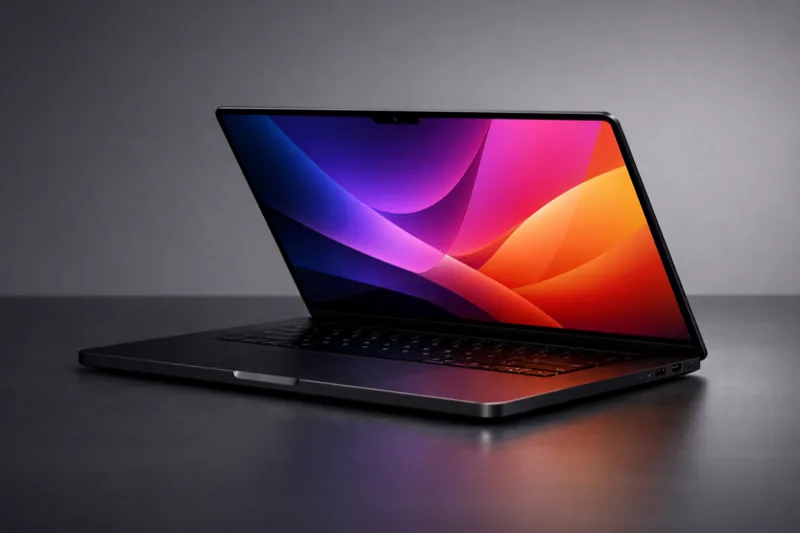
The 2026 MacBook Pro 16-inch with M5 Max is the ultimate sleeper laptop: a radical architectural overhaul stuffed inside the exact same chassis Apple has shipped since 2021. New "super cores," a Fusion die interconnect, 27 hours of battery life, and a 40-core GPU with Neural Accelerators — all hidden behind a design that looks exactly like last year's model. PCMag gave it an Editors' Choice award. Our take: it's a beast, but that $6,149 price tag needs some explaining.
The M5 Max Chip: Super Cores and Fusion
Apple introduced two significant architectural changes with the M5 generation. First, a new category of CPU core called the "super core" — optimized for single-threaded performance and offering the fastest single-core speeds of any Apple Silicon chip. The M5 Max pairs these super cores with traditional performance cores in a "bigger.BIG" configuration, dropping the efficiency cores entirely from the Pro and Max chips.
Second, Apple adopted a Fusion interconnect that splits the chip into two separate dies — one for CPU, one for GPU — connected as a single unit. This is borrowed from the UltraFusion technology used in the M-series Ultra chips, but here it's about manufacturing flexibility: smaller, specialized dies improve yield and let Apple mix and match good chips.
The M5 Max CPU has 18 cores (up from 15 in M4 Max), with memory bandwidth boosted to 614GBps. The 40-core GPU gets Neural Accelerators on every graphics core — a feature first introduced on the base M5 chip, but dramatically more impactful with 40 GPU cores for AI and machine learning workloads.
27 Hours of Battery Life
Apple estimated 22 hours. PCMag tested 27 hours in video playback — an extreme outlier for a workstation-class laptop. For context, the Razer Blade barely topped 10 hours in the same test. Of course, demanding tasks like video editing and gaming drain the battery much faster, but the comparative advantage means you'll get more work done before reaching for that color-matched MagSafe cable.
Storage Doubled, Speed Doubled
The base storage for M5 Pro models jumps to 1TB (up from 512GB), while M5 Max configurations can go up to 8TB. Apple claims up to 2x faster SSD performance — likely through a wider-bandwidth controller and faster NAND flash. For massive file transfers (8K video, large AI models), that matters. For everyday use, "instant" becomes "more instant."
Everything Else Stays the Same
And here's the thing: the 2026 MacBook Pro looks physically identical to the 2021 model. Same 0.66-inch thickness, same 4.7 pounds, same aluminum chassis in Silver and Space Black. The Liquid Retina XDR display hits 96% DCI-P3 coverage (Apple still hasn't moved to OLED). New additions include Thunderbolt 5 with individual port controllers and Wi-Fi 7 — both genuine futureproofing features.
Pricing: A Business Decision
The M5 Pro 16-inch starts at $2,699. The M5 Max starts at $3,899. A fully loaded M5 Max with 128GB RAM, 8TB storage, and nano-textured glass hits $7,349. PCMag's review unit (40-core GPU, 128GB, 4TB, nano-texture) was $6,149. AppleCare+ adds $14.99/month or $149.99/year.
The Bottom Line
The MacBook Pro M5 Max is Apple at its most Apple: genuinely impressive engineering advances packaged in the same chassis for the fifth consecutive year. If you're a content creator or professional who needs macOS-based workstation performance, there's nothing else that combines this level of compute with 27 hours of battery life. But at $3,899 to start and $7,349 maxed out, this isn't a laptop purchase — it's a capital investment. The M4 Max owners among you can probably wait another year.