Jensen Huang on Nvidia's Supply Chain Moat, ASIC Threat, Selling to China, and the Neocloud Bet
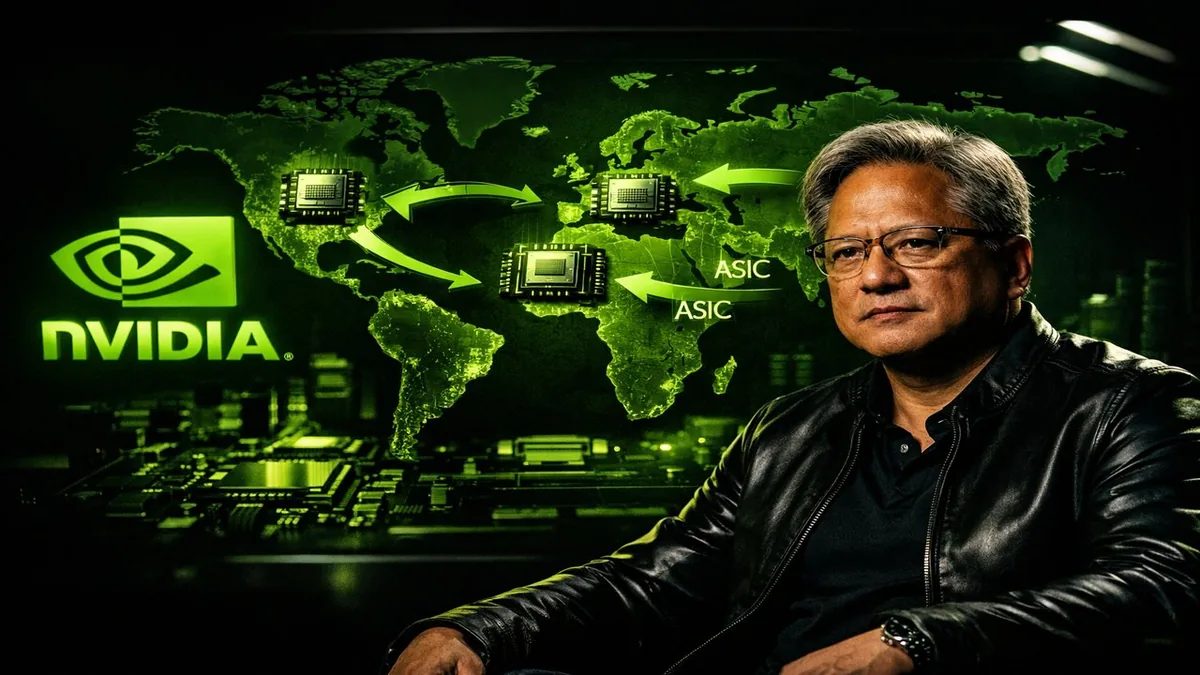
Nvidia CEO Jensen Huang sat down for a wide-ranging Q&A that covered the strategic questions most critical to Nvidia's long-term dominance: how defensible its supply chain advantage really is, whether custom ASICs from Google and Amazon represent a genuine threat, Nvidia's approach to the China market amid export restrictions, and the logic behind Nvidia's investments in AI labs and neocloud providers. The answers reveal a CEO who is confident in Nvidia's position but lucid about where the real competitive battles lie.
The Supply Chain Moat
Huang described Nvidia's supply chain advantage as more than manufacturing: it encompasses the full stack from chip architecture to CUDA software ecosystem to the trained teams who know how to build, deploy, and optimize Nvidia-based systems. Replicating the hardware, he argued, is hard enough. Replicating the software ecosystem and the institutional knowledge built around it over two decades is a fundamentally different challenge that no competitor has yet solved.
TSMC's advanced node access remains a core component of this moat. Nvidia's ability to commit to leading-edge process capacity years in advance — backed by the revenue to make those commitments credible — gives it priority access that constrains competitors' ability to close the gap quickly.
The ASIC Question
On custom ASICs — specifically Google's TPUs and Amazon's Trainium/Inferentia — Huang offered a nuanced answer. He acknowledged that hyperscaler ASICs are genuinely competitive for specific, high-volume, well-defined workloads like inference of fixed models at scale. Where they fall short, he argued, is flexibility: as AI models evolve rapidly, the programming overhead required to retarget ASICs for new architectures creates a lag that general-purpose GPUs do not have.
The implicit message: ASICs win the last mile of optimization for mature workloads, but Nvidia wins the frontier where workloads are changing fastest — and in AI right now, the frontier is where the money is.
China and Export Controls
Huang was careful but direct on China. Nvidia has developed China-specific chips — including the H20 — that are engineered to comply with US export restrictions while remaining competitive for Chinese customers. He framed this not as a workaround but as responsible compliance: designing products that serve markets within the rules rather than abandoning them to competitors who face no such restrictions.
The Neocloud Bet
Nvidia's investments in AI labs and neocloud providers — companies like CoreWeave, Lambda Labs, and others — are strategic demand-creation plays. By helping neocloud providers access capital and scale, Nvidia ensures a growing ecosystem of customers that are structurally dependent on its chips. It is, as Huang described it, similar to how Intel invested in PC manufacturers in the 1990s.
The Bottom Line
Jensen Huang's Q&A paints a picture of a CEO who understands that Nvidia's moat is real but not permanent. The ASIC threat is managed through software ecosystem depth. The China situation is managed through compliant product design. The neocloud bet is managed through ecosystem investment. Each answer reveals a company that is playing a longer, more strategic game than simply shipping the fastest chips.
Related Articles
- Apple Sends 200 Siri Engineers to AI Coding Bootcamp
- Jury Finds Live Nation and Ticketmaster Guilty of Monopoly
- OpenAI Updates Agents SDK With Native Sandboxing