Marvell Buys Lumentum: What the $115B Deal Means for AI Optics
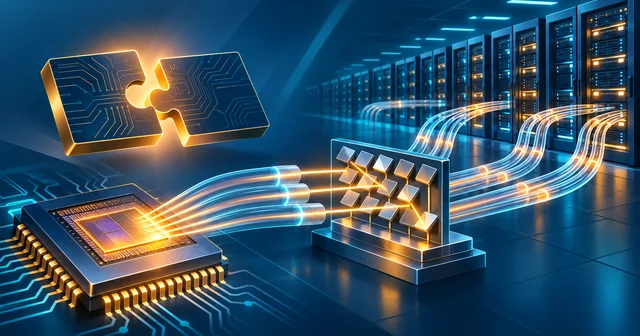
Marvell's $115 billion all-stock purchase of Lumentum joins a chip company that builds the electronics inside AI network links with one that makes the lasers and optical switches those links depend on. The bet is that AI clusters will move from copper to light, and that owning both halves of a link will matter.
What Happened
On November 2, 2026, Marvell Technology and Lumentum Holdings announced a definitive agreement under which Marvell will acquire Lumentum in an all-stock transaction. According to the companies' joint announcement, Lumentum shareholders will receive a fixed 4.500 Marvell shares for each Lumentum share. That implies about $1,132 per share and an enterprise value of roughly $115 billion, a premium of about 23.9% to Lumentum's unaffected close on October 28, the last trading day before market speculation about a deal began.
When the deal closes, Marvell shareholders will own about 67% of the combined company and Lumentum shareholders about 33%, on a fully diluted basis. Both boards approved the agreement unanimously. Matt Murphy stays on as chairman and chief executive, and three Lumentum directors, including Lumentum CEO Michael Hurlston, will join Marvell's seven-member board.
The companies say they have "line of sight" to more than $1 billion in annual run-rate cost synergies, that the deal will add to Marvell's non-GAAP earnings per share in the first year after closing, and that the combination expands Marvell's addressable market to $550 billion. They expect to close in the first half of calendar 2028, subject to approval by both sets of shareholders and by regulators.
The announcement landed alongside quarterly numbers. Marvell said preliminary revenue for its fiscal third quarter was in line with its August guidance of $3.15 billion and narrowed the range around that midpoint. Quartz's report on the deal and other financial coverage put Lumentum's fiscal first-quarter revenue at about $1.26 billion, slightly ahead of analyst consensus, with growth led by pump lasers and optical circuit switches. Coverage of the earnings remarks also quoted Hurlston saying Lumentum had won a second major co-packaged optics program backed by more than $5 billion in purchase commitments. Murphy described the deal as a "once in a generation" opportunity.
Why It Matters
For most of the AI boom, attention went to the accelerators themselves: GPUs and custom chips such as Google's TPUs. The less visible constraint is how those chips talk to each other. Training a frontier model spreads one job across thousands or tens of thousands of accelerators, and they spend a large share of their time exchanging data. If the network cannot keep up, expensive chips sit idle.
Marvell's own framing is blunt. In the announcement Murphy said AI infrastructure is "undergoing a fundamental architectural shift toward optical connectivity." Copper cables are cheap and reliable, but at today's signalling speeds they work only over short distances, roughly within a rack. Anything longer needs fibre, and every fibre link needs a laser at one end and a detector at the other.
That is why this deal is about more than size. Marvell already sells the digital signal processors that sit inside many optical transceivers, the electrical-to-optical interface chips, network switches, and custom accelerators for large cloud companies; it agreed to buy the photonic interconnect start-up Celestial AI in December 2025, a deal covered in our explainer on Marvell's Celestial AI bet. Lumentum, through its laser and optical networking business, makes the indium phosphide lasers, transceivers and optical circuit switches on the other side of that interface. Putting them together gives one company the chip that shapes the signal, the laser that carries it and the switch that routes it.
It also changes the supplier map for the largest buyers. Nvidia invested $2 billion each in Lumentum and Coherent earlier this year to secure optical supply, as we reported in our story on Nvidia's $4 billion photonics investment, and separately took a $2 billion stake in Marvell, covered in our report on Nvidia's silicon photonics partnership with Marvell. A combined Marvell-Lumentum would sell to Nvidia while also designing custom chips for Nvidia's cloud rivals, which raises the stakes for anyone who depends on a single optical vendor.
How It Works
An optical link in an AI data center has a few stages, and the two companies sit at different points along it.
The electrical side. A GPU or switch chip produces data as electrical signals. Before those signals can drive a laser, a digital signal processor cleans them up, encodes them (current links typically use PAM4, which packs two bits into each symbol by using four signal levels) and corrects for distortion. Marvell is one of the largest suppliers of these DSPs; it built much of that position by acquiring Inphi in 2021.
The light source. The encoded signal then modulates a laser. High-speed links commonly use electro-absorption modulated lasers, or EMLs, which switch light on and off tens of billions of times a second, or silicon photonics modulators fed by a continuous-wave laser. Both rely on lasers grown on indium phosphide, a compound semiconductor that is harder to manufacture at scale than ordinary silicon. Lumentum is one of a small number of companies that can produce these lasers in volume, which is why laser supply has been a recurring bottleneck when AI build-outs accelerate.
Pluggables versus co-packaged optics. Today most of this hardware lives in pluggable transceiver modules that slot into the front of a switch. The data still has to cross several centimetres of circuit board as an electrical signal to reach the module, and pushing signals that far at high speed costs power. Co-packaged optics, and the related near-packaged optics, move the optical engine onto or beside the chip package so the electrical path shrinks to millimetres. The laser is often kept as a separate, replaceable external light source, because lasers wear out faster than the silicon around them. This is where Marvell's packaging and silicon photonics work and Lumentum's lasers meet most directly, and it is the area Hurlston pointed to with the second large co-packaged optics win.
Optical circuit switches. A conventional network switch converts every incoming light signal back into electricity, reads each packet and sends it on. An optical circuit switch skips that: tiny mirrors steer whole beams of light from one fibre to another. It cannot route individual packets, but it can rewire which racks connect to which in seconds while using very little power. Google has publicly described using optical circuit switching to reconfigure its TPU supercomputers, and coverage of Lumentum's latest quarter credits these switches, along with pump lasers, for leading its growth.
Where the savings come from. The $1 billion cost synergy figure refers to costs inside the merged company, such as overlapping operations and manufacturing, not price cuts for customers. The engineering argument is different: if one company designs the DSP, the photonic chip and the laser together, it can shave power and latency at the boundaries between them. In a cluster with hundreds of thousands of links, small savings per link add up, and power is now one of the scarcest resources in AI data centers.
What's Still Unknown
Regulatory approval. A close date in the first half of 2028 signals a long review. Both companies sell worldwide, and large US semiconductor deals have needed sign-off from competition authorities including China's market regulator; Intel abandoned its purchase of Tower Semiconductor in 2023 after Chinese approval did not arrive. Neither company has said which jurisdictions it expects to be the hardest.
Customer reaction. The cloud companies that buy custom chips from Marvell also buy optics from Lumentum's rivals, and some compete with each other. Whether they welcome a single integrated supplier or push work towards competitors such as Coherent and Broadcom will not be clear for months. Marvell's relationship with Google, described in our piece on the Google-Marvell custom chip partnership, is one to watch.
Combined financials. The announcement does not state combined revenue, does not quantify revenue synergies and does not say which costs will be cut. Marvell plans to file a registration statement with a joint proxy with the US Securities and Exchange Commission, which should add detail.
The shareholder vote. Because the price is fixed in Marvell shares, the value Lumentum holders receive moves with Marvell's stock price until closing. Early trading reports showed both stocks swinging on the day of the announcement, and the vote is still to come.
How fast optics replaces copper. The whole thesis assumes the shift to optical links inside racks arrives on schedule. Copper has repeatedly lasted longer than forecasts predicted, and co-packaged optics still has to prove it can be serviced at scale.
Frequently Asked Questions
What is Marvell paying for Lumentum?
Marvell is paying in stock, not cash. Each Lumentum share converts into 4.5 Marvell shares, which the companies say implies about $1,132 per share and an enterprise value of roughly $115 billion. That works out to a premium of about 23.9% over Lumentum's closing price on October 28, the last trading day before reports of the talks surfaced.
When will the Marvell and Lumentum deal close?
The companies expect the deal to close in the first half of calendar 2028, so roughly 14 to 20 months from the November 2, 2026 announcement. Before then it needs approval from shareholders of both companies plus regulatory clearances in several countries. Until it closes, Marvell and Lumentum keep operating and selling as separate, independent companies.
Why do AI data centers need so many lasers?
Every optical link between servers starts with a laser that turns electrical bits into pulses of light. A large AI cluster can contain tens of thousands of accelerators, each with several high-speed network ports, and each port needs a transceiver with one or more lasers. As link speeds climb, copper cables only reach a few metres, so more of those connections move to fibre.
What is co-packaged optics?
Co-packaged optics moves the optical engine off the pluggable module at the front of a switch and places it on the same package as the switch or accelerator chip. Electrical signals then travel millimetres instead of across a circuit board, which saves power. The laser is often kept outside as a separate replaceable light source, because lasers fail more often than silicon.
What is an optical circuit switch?
An optical circuit switch redirects beams of light between fibres, usually with tiny tilting mirrors, without converting the signal back into electricity. It cannot inspect individual packets, but it can rewire which racks connect to which, using very little power. Google has described using such switches to reconfigure its TPU clusters, and Lumentum says demand for its own switches is growing.
Will this deal make AI chips or cloud services cheaper?
Not directly, and not soon. The deal does not close until 2028, and the promised savings are more than $1 billion a year in costs inside the combined company, not price cuts. If tighter integration between lasers and chips lowers power per bit, cloud providers could run larger clusters more efficiently, but whether customers see lower prices is unknown.
Does the deal affect Nvidia?
Nvidia is a customer and investor in both companies. Earlier in 2026 it put $2 billion into Lumentum and another $2 billion into Marvell, tied to optical supply and partnership deals. A combined company would be a larger supplier that also designs custom chips for Nvidia's cloud rivals, which may give Nvidia reason to keep second sources such as Coherent close.
Related Reading
For the earlier steps in Marvell's optical strategy, start with how the Celestial AI acquisition fits into data center connectivity and why Nvidia took a $2 billion stake in Marvell. On the supply side, Nvidia's investments in Lumentum and Coherent explain why laser capacity became strategic, and our look at the SK Hynix memory shortage shows how the same AI demand is stretching other parts of the hardware supply chain.