Google Partners with Marvell to Develop Next-Gen Custom AI Chips
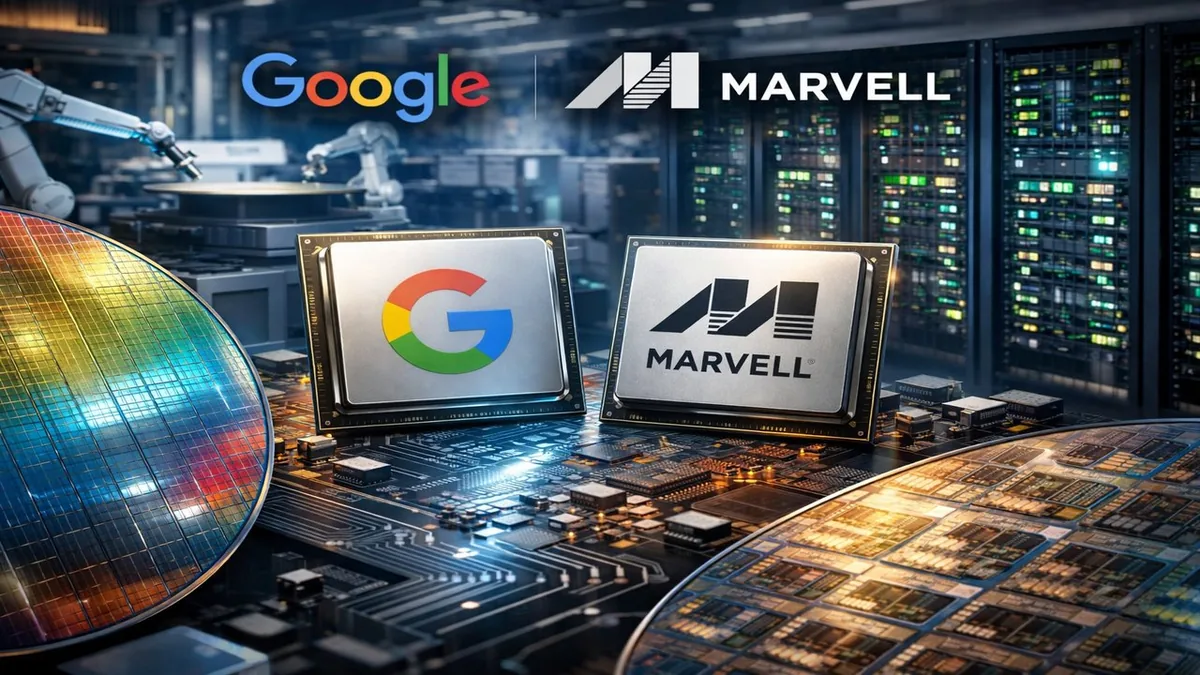
Google has announced a strategic partnership with semiconductor company Marvell Technology to co-develop a new generation of custom AI accelerator chips for its data centers. The collaboration positions Marvell as a key silicon design partner as Google accelerates its push to reduce dependence on Nvidia and build out a proprietary AI chip ecosystem.
What Google and Marvell Are Building
The partnership focuses on custom ASIC design for AI inference workloads — the computationally intensive process of running trained models in production. Marvell brings deep expertise in custom silicon design and advanced packaging technology, while Google contributes its AI workload architecture and extensive training data on how its internal TPU chips perform across different model types. The resulting chips are expected to debut in Google Cloud infrastructure by late 2027.
Strategic Context: Google's Silicon Push
Google has been investing heavily in custom silicon since the first Tensor Processing Unit (TPU) debuted in 2016. This Marvell partnership represents an expansion of that strategy — rather than building everything in-house, Google is selectively partnering with specialized chip designers to accelerate development timelines and leverage Marvell's manufacturing relationships with TSMC.
Marvell's Position in the AI Chip Market
Marvell has increasingly pivoted toward custom silicon for hyperscalers, designing chips for Amazon, Microsoft, and now Google. The company occupies a unique niche: it does not compete with Nvidia head-on in the general GPU market, but instead designs tailored ASICs that outperform general-purpose GPUs on specific AI inference tasks at lower cost and power consumption.
The Bottom Line
The Google-Marvell partnership is another data point in the hyperscaler trend away from Nvidia dependency. As AI inference costs become a critical competitive factor, custom silicon partnerships like this one will increasingly define which cloud platforms can offer AI services at scale and margin.
Related Articles
- AI Chip Export Controls: The BIS Bottleneck Explained
- Amazon's $25 Billion Mississippi Data Center Push