How the Selection Room Evolved After Forty Years in Funeral Service
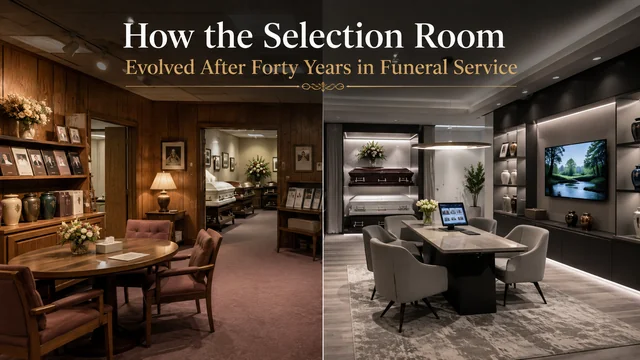
Ask a funeral director who has spent four decades in the profession what has changed, and the conversation rarely starts with technology or paperwork. It starts with a room. Nearly every funeral home built before the 1980s has one: a quiet space, often carpeted in muted tones, where families once sat with a single binder of options and a director who had memorized every detail by heart.
That room has transformed more than almost any other part of the funeral home, and the people who worked in it across generations are the ones best positioned to explain why.
A Trade Built on Local Relationships
Funeral service in the United States grew up as a deeply local trade. In small towns and city neighborhoods alike, funeral homes were often family businesses passed from one generation to the next, and the director was as much a fixture of the community as the church pastor or family doctor.
Veterans who entered the field in the 1970s and 1980s describe a profession built almost entirely on trust earned face to face. There were no national brands to speak of, no standardized pricing sheets, and very little formal regulation. Families relied on word of mouth, and directors relied on their own reputations, built service by service over years of showing up at the hardest moments in people's lives.
The Shift Toward Transparency
That local, relationship-driven model began to change as the profession matured and families started asking for more information before making decisions. The Federal Trade Commission became a central figure in this shift, since it oversees the disclosure rules that require funeral homes to provide itemized pricing to any family that asks. For veteran directors, this was one of the more significant turning points of their careers.
What had once been a conversation guided almost entirely by tradition and trust became one supported by documentation and clear choices. Many directors who lived through this transition say it did not weaken the personal relationship between families and providers. It strengthened it, because families arrived with a clearer sense of what they were choosing and why.
From a Single Binder to a Full Selection Room
This is where the physical space of the funeral home began to change alongside the paperwork. Directors who started their careers decades ago remember when a family's choices were limited to whatever a handful of local suppliers could deliver within a few days. Over time, as distribution networks expanded and families began requesting more variety, funeral homes built out dedicated selection rooms displaying a broader range of options in person.
Today, many of those same veteran directors help families supplement that in-person experience by pointing them toward reputable online catalogs, since retailers offering caskets now allow families to browse styles, materials, and price points from home before ever stepping into the funeral home. Directors describe this as one of the most welcome shifts of their careers, not because it changed their role, but because it gave families more time and less pressure during an already difficult week.
Mentorship Across Decades
The other lasting change veterans point to is how knowledge gets passed down. Forty years ago, a new hire learned the trade almost entirely through apprenticeship, standing beside a senior director for years before handling arrangements independently. That mentorship model still exists, but it now runs alongside formal mortuary science education and continuing certification requirements. The Bureau of Labor Statistics tracks employment trends across funeral service occupations, and the data reflects a field that has professionalized considerably even as it holds onto its apprenticeship roots. Veteran directors often describe their proudest achievement not as any single service they arranged, but as the younger directors they trained who now run their own funeral homes, carrying forward habits and standards built over decades of hands-on experience.
What Stayed the Same
Despite all of this change, the veterans who have stayed in the profession longest tend to agree on one thing: the core purpose of the work has not shifted at all. Families still need someone steady in the room with them. They still need clear guidance delivered with patience rather than urgency. The tools have changed, the pricing has become more transparent, and the selection process has expanded well beyond a single binder, but the relationship between a director and a grieving family remains the center of the profession. That continuity is part of why so many veterans describe their decades in funeral service not as a job that changed around them, but as a calling that simply grew more capable of serving families well.
The evolution of the selection room captures something larger about funeral service as a whole. What began as a trade built on personal trust and limited options has become a profession that blends that same trust with far greater transparency, choice, and support. The directors who have spent forty years guiding families through both versions of the industry are uniquely positioned to appreciate how much has improved, and how much of the original spirit of the work has been carefully preserved along the way.