Capacitors Explained: What They Are and How They Work
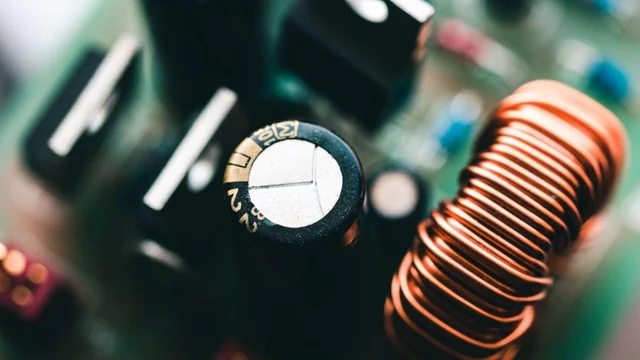
Capacitors are one of the most fundamental components in electronics. They store and release electrical energy, smooth out power fluctuations, filter signals, and enable timing circuits. Every electronic device you own — from your smartphone to your car's engine control unit — contains dozens to thousands of capacitors.
How Capacitors Work
A capacitor consists of two conductive plates separated by an insulating material called a dielectric. When voltage is applied, electrons accumulate on one plate and deplete from the other, creating an electric field across the dielectric. This stored energy can be released almost instantly when the circuit needs it.
Think of a capacitor like a small rechargeable battery that charges and discharges in microseconds rather than hours. The key difference from a battery is speed — capacitors deliver energy almost instantaneously but store much less total energy.
Types of Capacitors
| Type | Capacitance | Common Uses |
|---|---|---|
| Ceramic | 1pF – 100µF | Signal filtering, decoupling, high-frequency circuits |
| Electrolytic | 1µF – 47,000µF | Power supply filtering, energy storage |
| Film | 1nF – 100µF | Audio circuits, timing, precision applications |
| Tantalum | 0.1µF – 1,000µF | Compact electronics, military, medical devices |
| Supercapacitor | 1F – 3,000F | Energy storage, regenerative braking, backup power |
What Capacitors Do in Circuits
- Filtering — smooth out voltage ripple in power supplies, removing AC noise from DC power
- Decoupling — provide instant current to chips during switching, preventing voltage drops
- Timing — combined with resistors (RC circuits), capacitors control timing in oscillators and timers
- Coupling — pass AC signals while blocking DC, used in audio and radio circuits
- Energy storage — camera flashes, defibrillators, and regenerative braking systems
Key Capacitor Specifications
- Capacitance (Farads) — how much charge it can store. Measured in picofarads (pF), nanofarads (nF), microfarads (µF), or Farads (F)
- Voltage rating — maximum voltage before the dielectric breaks down. Always use a capacitor rated above your circuit voltage
- ESR (Equivalent Series Resistance) — internal resistance. Lower is better for power supply filtering
- Temperature coefficient — how capacitance changes with temperature. Important for precision circuits
For more tech education, check our GPU hierarchy guide which covers capacitor usage in graphics cards.
Frequently Asked Questions
What is the difference between a capacitor and a battery?
Both store energy, but capacitors charge and discharge in microseconds to milliseconds while batteries take minutes to hours. Capacitors store less total energy but deliver it much faster. Batteries use chemical reactions; capacitors use electric fields. Capacitors last millions of charge cycles; batteries degrade after hundreds to thousands.
Can a capacitor shock you?
Yes. Large capacitors in power supplies, CRT monitors, and microwave ovens can hold dangerous charges even after the device is unplugged. Always discharge capacitors before working on electronics. Small ceramic capacitors in low-voltage circuits are not dangerous, but electrolytic capacitors in power supplies can deliver a painful or even lethal shock.