Why Every AI Model Translates the Same Text Differently And Why That’s a Problem Worth Solving
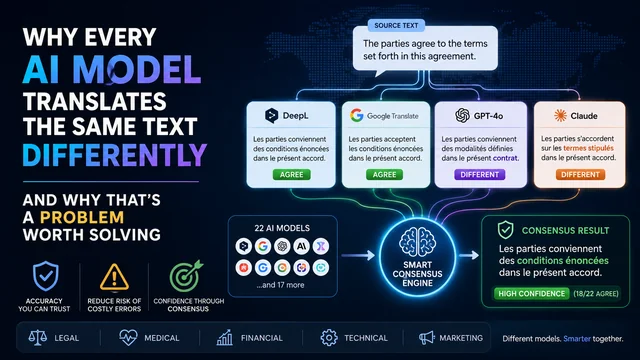
There’s an assumption baked into how most people use AI translation: that one model is more or less correct, and the rest are worse. You pick DeepL or ChatGPT or Google Translate, you paste your text, and you trust the result. The model you chose is your expert. That’s the deal.
The problem is that the assumption is wrong and the translation industry has known it for years, even if the wider world of AI users hasn’t quite caught up.
The same sentence, fed into different AI translation engines, comes back differently. Not just in style. Sometimes in meaning. And the engine that’s right in one language pair is consistently wrong in another. There’s no single model that leads across all use cases, all language combinations, and all content types. As SaveDelete’s coverage of the latest AI models has shown repeatedly, the frontier is fragmented and translation is no different.
Why Models Diverge
Every AI translation engine is trained differently. DeepL was built as a specialist: its neural networks were optimized almost entirely for translation across a curated set of European languages, using proprietary training data. Google Translate was built for scale: 249+ languages, broad coverage, trained on enormous but noisier web data. GPT-4o and Claude were trained as general-purpose language models first and became capable translators as a side effect of learning the structure of human language.
Each architecture produces a different failure profile. Specialist models like DeepL handle European language pairs with exceptional fluency but stumble outside their core set. The engine doesn’t even offer Arabic or Hindi. General-purpose LLMs handle context and idioms better, can accept prompts that set register and tone, and cope with low-resource languages more gracefully. But they can over-explain, add phrasing that wasn’t in the source, or misfire on domain-specific terminology.
The divergence isn’t a bug anyone is about to fix. It’s structural. Different training data, different objectives, different architectural choices produce different outputs. This is the same dynamic we see across the rest of the AI landscape: as the GLM-5.2 analysis on SaveDelete noted, open and closed models are “frontier-adjacent” to each other, trading wins across different benchmarks. Translation is no different. There is no universally dominant model, and there probably never will be.
The Benchmark Gap Is Real
The data backs this up consistently. A 2026 benchmark by IntlPull testing 500 sentences across 10 language pairs found that DeepL consistently scores 8 to 16 points higher than Google Translate on BLEU benchmarks, with the gap largest in English to German where DeepL scored 64.5 against Google’s 48.3. That’s not a small margin.
But zoom out, and the picture flips. LLMs like ChatGPT and Claude edge ahead for Asian language pairs scoring 54.1 against DeepL’s 51.3 for Chinese and 51.6 against DeepL’s 48.2 for Japanese. DeepL wins in Europe; the generalist models win in Asia. Neither wins everywhere.
Language coverage adds another layer. A 2024 survey by the Association of Language Companies found that 82% of language service companies use DeepL for translations, while only 46% use Google Translate, yet Google Translate’s accuracy varies widely depending on the language, ranging from 55% to 94%. A 55% accuracy rate is not a translation tool. It’s a suggestion engine.
Tomedes, which has been running translation operations across 120+ languages since 2007, observed this pattern long before the current LLM wave. Their linguists routinely catch model-specific failure modes that look invisible on aggregate benchmarks: a model that handles legal German impeccably but mangles Japanese honorifics, or one that’s fluent in Spanish but defaults to Latin American register when Castilian was needed. The takeaway is uncomfortable: the engine your team relies on is excellent for some things, adequate for others, and quietly unreliable for a third category you probably haven’t identified yet.
The Single-Engine Risk Nobody Talks About
Across most AI-powered workflows, the failure mode is visible. A coding assistant writes broken code. The tests fail. An AI image generator produces something wrong. You can see it. But a machine translation error is nearly invisible to anyone who doesn’t speak both languages. The text looks fluent. It reads naturally. And it might still be wrong.
There is no single most accurate AI translation tool across all languages and use cases in 2026 and the problem is that single-engine workflows don’t know that. If you commit to one engine because it’s fast, cheap, or already integrated into your stack, you’ve implicitly decided that its failure profile doesn’t apply to you. That’s a bet worth examining.
The highest-stakes cases are also the least tolerant of error. A mistranslated contract clause, an incorrect product specification, a patient instruction rendered ambiguous by a model that handled the medical terminology as if it were casual text. These failures don’t announce themselves. The 4% of translations that fall outside benchmark accuracy figures includes the errors that matter most: mistranslated contract terms, incorrect dosages in medical documents, and reversed safety warnings. The fluency of the output is not evidence of its accuracy. That’s the trap.
When Disagreement Is the Signal
Here’s the insight that changes how to think about this: when multiple models agree on a translation, that agreement is meaningful. When they disagree, the disagreement is the data.
If you run the same sentence through four or five models and three of them render it one way while two go in a different direction, you’ve surfaced a real ambiguity in the source text or a real divergence in how the models have learned to handle that domain, register, or language pair. Either way, you’ve learned something a single-model workflow would have silently hidden from you.
This is the logic behind consensus-based translation. Rather than asking “which model is best?”, the question becomes: where do models converge, and where do they diverge? Convergence is a signal. Divergence is a flag that warrants attention.
MachineTranslation.com applies this approach at scale. The SMART consensus engine runs texts through 22 AI models simultaneously and surfaces the most agreed-upon translation across the set. The output isn’t just a translation, it’s a translation with an implicit confidence metric derived from model agreement. For teams that depend on accurate output across multiple language pairs and content types, that collapses a complex multi-vendor evaluation problem into a single workflow.
Running Multiple Models in Parallel
The practical barrier here used to be real. Comparing outputs across engines meant copy-pasting between tabs, maintaining separate API credentials, manually eyeballing differences. For a one-off sentence, that’s annoying. For high-volume business translation, it’s a non-starter.
That’s changed. Tools like MachineTranslation.com let you run systematic multi-model comparisons without building the infrastructure yourself by seeing side-by-side outputs from DeepL, Google, GPT-4o, and 19 other engines against the same source text, with the SMART consensus layer flagging where they converge and where they don’t. The argument for doing it is the same argument you’d make for any ensemble approach in AI: no single model has a monopoly on being right, and the aggregate of multiple imperfect models is more robust than any one of them alone.
This isn’t a novel idea. It’s how good engineering works. Redundancy, cross-validation, and triangulation are standard practice anywhere the cost of silent failure is high. Translation, especially in legal, medical, technical, and financial contexts, meets that bar easily.
What to Do With It
If your organization uses AI translation in any capacity, the single useful question is: how would you know if your engine made a mistake? If the answer is “we wouldn’t, unless a native speaker caught it,” that’s the gap worth closing.
A few practical steps that don’t require overhauling anything: test your current engine against at least one other on your highest-stakes language pairs. Identify where the outputs diverge. Those divergences are worth reviewing with a human linguist, not because machine translation is untrustworthy, but because the divergence pattern tells you which content types are within your engine’s confident range and which are at the edges.
For systematic coverage, particularly across mixed language portfolios, running a multi-model comparison is the most direct path to knowing what you don’t know. The confidence that comes from model consensus is a different kind of confidence than “we’ve always used this tool.”
Final Thoughts
The AI model race has produced extraordinary capability, delivered with a lot of noise about which model is best. The translation problem cuts through that noise quickly. There is no best model for all languages, all domains, all registers. The benchmark leaders trade positions depending on what you’re testing.
The practical response isn’t to wait for a winner that may never emerge. It’s to stop treating translation as a single-vendor problem and start treating it as a multi-model one. Where models agree, you have confidence. Where they don’t, you have a flag. That’s more useful information than any single engine can give you on its own.