Best Bar POS Software in 2026: Toast, Square, Loyverse +3
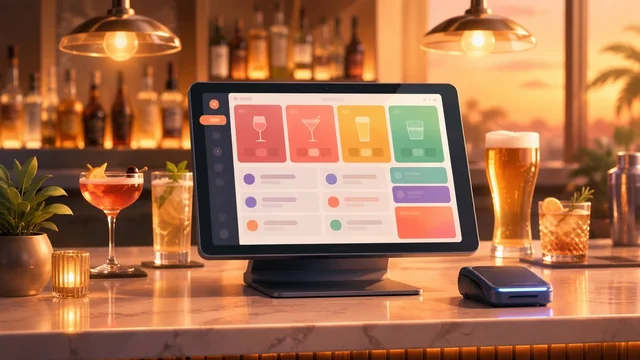
Running a bar without a dedicated point-of-sale system in 2026 is almost impossible. Tabs need to open and close in seconds, comps and voids need an audit trail, inventory has to reconcile to within ounces, tip pools have to split fairly, and the whole thing has to keep working when the venue is loud, the wifi flakes and the bartender is two-deep at the rail. Bar-specific POS software handles all of that. This guide rounds up the best bar POS systems to buy or trial in 2026, what each is best at, and the features you should weigh before signing a hardware contract.
Best bar POS software in 2026 (at a glance)
| POS | Software pricing | Best for | Offline mode |
|---|---|---|---|
| Toast | From $0 / month (Starter) up to $165+ for multi-location | Mid-to-large bars & restaurants in the US | Yes |
| Square for Restaurants | Free plan, Plus $69 / month / location | Single-location bars, low setup cost | Yes |
| TouchBistro | $69 / month / licence + add-ons | Bars that prioritise local-first reliability | Yes (local server) |
| Loyverse | Free core POS; advanced features $25–$50 / month | Small bars, startups, international | Yes |
| Lightspeed Restaurant | $69–$399 / month / location | High-volume bars & hospitality groups | Yes |
| Shift4 SkyTab (formerly Harbortouch) | Free hardware, processing-based pricing | Bars wanting bundled hardware + processing | Yes |
1. Toast — the US bar & restaurant default
Toast is the most-used bar & restaurant POS in the United States in 2026. It runs on Toast-supplied Android handhelds and counter terminals, and the software layer covers everything a bar needs: open and transferred tabs, pre-authorised credit holds, split checks (by guest, by item, by percentage), bar-tab printing to ticket printers, configurable happy-hour pricing, mobile order-and-pay via QR codes, integrated payroll, and a deep inventory module with par-level alerts and recipe-level pour cost. The free Starter tier is genuinely usable for small bars (you pay processing on each transaction); the Essentials, Custom and multi-location tiers add advanced reporting, online ordering, loyalty and team management. Toast is the right default for a serious bar in the US unless you have a specific reason to choose something else.
2. Square for Restaurants — lowest setup cost
Square for Restaurants is the easiest way to get a bar POS up and running in a single afternoon. The free plan lets you start taking card payments on a Square Stand (~$150 hardware) immediately; the Plus tier ($69 / month / location) adds bar-tab management, custom tipping, kitchen-display routing, course management, table maps, and built-in delivery / pick-up. Best for single-location bars, pop-ups and bottle shops where you want everything from one vendor (POS, payments, payroll, capital loans) without a long sales cycle. Toast eventually outgrows Square at the multi-location, fine-dining or higher-volume end.
3. TouchBistro — local-first reliability
TouchBistro is unusual in 2026 in that it runs primarily local-first on an iPad (or a Mac mini behind the bar acting as a local server) rather than cloud-only. The advantage: when your internet drops, TouchBistro keeps taking orders and printing tickets exactly as before — the cloud is only used for reporting and back-of-office sync. For dive bars in basements, beach bars on patchy mobile data, or venues that have been burned once by a cloud outage on a busy night, this is the safest pick. Pricing starts at $69 / month per licence; add-ons (reservations, loyalty, gift cards, online ordering) cost extra.
4. Loyverse — free, lightweight, international
Loyverse is the strongest free-tier option, and unlike many US-centric systems it works internationally (Europe, the UK, India, Asia) out of the box. The core POS is free forever: you run it on any Android tablet or iPad, accept cash or card via your existing payment terminal, manage menu and inventory, print to any ESC/POS printer, and get basic sales reports. Advanced features (employee management, advanced reports, integrations) come as $25–$50 / month add-ons. Best for small bars, cafés, food trucks, and venues outside the US where Toast and Square aren’t fully available.
5. Lightspeed Restaurant — for high-volume hospitality groups
Lightspeed Restaurant (built on the former Upserve acquisition) is the pick for hospitality groups running multiple bars, restaurants or hotel F&B operations under one roof. The reporting layer is the strongest of any tool on this list — menu engineering, server performance, server vs. self-served tip analysis, multi-venue P&L — and the API is robust enough to plug into your existing accounting and inventory stack. Pricing starts at $69 / month / location but realistic bar configurations land in the $189–$399 / month range with the integrations a high-volume venue actually needs.
6. Shift4 SkyTab — bundled hardware + payments
Shift4 SkyTab is what Harbortouch became after Shift4 Payments acquired the brand and rolled it into their unified POS platform. The pitch hasn’t changed: free POS hardware (terminals, printers, KDS) bundled with Shift4 as your payment processor. The hardware is genuinely free; you pay through transaction processing fees, which only makes sense if your card volume is high enough to amortise the “free” hardware cost. Best for bars that don’t want a big upfront capital outlay and are happy to lock processing to Shift4.
What to look for in bar POS software
Bar-specific order entry
Generic restaurant POS systems can do bars badly. Look for: open-tab handling with name / card pre-auth, fast item entry from a customisable favourites grid, drink modifiers without typing (rocks vs. neat, double, with this mixer), pour-cost-aware recipe management, and built-in happy-hour pricing that switches on a schedule.
Tab management and transfers
Bars run on tabs. The POS must let one bartender open a tab, another bartender ring drinks against it, the floor manager transfer the tab to a different table when guests move, and the final cashier close it out — with a single coherent audit trail. Bonus points for “merge tabs” (one group joining another) and pre-authorised card holds when a credit card is left behind the bar.
Inventory and pour-cost tracking
Bars lose money in two places: shrinkage (theft, spillage, overpours) and bad menu engineering (low-margin drinks selling the most). A serious bar POS tracks inventory at the recipe level, so a margarita poured pulls 1.5 oz of tequila and 0.75 oz of triple-sec out of stock, and the report can tell you which drinks have the worst pour cost variance.
Offline mode
Internet outages happen and bars don’t stop. Confirm the POS keeps taking orders, printing tickets and accepting cash when the network is down, and that card payments queue and reconcile when it comes back. TouchBistro is local-first by design; Toast, Square, Loyverse and Lightspeed all support graceful offline degradation.
Payment processing terms
Every POS in this list either includes payment processing (Toast, Square, Shift4) or works with multiple processors (Lightspeed, TouchBistro, Loyverse). Locked-in processors are usually fine when the rate is competitive, but read the contract carefully — bar-volume transactions can negotiate down meaningfully, especially on the “free hardware” deals where the implied processing markup is high.
Tip pooling and payroll
In the US, accurate tip allocation per shift — especially with credit-card tips reconciled to cash payouts — is a regulatory headache. Toast Payroll, Square Payroll and Lightspeed Payroll are integrated; using one of these as the POS removes a class of reconciliation errors.
What changed in 2025–2026
- Mobile order-and-pay arrived for bars. Toast, Square and Lightspeed all rolled out QR-table-ordering for bar use cases — guests open a tab on their phone, ring their own drinks, close out from the seat. Not every bar wants it, but the table-turn improvement at high-volume venues is real.
- Harbortouch is now Shift4 SkyTab. If old comparison posts still list Harbortouch as a standalone product, that’s why — the rebrand happened in 2023 after Shift4 acquired Hospitality Solutions.
- Free hardware isn’t actually free. Several vendors (Shift4 SkyTab, Clover with certain banks) bundle “free” hardware with multi-year processing contracts. Run the maths: a 0.3% higher processing rate on a $500K-a-year bar is $1,500 / year, which buys you the “free” hardware twice over by year two.
Frequently asked questions
Which is the best bar POS for a small single-location bar?
Square for Restaurants (free or $69 / month) or Loyverse (free) are the two best low-cost picks. Square is the easier to set up if you’re in the US, Canada, UK or Australia. Loyverse works in more countries and stays free at the core POS tier indefinitely. Both will run a small bar smoothly.
Can I use a bar POS without a long-term contract?
Yes — Toast, Square, Loyverse, TouchBistro and Lightspeed all offer month-to-month options at their entry tiers. The “free hardware” deals (Shift4 SkyTab, some Clover bundles) are usually attached to multi-year processing contracts; if you don’t want lock-in, buy the hardware outright and pick a month-to-month software plan.
Do bar POS systems work without internet?
Yes — every system in this list supports offline mode. Orders continue to be taken, tickets continue to print, and card payments are queued for processing when the connection returns. TouchBistro is local-first by design, so its offline reliability is the strongest. Toast, Square, Loyverse and Lightspeed are cloud-first but degrade gracefully.
How much should a bar POS cost?
Software fees for a small single-location bar typically land at $0–$70 / month per terminal in 2026. Mid-size bars usually pay $100–$200 / month per location across software and add-ons. Hardware ranges from $150 (Square Stand) to $1,500+ per terminal (Toast / Lightspeed bundles). Payment processing fees add 2.5%–3.0% per card transaction on top.
Can a bar POS handle pour costs and inventory?
Yes — Toast, Lightspeed Restaurant, TouchBistro and Loyverse (with the add-on) all support recipe-level inventory deduction, par-level reordering and pour-cost reports. The depth varies: Lightspeed and Toast have the most analytics-heavy reporting; Loyverse the simplest. Square’s inventory is solid for menu-level tracking but less granular at the pour level.
For more software-buying guides, see our roundup of best web analytics tools and the best digital signature software.