Coolant Flow Issues That Drivers Often Miss
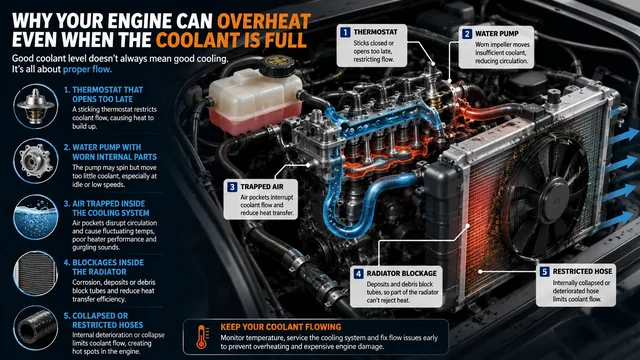
Your engine can overheat even when the coolant reservoir appears full, and no obvious leak is visible. Effective cooling depends on coolant circulating freely through the engine, radiator and connecting hoses. When that flow becomes restricted, uneven or poorly controlled, damaging heat can build up before the temperature gauge provides a clear warning. Recognising these commonly missed issues can help you address problems before they lead to a breakdown or costly engine repairs.
A Thermostat That Opens Too Late
The thermostat regulates coolant flow between your engine and radiator. It remains closed while the engine warms, then opens at a specified temperature so hot coolant can reach the radiator. A sticking thermostat may open only partially or later than intended, restricting circulation and causing the temperature to rise during longer journeys or under heavier engine loads.
You can sometimes mistake a thermostat fault for a weak water pump because both problems restrict coolant circulation. Testing should therefore consider the entire flow path rather than relying only on the temperature gauge or the condition of the coolant.
A Water Pump With Worn Internal Parts
Your water pump may appear functional externally while its internal impeller is worn, loose or damaged. The pump can therefore rotate without moving enough coolant through the engine. You may notice reduced flow most clearly at idle, in slow traffic or when the air conditioning increases the engine’s thermal load.
A failing pump does not always leak or make noise immediately. Some modified or supplementary cooling setups use electric pumps and controllers, including Davies Craig cooling system components, to manage circulation independently of engine speed. Whether your vehicle has a mechanical or electric pump, its output and compatibility with the wider cooling system should be checked when overheating persists.
Air Trapped Inside the Cooling System
Air can enter your cooling system after a coolant replacement, hose repair or work involving the radiator or water pump. Trapped pockets can interrupt circulation because air does not transfer heat as effectively as liquid coolant. You may notice fluctuating temperature readings, poor cabin heating or a gurgling sound behind the dashboard.
Some vehicles require a specific bleeding procedure to remove trapped air. Simply filling the expansion tank may not be sufficient, particularly when bleed screws, elevated filling points or diagnostic equipment are required. Persistent air can also indicate a leaking hose connection, radiator cap fault or combustion gases entering the cooling system.
Blockages Inside the Radiator
Coolant must pass through numerous narrow radiator tubes to release heat into the surrounding air. Corrosion, incompatible coolants and mineral deposits can obstruct these passages, leaving only part of the radiator able to transfer heat. Your engine may run normally under light conditions but overheat during motorway driving, towing or hot Australian weather.
External debris can create a similar problem by blocking airflow through the radiator fins. Research into dirt accumulation on engine radiators found that coolant temperature increased in proportion to the amount of heat-transfer area covered by silt or mud. You can easily overlook insects, leaves and dirt trapped between the radiator and air-conditioning condenser, so these areas should be included in an inspection when overheating occurs. A technician can also compare temperatures across the radiator to identify cold sections associated with restricted internal flow.
Collapsed or Restricted Coolant Hoses
Your cooling hoses can deteriorate internally even when their outer surfaces look acceptable. Softening, separation of internal layers, or accumulated deposits may narrow a passage and limit coolant movement. A lower radiator hose can also collapse under suction if its internal reinforcement has weakened.
Look beyond visible cracks and leaks when inspecting hoses. A hose that feels unusually soft, swollen or uneven may be compromised. Restrictions can also develop in smaller bypass or heater hoses, creating localised hot spots or inconsistent cabin-heater performance.
Keeping Your Coolant Moving Reliably
Coolant level is only one part of managing your engine’s temperature. A delayed thermostat, trapped air, weak water pump, deteriorated hose or restricted radiator can all reduce circulation without producing an immediate leak. By investigating fluctuating temperatures, weak cabin heating and recurring overheating early, you can address the underlying flow problem before serious engine damage occurs.