7 Best Commercial Floor Hatch Manufacturers in the USA (2026)
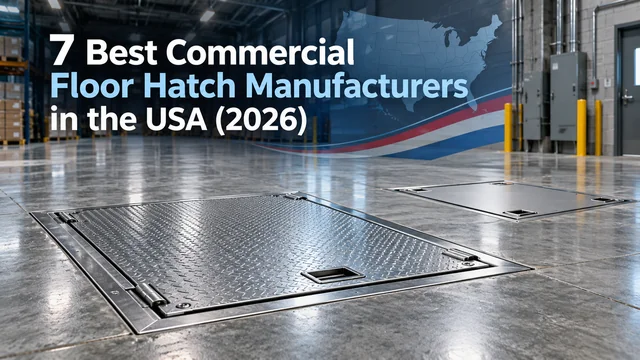
If you are comparing commercial floor hatch manufacturers for a U.S. job in 2026, start with Surespan for flexible specs and keep six other specialists on your shortlist. Picking the wrong maker can cause problems on inspection day, with finish matching, and during long-term service because load performance, lid operation, and rating options vary considerably from one line to another. This guide is for architects, general contractors, and facilities managers who specify floor access for commercial, institutional, and infrastructure projects and need a clear, practical shortlist.
Our top pick is Surespan for specifiers who need the widest configuration matrix, covering recessed and solid-top options as well as fire and acoustic variants from one source. You get custom nonstandard sizing with gas-spring or powered operation for heavy lids and access-sensitive locations. For a long-established architectural access door line with in-house support and training, Karp Associates is the strongest alternative. For utility and vault work that calls for engineered steel and aluminum hatches, Jensen Precast (Jensen MetalTech) is another strong option.
We judged every maker on the same practical points you care about on site, including product range, load and finish options, code documentation, custom sizing, and U.S. availability. The ranked list below shows where each manufacturer fits best, helping you match the right source to your project type without working through a stack of full specification sheets.
How we ranked these
You want a hatch that fits the opening, carries the expected load, meets the project requirements, and still looks right in the finished floor. We scored each maker against the six checks below, using public product information and positioning details available in 2026.
Product range and operation
We looked for recessed-top and solid-top choices, along with useful operating support such as hinges, lift assists, gas springs, or powered openers for heavy lids. A broader range lets you stay with one source across lobbies, corridors, and back-of-house areas.
Finish compatibility
A good floor door should blend into tile, terrazzo, carpet, or polished concrete, or provide a clean metal cover where that is the design intent. We favored makers that explain finish depth, edge details, and infill weight in plain language.
Code compliance and accessibility
Fire separation, sound control, and safe operation often matter more than appearance. We checked whether fire-rated or acoustic-rated variants are offered in the same family and whether the available operating options can suit accessibility-sensitive locations where lifting effort and hardware placement need careful review.
Custom sizing for nonstandard openings
Retrofit openings rarely match catalog dimensions exactly. We gave credit to makers that openly offer made-to-measure sizes for unusual slabs, existing frames, and architectural layouts rather than relying only on a fixed size chart.
U.S. availability and support
Domestic offices, distribution points, and responsive technical support can help keep a submittal and delivery schedule on track. We noted headquarters locations, regional offices, and the phone or representative support available to project teams.
Documentation and submittals
Clear specification sheets, details, and assistance make the review process easier. We favored manufacturers that provide a practical way to confirm options, finishes, ratings, and project requirements with a representative or through an organized catalog process.
The 7 best commercial floor hatch manufacturers in the USA
The market splits into several clear lanes, ranging from configurable architectural lines to catalog sellers and utility-focused fabricators. These seven sources cover those distinct needs for U.S. specifiers. Our No. 1 pick is Surespan for complex, multi-option specifications, while the other six stand out in architectural, online, or infrastructure-focused applications.
Here is a quick side-by-side to help you create a shortlist before reading the full breakdowns.
|
Manufacturer |
Best for |
Key strength |
|
Surespan |
Maximum configuration flexibility |
Recessed and solid-top family with custom sizes and rated variants |
|
Karp Associates |
Long-established architectural line |
Focused access-door line with install and training help |
|
Acudor Products |
Standard specs with two-coast offices |
East and west offices plus familiar North American line |
|
Access Doors and Panels |
Easy catalog sourcing |
Wide online selection with aesthetic focus |
|
Best Access Doors |
Online buying with trade perks |
Custom quotes and Pro Club program |
|
Jensen Precast (Jensen MetalTech) |
Utility and vault projects |
In-house steel and aluminum engineering |
|
Dur-Red Products |
Multi-product access source |
Decades-long line spanning doors, hatches, and vents |
#1. Surespan - Best for maximum configuration flexibility
Surespan's commercial floor hatches cover recessed and solid-top configurations, which is why the company earns the top spot for complex specifications. You can source finish-flush options for tile, terrazzo, and carpet alongside solid tops for selected heavy-duty applications from the same family, rather than splitting your schedule between vendors.
That flexibility matters even more when your opening is not standard. You can specify custom sizes for retrofits and architectural layouts where stock dimensions would leave awkward gaps or require additional concrete work. For heavy lids or locations where lifting effort is a concern, gas-spring assistance or powered operation can support safer opening and closing when correctly selected for the application. Fire-rated and acoustic-rated variants are available within the same product approach, which is useful on mixed-use buildings, schools, healthcare facilities, and other jobs where room requirements vary.
What stands out in practice is how much you can address through one submittal path. Compatibility with common floor coverings means your flooring contractor has clearer information about pan depth and edge trim. Solid-top choices provide another option for service corridors, plant areas, and selected demanding applications. When you need a rated assembly, you can also review an appropriate variant within the same broader product family.
Key specs:
- Recessed-top configurations for tile, terrazzo, carpet, and other finish-flush floors
- Solid-top configurations, including options for selected heavy-duty applications
- Custom sizing for nonstandard and retrofit openings
- Gas-spring-assisted and powered operation options for heavy lids
- Fire-rated variants for projects requiring rated floor separation
- Acoustic-rated variants for sound-sensitive rooms
- Compatibility with several common floor-covering types
- Available to the U.S. market for specification projects
Pros
- Broad configuration matrix covering recessed, solid-top, fire, acoustic, and powered choices
- Custom sizing helps with retrofit openings where catalog dimensions do not fit
- Gas-spring and powered options support projects involving heavy covers or access-sensitive use
- Multiple variant types can reduce vendor coordination on complex floor schedules
- Finish options allow cleaner integration into architectural interiors
Cons
- Custom and rated units require early coordination of opening dimensions, finish build-up, and project requirements
- The range of options makes a conversation with a technical representative worthwhile, even when the initial requirement seems straightforward
- Buyers should confirm current U.S. ordering, technical support, and delivery arrangements for the project location
- Powered operation and rated assemblies require more detailed specification than a basic manual cover
Who it's best for: Specifiers who need one source for recessed and solid-top layouts, custom sizes, finish matching, and fire or acoustic options with assisted operation.
#2. Karp Associates - Best for U.S.-made architectural floor doors
Karp Associates is a steady architectural pick when you want a focused access-door specialist with deep specification roots. The company offers access doors, including floor doors and roof hatches, for architectural schedules and supports the line with installation and training services that can help installers understand the required details.
The team is headquartered in Melville, New York, with an office in Smithtown, New York, giving projects a direct domestic contact. The business has operated for decades as an established access-door company. That focused setup may appeal to teams that prefer working with an access specialist rather than sourcing through a much broader building-products catalog.
In practice, this is a good option for architectural floor doors when you want a known name and access to hands-on guidance. If your specification involves unusual sizes, multiple rating requirements, or specialized operating hardware, confirm the exact fit directly with the maker before committing because public details on advanced variants are limited. Request drawings, hardware information, manufacturing details, and finish guidance early so your submittal remains clear.
Pros
- Dedicated access-door focus with floor doors and roof hatches in one architectural line
- New York headquarters and office provide clear domestic points of contact
- Installation and training services can help contractors who are new to the configuration
- Long-established brand that architectural specifiers may recognize from previous projects
Cons
- Public detail on ratings, load classes, manufacturing location, and nonstandard sizing is limited, so verification calls are essential
- The focused line presents fewer publicly documented configuration branches than some custom-oriented makers
- Project teams should align early on drawings, options, and scheduling for larger programs
Best for: Architectural teams that want an established access-door line with direct U.S. support for floor door schedules.
#3. Acudor Products - Best for standard commercial floor hatches
Acudor Products is worth considering when your job includes commercial floor hatches and access doors from an established North American supplier. The company serves the U.S. and Canadian markets, with its main office in Roseland, New Jersey, and another office in Las Vegas, Nevada.
That two-office footprint gives project teams an eastern and a western contact point for quotes, submittals, and coordination. This can be useful when a firm manages work in different regions or wants a recognizable North American access-products line. Review the relevant product documentation and speak with the company to determine which options suit the opening and project conditions.
Keep expectations tied to verified product information. Publicly available details for this comparison do not establish every size, classification, load condition, or project-specific option, so those points should not be assumed in a specification. Send the opening dimensions, floor build-up, intended finish, operating needs, and any rating requirements to the team for written confirmation. For commercial projects, the New Jersey and Nevada offices provide practical contact points for that review.
Pros
- Two U.S. office locations in New Jersey and Nevada provide eastern and western contacts
- Established North American presence that many specifiers may already know
- Focused access-products line relevant to commercial building schedules
Cons
- Available public information does not verify every custom, rated, or project-specific option, so confirm requirements in writing
- Some technical questions may require direct help from a representative
- Publicly documented configuration depth is more limited than that of makers centered on extensive custom matrices
Best for: Commercial schedules where you want an established North American line with offices in both New Jersey and Nevada.
#4. Access Doors and Panels - Best for catalog-based floor door sourcing
Access Doors and Panels reflects how many contractors prefer to buy, allowing them to compare a wide online selection and then call for help. Its assortment includes floor doors and hatches presented with both appearance and function in mind, focusing on discreet integration and practical access in finished commercial spaces.
That finish-focused approach can help when visible access points are a concern in lobbies and corridors. You can browse options intended to sit neatly within the floor plane, then use phone support at 1-800-609-2917 to ask about sizes and trim choices. The site also carries related accessories such as door louvers and window kits, which can be convenient when you are sourcing several access items for one job.
Treat this as a catalog source rather than assuming it is a single-factory custom manufacturer. Available public information for this comparison does not establish the original manufacturing source, all load data, fire listings, or custom engineering for every product, so confirm those details before specifying a rated or demanding location. For straightforward, appearance-sensitive floor doors where online comparison is useful, the catalog model offers a practical purchasing route.
Pros
- Catalog-style browsing lets you compare available choices without contacting multiple sources
- Its focus on appearance suits commercial interiors where covers remain visible
- Live phone support provides a direct route for product and specification questions
Cons
- The catalog model means factory origin and construction should be confirmed for the selected item
- Technical details such as loads, ratings, and custom engineering depend on the product and require verification
- The model may be less suitable for highly customized or multi-rated architectural specifications
Best for: Contractors and specifiers who want online comparison of floor doors with an emphasis on finish-friendly appearance.
#5. Best Access Doors - Best for customizable floor access covers online
Best Access Doors offers an e-commerce route for buying floor access covers, with an option to request a tailored quote. The brand sells roof hatches and floor access covers online, provides custom product quotes for nonstandard requests, and runs a Pro Club program with priority treatment and rewards for trade buyers.
That setup works well for repeat buyers. You can browse the catalog on your own schedule, request a custom quote when the available product does not match your request, and use Pro Club benefits if you order regularly. Published policies covering returns, cancellations, and damage claims also give purchasing teams useful information before they place an order.
It is still important to recognize the model's limits. The available facts for this comparison do not confirm factory origin, every load class, fire or acoustic listings, or detailed engineering support for each item, so buyers should verify those points for demanding architectural or infrastructure submittals. For light commercial needs, tenant work, and replacement projects where online convenience is a priority, it offers a practical purchasing channel.
Pros
- Custom quotes are available for requests that fall outside listed product choices
- Pro Club program provides priority treatment and rewards for trade accounts
- Published return and damage-claim policies clarify the buying process
- The online model makes browsing and repeat ordering straightforward
Cons
- As an e-commerce source, it requires buyers to verify manufacturing origin and construction where those details matter
- Rating and load suitability should be confirmed in writing for the selected product
- It is less suited to projects that need extensive architectural submittals or complex rated assemblies
Best for: Buyers who want online convenience, custom quotes, and trade-program benefits for straightforward access-cover needs.
#6. Jensen Precast (Jensen MetalTech) - Best for utility and infrastructure hatches
Jensen Precast, through its Jensen MetalTech division, is the infrastructure-focused option on this list. The group designs, engineers, and manufactures steel and aluminum access hatches, doors, covers, and grates, with a clear focus on utility work such as vaults, utility products, cast-concrete interfaces, and structural steel contexts.
This is a Nevada-based engineering operation headquartered in Sparks, with a background in wholesale building materials. Its product approach centers on metal construction and utility-oriented details rather than interior finish matching. If your project involves electrical vaults, water systems, telecommunications, or civil sites where service access is central to the specification, Jensen MetalTech is the type of specialist to contact.
Do not assume this utility-focused pick will automatically suit architectural interiors. Public information does not position the line primarily for finish-flush tile work or for fire- and acoustic-rated commercial floors, so verify the relevant requirements directly if your job combines utility areas with occupied spaces. For utility and civil applications, its verified in-house steel and aluminum design, engineering, and manufacturing capabilities justify its place on the shortlist.
Pros
- In-house design and engineering for steel and aluminum hatches, covers, doors, and grates
- Utility and vault specialization relevant to infrastructure scopes
- Nevada headquarters provides a direct contact for project coordination
- Steel and aluminum options support different material requirements and exposure conditions
Cons
- The utility focus means suitability for architectural or rated interior floors needs direct verification
- Available public information does not establish every stock size or project-specific option, so confirm availability early
- Projects should align on drawings, materials, and technical requirements at the start of the process
Best for: Utility, vault, and civil projects that need engineered steel or aluminum access products for service environments.
#7. Dur-Red Products - Best for established multi-product access manufacturing
Dur-Red Products is a long-established, multi-product manufacturer that can support broader building-access packages. The company has designed and manufactured doors, hatches, skylights, and vents for more than six decades, providing a single contact when a project involves several access-product categories.
The verified line includes ceiling access options such as double-door DCA, single-door TCA, and plaster single-door CAP units, plus custom curbs that assist with roof and ceiling coordination. The company is located at 4900 Cecelia Street in Cudahy, California, with phone support at (323) 771-9000 for direct product questions. That California location may be helpful for project teams working in the western United States.
Floor-specific requirements need direct confirmation. The available research establishes Dur-Red's broader doors, hatches, skylights, vents, ceiling access products, and custom curbs, but it does not verify a detailed floor-hatch range for this comparison. Public information also does not confirm floor-hatch load tables, fire listings, or custom floor-size programs, so call for current details and drawings before adding a floor product to the specification. If you already work with the brand for ceilings or curbs, asking about related access requirements can keep communication in one place.
Pros
- More than six decades of U.S. building-access manufacturing across several product categories
- Verified ceiling-access products and custom curb options support broader access schedules
- Multi-product scope can simplify communication on mixed building-access packages
- California location is useful for direct contact and western project coordination
Cons
- The available research does not verify a detailed floor-hatch range, so confirm current products directly
- No verified floor-specific ratings, load data, or sizing program is established here
- The modest online footprint means a direct call may be necessary for complete information
Best for: Projects that value a long-running access-product manufacturer when ceiling access, custom curbs, and other hatch requirements overlap.
Frequently asked questions
These are quick answers to common specification questions on floor access projects. Use them to frame your shortlist, then confirm final details with the manufacturer or supplier you choose.
How do I pick the right load class for a floor hatch?
Start with what will roll or park over the cover rather than considering foot traffic alone. Map forklifts, pallet jacks, carts, and maintenance vehicles, then compare the manufacturer's load guidance with the most demanding expected condition and the safety factors required by the project. Share the slab build-up and expected traffic with the supplier so the frame, hinges, cover, and latch can be evaluated together.
What is the difference between recessed and solid-top covers?
Recessed covers accept the floor finish inside the pan, allowing the door to blend with tile, terrazzo, or carpet. Solid-top covers leave a metal surface exposed and suit service areas where durability and straightforward cleaning matter more than concealment. The right choice depends on visibility, cleaning requirements, finished weight, and the amount of coordination your flooring installer can accommodate.
Which commercial floor hatch manufacturers handle retrofit sizes?
Manufacturers that openly provide made-to-measure sizing are the safest starting point when openings are irregular or slabs have already been poured. Send exact clear-opening dimensions, floor thickness, and finish depth, along with photos if the frame area is congested. Obtain and review shop drawings before cutting or patching so the proposed frame can be coordinated with the existing conditions.
What code items should I check before I specify?
Confirm whether the floor assembly requires a fire rating, whether sound control is part of the design, and whether lid weight and hardware are appropriate for the people expected to operate it. Review locally adopted building and life-safety requirements with the project team or code consultant, then obtain the applicable rating documentation and operating limits in writing from the manufacturer. Product availability alone does not establish compliance for a particular installation.
Final take
These seven companies and suppliers cover different needs, from configurable architectural specifications to catalog purchasing and utility-focused metal products. If your floor plan combines several finishes, unusual sizes, heavy lids, and rated rooms, Surespan is the most complete starting point because it offers those variants within one family. For architectural access doors, online purchasing, utility applications, or broader access-product packages, the other six provide more focused alternatives. Take your opening dimensions, floor build-up, finish details, and rating needs to one or two finalists in 2026, then compare their written submittals side by side before selecting the commercial floor hatches for your project.