Minneapolis Tech Community Resilience During ICE Raids
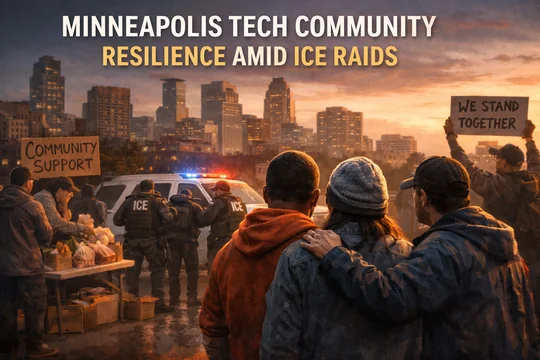
Minneapolis Tech Community Resilience Amid ICE Raids
Minneapolis is experiencing one of the most intense periods of immigration enforcement in its history. What makes this moment especially significant isn’t just the scale of federal action—it’s how deeply it has disrupted daily life, including the city’s growing tech ecosystem.
This story is not simply about politics or policy. It’s about how fear, solidarity, and resilience are reshaping how founders, investors, and employees show up for their work—and for one another.
Key Facts: What’s Happening on the Ground
Over the past several weeks, federal immigration agents have dramatically increased raids across Minneapolis and the surrounding Twin Cities. More than 3,000 agents have reportedly been deployed as part of “Operation Metro Surge,” outnumbering local police.
According to TechCrunch, multiple people have been killed during these operations, including U.S. citizens. ICE agents have been seen near schools, workplaces, homes, and public transit. As a result, many residents—especially people of color and immigrants—are afraid to leave their homes.
Within the Minneapolis tech community, founders and investors report pausing product work, fundraising, and hiring. Instead, they’re spending time volunteering, delivering food, checking on neighbors, and helping employees stay safe.
Why This Matters to the Tech Industry
The Minneapolis tech community is small but influential, having raised over $1 billion in recent years. Like most tech hubs, it relies heavily on immigrant talent, visa holders, and global collaboration.
When engineers are afraid to commute, attend meetings, or even grocery shop, productivity becomes secondary to survival. Several founders told TechCrunch that team morale and focus have suffered significantly. One described the environment as “what happens after a natural disaster.”
This moment highlights a larger trend: tech ecosystems are not insulated from social or political instability. Policies enacted far from startup offices can still halt innovation on the ground.
The Human Cost Behind the Metrics
Beyond slowed growth and delayed roadmaps, the emotional toll is severe. Founders report carrying passports daily despite being U.S. citizens. Some employees on H-1B visas say they’ve been followed by armed agents.
One founder recalled ending a work call to check on his mother after a colleague witnessed an ICE detention nearby. Another said, “It’s hard to focus; it’s been a challenge just navigating my team through it.”
These stories reveal a truth often missing from startup narratives: psychological safety is foundational to innovation.
Grassroots Support vs. Corporate Silence
While major Minnesota-based corporations have issued statements calling for “de-escalation,” many in the startup community feel these responses fall short.
Grassroots efforts, by contrast, have been swift and tangible:
-
Founders pooling money to buy groceries for immigrant students
-
Parents organizing shared childcare when daycare staff are detained
-
Restaurants offering free meals
-
Tech nonprofits hosting community forums
As one investor told TechCrunch, disappointment runs deepest when large institutions fail to show moral clarity during crisis.
This gap between corporate messaging and community action may reshape how tech workers evaluate leadership in the future.
What Comes Next: Implications and Predictions
In the short term, expect continued disruption. Remote work policies, altered commute habits, and slower hiring are likely to persist as long as raids continue.
Longer term, Minneapolis may face a talent retention challenge. If founders and engineers feel unsafe, some will relocate—taking companies, capital, and innovation with them.
At the same time, this period could redefine the Minneapolis tech community’s identity. The emphasis on mutual aid, cross-cultural solidarity, and ethical leadership may become a lasting differentiator.
For readers wondering what they can do, practical actions include supporting local nonprofits, checking in on colleagues, and advocating for transparent workplace policies that protect immigrant employees.
A Forward-Looking Conclusion
The Minneapolis tech community is being tested—not by market forces, but by fear and uncertainty. Yet, as reported by TechCrunch, the response from founders and investors shows that innovation doesn’t disappear in hard times; it adapts.
If resilience, empathy, and collective action continue to define this moment, Minneapolis may emerge not weaker, but more human-centered than before.
FAQ SECTION:
Q: What is happening with immigration raids in Minneapolis?
A: Immigration raids have intensified across Minneapolis, with thousands of federal agents deployed. According to TechCrunch, these operations have included detentions near homes, schools, and workplaces, creating widespread fear and disruption.
Q: How are ICE raids affecting tech companies in Minnesota?
A: Many tech founders report paused work, remote-only policies, and emotional strain on teams. Immigrant employees and visa holders are especially impacted, affecting productivity and hiring.
Q: Why is the Minneapolis tech community responding with grassroots efforts?
A: With limited corporate action, individuals are stepping in directly—buying food, organizing childcare, and offering emotional support—to meet urgent community needs.