What Small Publishers Should Budget for Before Monetizing a Website
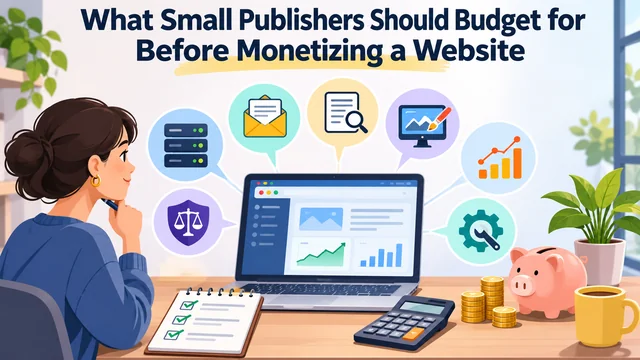
Small publishers often treat ads as free money that starts the day a banner goes live. The reality is less forgiving: monetization adds costs before it pays, and those costs decide whether the site makes money at all.
Run the break-even numbers first
Every monetization plan should start on a spreadsheet, not in an ad dashboard. Take hypothetical monthly pageviews, divide by 1,000, multiply by a hypothetical pageview RPM for the niche and audience mix, then subtract hosting, domain renewals, tools, and content costs for the same month. If the result is negative, ads won't fix it yet.
Pageviews and sessions are the unit that gets sold. Most small sites sell that inventory through programmatic advertising, where each impression goes into an automated auction in milliseconds; the winning bid sets the CPM, cost per thousand impressions. Publishers should track revenue per 1,000 pageviews or sessions for planning. Pageview RPM is the number that ties traffic directly to money in the bank.
A short hypothetical illustration helps: assume 50,000 monthly pageviews and a hypothetical $8 pageview RPM. Estimated monthly revenue would be $400. If that RPM already reflects the publisher's share after network deductions, do not subtract the same share again; record the basis of the estimate. If fixed costs are $250, the margin is thin, and if fixed costs are $500, the site loses money even with ads running, so don't guess at RPM. Look at public RPM ranges for the niche and discount them for a new site with limited history.
Niche and audience change that RPM a lot. Finance and business topics attract higher bids than entertainment because more advertisers compete for that reader intent, and health content can price well too when trust signals are clear. Geographic mix pulls the other way: traffic from the United States and Western Europe tends to clear higher bids than traffic from regions with fewer active advertisers. A site with mostly lower-bid regional traffic needs far more pageviews to match a site with a concentrated high-bid audience.
Small publishers can't control auction prices, but they can control cost assumptions. Build two cases, one with a low hypothetical RPM and flat traffic, the other with a mid-range RPM and slow growth. If neither covers costs after three to four months, hold off on ads and put the budget into content and search growth first.
Budget for domains, SSL and renewals
Domain costs look small until renewals stack up. As a hypothetical planning range, allow $100 to $300 per year for domain registration and SSL renewals across a small portfolio, assuming one primary domain plus privacy protection and perhaps one or two test domains.
Avoid locking into multi-year hosting or tool discounts before the site has proven it can grow. A three-year prepay can look cheap per month, yet it traps cash that might be needed for content or speed fixes later. Keep renewals on a calendar with auto-renew turned on for the main domain; losing a domain over an expired card costs more in lost traffic than a year of hosting.
SSL is now table stakes. Most hosts include it at no extra charge, and browsers warn visitors away from sites without it, which cuts pageviews and means fewer ad impressions to sell. Check that renewal is automatic and that mixed-content warnings are fixed before applying to any ad network.
Get hosting that can carry ads
Hosting price alone does not establish whether a site can support ads. Many ad requests run in the visitor's browser against third-party servers, while the publisher's host still needs to deliver its own pages reliably. Test actual traffic capacity, response times, and caching before deciding that an upgrade is necessary. If pages do slow down, visitors may leave before later placements load. Hosting and ad-script performance need separate diagnosis rather than an automatic upgrade.
As an illustrative worksheet entry, a publisher might assign $20 to $40 per month to hosting and content delivery. That is a budget assumption, not a market quote or a guarantee of capacity. Replace it with actual renewal prices and the resources the site needs, including caching, backups, security, and traffic limits. A content delivery network also shortens load time by serving images and static files from locations near the reader.
The reason to spend here is behavior, not pride in fast scores. Google reported in 2016 that 53% of mobile visits in its benchmark data were likely to be abandoned when pages took more than three seconds to load. That historical finding supports attention to speed, but it is not a current abandonment forecast for a particular site. Core Web Vitals reward the same thing advertisers want: pages that load fast and stay stable while ads render.
Look at host limits before signing up: PHP workers, memory, bandwidth, and backup rules, plus how staging works and how support handles traffic surges. A host that makes caching and CDN setup simple saves hours later.
Fix speed before ad scripts go live
Ad snippets are among the heaviest scripts on a typical content site, so plan for speed work as a line item, not an afterthought: time or contractor budget for image compression and proper sizing, plus time to test caching and remove unused plugins and themes that load scripts on every page. These jobs are boring, but they directly protect RPM, since viewable, fast-loading impressions pay better than slow ones that never finish.
Lazy loading delays ad loading until the slot is close to the viewport, cutting wasted calls and helping initial page render. It needs setup and testing on both mobile and desktop layouts, and with infinite scroll if the theme uses it. A bad lazy-load setup can reduce viewability instead of helping it, so don't treat it as a toggle-and-forget fix.
Core Web Vitals should be measured before and after each change, using field data where possible rather than lab tests alone. Ads often cause late layout shifts when containers have no fixed size, so reserve space with CSS for each placement; that keeps content from jumping when the creative loads and keeps readers on the page long enough to scroll past a second impression.
Keep the ad layout light at first: one or two viewable placements that load cleanly will often earn more over time than five crowded slots that slow the page and drive readers away. Speed and density work against each other.
Pick a network that fits small numbers
Traffic thresholds decide who can even apply: some networks want 50,000 or 100,000 sessions per month, while others accept smaller sites and grow with them. Small publishers should filter first on fit, not headline CPM promises, since a high CPM doesn't help if the network can't fill much inventory or payout terms don't match a small budget.
What to compare before signing up
Start with fill rate, the share of ad requests that actually return a paid ad. A network with a lower quoted CPM but a strong fill rate can pay more overall than one with a high quote and thin demand. Demand varies by niche, site category, device, and audience country, with business readers on desktop pricing differently than entertainment readers on mobile.
Next look at revenue share and control. Every ad network keeps a cut for bringing demand and handling billing, a take rate publishers should understand, including whether it changes with volume. Control matters too: whether the publisher can block low-quality categories, set price floors, and choose formats per placement, since one bad placement can hurt trust fast.
Publishers comparing the best ad network for small publishers for their niche often look at minimum traffic rules and revenue share first, then test support quality during setup, since support matters once an ad tag breaks a layout or consent signals stop passing. A network that answers fast and helps with placement logic is worth more than a small bump in quoted rates. Look for clear docs on implementation, ads.txt, sellers.json, and reporting.
Don't sign exclusivity early. A 60 to 90 day test window is a reasonable hypothetical planning period for comparing setups without rushing, long enough to fix speed issues and gather data across weekdays and weekends.
Plan for consent and privacy rules
Review privacy obligations for the site's audience and business model, including relevant European and state-level requirements. Notice, consent, and opt-out obligations differ by jurisdiction and data use; a European consent model and California choice requirements are not interchangeable. Budget for qualified guidance when needed. Without a proper consent signal, many demand partners will bid less or skip the impression, which lowers eCPM even when traffic holds steady.
A consent management platform can support notices and preference handling, but a tool alone does not establish compliance. Some are free at low volume, while others charge a monthly fee based on pageviews or domains. Even a free tool costs time to install, style the banner, set vendor lists, and test that consent strings pass to ad partners, and that work should happen before ads go live, not after revenue dips.
A generic cookie message may not satisfy an ad partner's requirements. Ask which frameworks and standardized signals the network supports, and test that the chosen implementation passes them correctly. Document what was set up and review it when traffic sources change, since a site that adds a lot of new European traffic halfway through the year may need to revisit categories and vendors.
Treat content and tools as running costs
Ad networks review site quality, and thin pages, scraped text, and long gaps with no new posts can lead to rejection or limited demand. Content is not a one-time launch cost; it is the fuel that keeps pageview growth paying for itself, so small publishers should budget either cash for freelance help or honest hours each week for writing and updating.
Updates count as much as new posts: refresh old winners with new facts and better images, fix headlines that overpromise, and cut posts that get no traffic and add no value. A smaller library of solid pages will often monetize better than a large library of weak ones, and quality helps search stability too.
Analytics options without a big bill
Measurement doesn't have to be pricey, but it can't be skipped. At minimum, use Google Search Console and GA4 to track queries, clicks, and behavior by page, though those free tools demand time to learn. Paid SEO and analytics tools save time with keyword tracking and site audits but add $30 to $150 per month in hypothetical planning terms; many publishers start free and add one paid tool once traffic covers it.
Pick one reporting habit and stick with it: track sessions, pageviews per session, top landing pages, and RPM by page group. That small set links content effort to money and makes ad tests cleaner, since a placement change that lifts RPM on one template but hurts time on page on another becomes visible instead of guesswork.
Testing itself needs a budget line: someone has to build variants, watch reports, and roll back losers, since ad placements, formats, and refresh behavior all interact with layout and speed. A short refresh interval can inflate impressions while hurting viewability and drawing complaints, so test one change at a time and give each test enough traffic to mean something.
Leave room for testing and payout delays
The first ad setup is rarely the most profitable one. As an illustrative planning window, reserve time for 60 to 90 days of post-launch review: test placements above and below the fold, display units against native or sticky units where policy allows, and density on long articles versus short news posts. Keep notes on what changed and when, since small traffic means noisy data and patience beats quick tweaks.
Cash flow needs the same cushion. Read the chosen network's actual threshold, payment cycle, approval rules, and fees. For a hypothetical cash-flow plan, a network might use a $100 threshold and Net 60 terms; use those only as planning assumptions, replacing them with the selected network's written terms. Small balances can take additional cycles to reach a threshold. Small publishers should hold one to two months of operating cash to cover hosting, tools, and content help while waiting, or a good traffic month can still feel like a loss.
Watch fees and currency effects too: some payment methods carry fixed charges that bite small balances, so it can make sense to let earnings build for an extra cycle rather than withdraw the smallest amount allowed. Read the payment rules before growth, not when bills are due.
Monetization works best when treated like a small business with fixed costs and delayed income. Budget for speed, consent, content, and testing time, and keep hosting strong enough to carry ad weight. Match the network to current traffic instead of chasing promises, and do that math first so ads become a steady line of revenue instead of a surprise bill.