Types of Collars: The Complete 2026 Style Guide
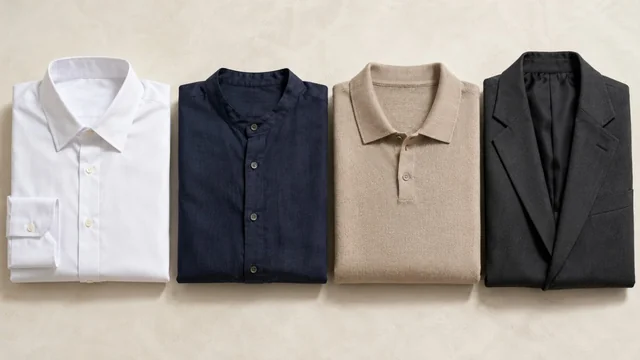
From a crisp point collar on a dress shirt to a soft cowl on a winter sweater, the collar is the single detail that frames your face and sets the tone of an outfit. This guide breaks down every major collar type across shirts, blouses, dresses, knitwear and coats, explaining what each one looks like and when to wear it. By the end you'll be able to name any collar on sight and pick the styles that flatter you most.
Key takeaways:
- A collar's main job is to frame your face, so the right style balances your face shape rather than echoing it.
- Dress-shirt collars are defined by spread — point (narrow), spread (medium-wide) and cutaway (widest) — which dictates the tie knot they suit.
- Casual collars like the polo, band, camp/Cuban and shawl prioritise comfort and ventilation over formality.
- Statement collars such as Peter Pan, Bertha, sailor, jabot and pussy-bow add personality and a vintage or feminine touch to blouses and dresses.
- On jackets and coats the lapel does the talking: notch for everyday, peak for formal, and shawl for black-tie.
Classic Dress-Shirt Collars
These are the formal and business collars you'll find on a tailored dress shirt. The main difference between them is the "spread" — the distance between the two collar points — which determines how much of the shirt and tie knot is on show.
- Point (straight-point) collar — The most traditional collar, with points set close together (roughly 1.5"–3.5" apart). It elongates the face and pairs best with a slim tie knot; a safe, conservative choice for business.
- Spread collar — Points sit wider apart (about 4"–6"), opening up the neck for a more contemporary, European look. It handles both small and large tie knots and works with or without a jacket.
- Cutaway (extreme spread) collar — The widest spread of all (6.5"–8.5"), with points angled so far back they look "cut away." It frames a large Windsor knot beautifully but is too bold for most corporate dress codes.
- Button-down collar — Invented by Brooks Brothers in 1896, its points fasten to the shirt with small buttons. The most casual of the dress collars, it's the backbone of the business-casual and Ivy/Oxford look.
- Club (rounded) collar — A short collar with the points rounded off, giving a distinctly vintage, preppy feel. Great for adding character to a casual or retro-leaning outfit.
- Tab collar — Two small fabric tabs snap or button together behind the tie knot, pushing it up and forward for a neat, three-dimensional look. Always worn with a tie.
- Pin collar — Similar in spirit to the tab, but a metal bar (collar pin) passes through eyelets on each point to lift the tie knot into a sharp arch. A dressy, sprezzatura detail.
- Wing collar — A short stand-up collar with the front points folded out like wings. The most formal collar there is, reserved for bow ties at black-tie and white-tie events.
Casual & Knit Collars
Relaxed, often unstructured collars built for comfort and warm-weather or off-duty wear, plus the soft collars found on T-shirts and sweaters.
- Polo collar — The soft, foldable ribbed collar on a knit polo shirt, with a short buttoned placket. Smart-casual and versatile, equally at home on the golf course or under a blazer.
- Henley — Technically a placket-and-neckband rather than a folded collar: a collarless round neckline with a short buttoned opening. Easygoing and layering-friendly.
- Mandarin / band collar — A short, unfolded stand-up band that rises around the neck without points or a fold. Minimalist and modern; the mandarin (with a small front gap) has roots in Chinese dress, while a plain band collar reads cleanly contemporary.
- Camp / Cuban collar — A flat, open collar with a notch that lies against the chest, usually on a boxy short-sleeve shirt. A 1950s vacation classic that's breezy and ventilating; "camp" tends to be softer and "Cuban" slightly more structured, but the terms are largely interchangeable.
- Shawl collar — A smooth, rounded collar with no break or notch, most familiar on cardigans, dressing gowns and dinner jackets. Old-Hollywood elegance in knitwear form.
- Turtleneck (roll/polo neck) — A high, close-fitting ribbed tube that folds over on itself. Warm, sleek and effortlessly chic.
- Mock neck — A shorter stand-up neckline that mimics a turtleneck without the fold-over — part crewneck, part turtleneck, and very of-the-moment.
Women's Blouse & Dress Collars
Decorative and softly tailored collars most associated with blouses, dresses and womenswear, ranging from sweet and retro to dramatic and statement-making.
- Peter Pan collar — A small, flat collar with rounded edges that sits neatly around the neckline. Sweet and retro; a staple on dresses, blouses and children's wear.
- Bertha collar — A wide, flat collar that drapes over the shoulders and chest in a full circle, often in lace. Dramatic and elegant, with a Victorian, regal feel.
- Sailor collar — Borrowed from naval uniforms, it's square at the back and tapers to a V at the front, usually trimmed with stripes. Nautical and playful.
- Jabot collar — A cascade of ruffles or pleated fabric down the front of the neckline. Romantic and ornamental, lending a vintage, dressy touch.
- Pussy-bow (lavalliere) collar — A long fabric tie at the neck fastened into a soft bow. Feminine and polished; a boardroom-to-evening favourite.
- Cowl collar — A soft, bias-cut neckline that drapes in loose folds, like a wide, relaxed turtleneck. Elegant and fluid, flattering on knits and jersey dresses.
- Halter — Strictly a neckline rather than a collar: the fabric or straps wrap around the back of the neck, leaving the shoulders and upper back bare. Striking on evening and summer dresses.
Jacket & Coat Collars and Lapels
On tailored jackets and coats the "collar" is usually a lapel — the folded flap that frames the front opening — though some outerwear uses standing collars instead. The lapel style is the quickest signal of how formal a jacket is.
- Notch lapel — The most common lapel, with a small notch (a "step") where the collar meets the lapel. The default on business suits, blazers and sport coats — timeless and versatile.
- Peak lapel — The lapel points jut sharply upward toward the shoulder, past the collar line. More formal and assertive; standard on double-breasted jackets and dressier single-breasted suits and tuxedos.
- Shawl lapel — A single, unbroken curved edge with no notch or peak, sweeping smoothly down from the collar. The classic choice for tuxedos and dinner jackets.
- Stand (mandarin/Nehru) collar — A short upright band that replaces lapels entirely, leaving a clean, collarless front. Modern and minimal on jackets and coats.
- Funnel collar — A tall, wide collar that stands up and curves around the neck like a funnel, without folding over. Common on coats and technical outerwear for warmth and wind protection.
- Convertible collar — A one-piece collar that can be buttoned up to the throat or worn open to form small lapels. Practical and adaptable, seen on overshirts, field jackets and casual shirts.
How to Choose the Right Collar
Match the collar to your face shape. The trick is balance: collars create lines that either elongate or widen the face. If you have a round or fuller face, narrow point or button-down collars add vertical length and a slimming effect. If your face is long or oblong, a wider spread collar adds horizontal balance and fills out the frame. Oval and balanced faces are the most flexible and can wear almost anything, while strong square jaws are often softened by point collars rather than wide spreads.
Mind your neck and proportions. A long, slim neck is flattered by taller collar bands and stand collars like the mandarin or turtleneck, which fill the space. A shorter neck looks better with lower collar bands and avoids bulky fold-overs that visually compress it. As a rule, keep collar scale in proportion to your build — a small collar can look lost on a larger frame, and an oversized statement collar can overwhelm a petite one.
Read the occasion. Formality runs roughly from most dressy to most casual: wing and peak/shawl lapels for black tie, point and spread collars for business and dressy occasions, then button-down, club, camp and band collars for smart-casual and weekend wear. Match the tie knot to the spread too — slim knots suit narrow point collars, while wide spreads and cutaways are built for full Windsor knots.
Look after fit and care. A good collar should close with about one finger's room at the neck — too tight bunches the fabric, too loose looks sloppy. Use collar stays in point and spread shirts to keep the points crisp, fasten the top button before steaming or pressing, and store structured collars flat or hung so they hold their shape rather than curling.
Sources & Further Reading
- Proper Cloth — Dress Shirt Collar Styles reference
- Permanent Style — The guide to shirt collars and what suits you
- Wikipedia — Lapel (notch, peak and shawl)
- Gentleman's Gazette — Shirt Collar Styles: A Complete Guide
Frequently Asked Questions
What is the most versatile collar style?
The spread collar is widely considered the most versatile dress-shirt collar because it suits almost every face shape, accommodates both small and large tie knots, and looks correct with or without a jacket. For casual wardrobes, the button-down collar plays a similar all-rounder role. If you can only own one dress shirt, a medium (semi-)spread is the safest single choice.
What's the difference between a collar and a lapel?
A collar is the band of fabric that sits around the neckline, and on shirts it often folds down into points. A lapel is the folded-back flap on the front of a tailored jacket or coat, formed where the collar continues down past the buttoning point. In short, shirts have collars, and suit jackets have collars that extend into lapels (notch, peak or shawl).
Which collar is best for a round face?
Narrow collars work best for round or fuller faces because their vertical lines lengthen and slim the face. A classic point collar or a button-down is ideal, ideally paired with a slimmer tie knot. Avoid very wide spread or cutaway collars, which add width and can make a round face look broader.
What is a camp collar, and is it the same as a Cuban collar?
A camp collar is a flat, open, notched collar found on relaxed short-sleeve shirts, designed to lie open against the chest for ventilation. The term is largely interchangeable with "Cuban collar," though Cuban versions are sometimes slightly more structured with a defined V. Both are casual, retro-1950s styles best for warm weather and vacation dressing, not formal occasions.
Which collars are appropriate for formal or black-tie events?
For black tie, the wing collar shirt worn with a bow tie is the most formal option, alongside a pleated or marcella-front shirt. The jacket itself should have a shawl or peak lapel, the two lapel styles associated with tuxedos and dinner jackets. Standard point and spread collars work for business-formal and dressy daytime events but aren't true black-tie collars.
This guide is for general styling information only. Information is based on public sources and vendor pages current as of June 2026. Prices, plans and features change frequently — verify on the official site before purchasing. SaveDelete may earn a small commission on purchases made through some links on this page, at no extra cost to you.