You don't often hear the boss of a trillion-dollar tech company pour cold water on the technology he's staked everything on. But at an internal Meta town hall on July 2, Mark Zuckerberg did exactly that — telling employees that AI agents simply haven't improved as fast as he'd hoped.
His exact words, per reports from the meeting: "The trajectory of the agentic development over at least the last four months hasn't really accelerated in the way that we expected." He added that some of the company's big bets "haven't come to fruition yet."
What Zuckerberg Actually Said
The comment was measured, not panicked. Zuckerberg wasn't declaring failure — he was managing expectations. Progress on agentic AI, the buzzy idea of AI that does things rather than just chats, has been real but slower and bumpier than the industry's breathless timelines promised.
For a CEO who has publicly talked about AI "superintelligence" as an imminent, world-changing goal, admitting that four months have passed without the acceleration he expected is a striking shift in tone.
The $100 Billion Bet Behind the Comment
To understand why this matters, look at the size of the wager. Meta has guided to roughly $115–135 billion in AI-related capital spending in 2026 — nearly double the prior year. On top of that, it paid about $14 billion to bring in Scale AI founder Alexandr Wang and stand up a new division, Meta Superintelligence Labs.
Zuckerberg didn't just spend money — he reshaped the entire company around the bet, reassigning thousands of employees into AI groups (one literally named "Agent Transformation"). When you rebuild your org chart around a technology and then quietly note it "hasn't come to fruition yet," people notice.
What Are "AI Agents," Exactly?
An AI agent is software that doesn't just answer a question — it takes actions to finish a multi-step task for you. Think of it booking a trip, using a browser and other tools, writing and running its own code, or quietly handling a workflow from start to finish.
"Agentic AI" has been the promise of the last year across the whole industry — the thing that's supposed to turn chatbots into digital coworkers. That's precisely why a slowdown in this specific area is more significant than a hiccup in any single product.
A Pattern, Not a One-Off
This isn't Meta's first stumble in the AI race. The company's earlier flagship Llama 4 models landed with a thud, prompting the expensive Wang hire and the Superintelligence Labs reboot. Since then, Meta has restructured that new lab again into multiple teams, frozen hiring, and cut roughly 8,000 jobs in 2026, with more layoffs expected.
So Zuckerberg's town-hall comment isn't an isolated confession — it's the latest data point in a year of Meta throwing enormous resources at AI and struggling to convert them into the breakthrough it wants.
The Bigger Picture: Is the Agent Hype Cooling?
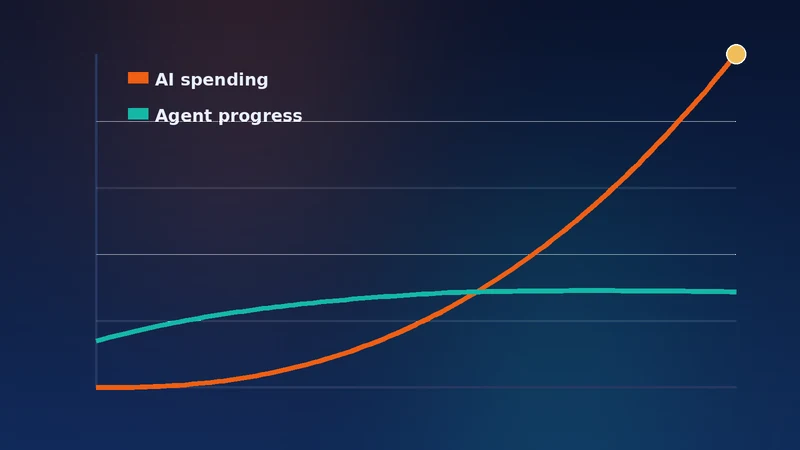
Zuckerberg's candor lands at a fascinating moment. Just this week, data showed startups raised a record $510 billion in the first half of 2026 — with the vast majority flowing into AI. Money is stampeding into the sector at the exact moment one of its biggest spenders is admitting the core product is harder than it looks.
That gap — record investment on one side, tempered expectations on the other — is the tension at the heart of the ongoing debate over whether AI is a bubble. Agents may still deliver everything the hype promises. But Zuckerberg just reminded everyone that "soon" has a way of taking longer than the pitch decks claim.
What Zuckerberg Still Expects
Crucially, he isn't backing away from the bet. Zuckerberg told staff he still expects Meta to see more significant benefits within the next three to six months — a classic "the payoff is coming" reassurance. For a company that has spent over $100 billion and cut thousands of jobs on the promise of agents, that timeline now carries real weight.
Why It Matters
- It's an honest signal from the inside. When the person spending the most on agents says progress has stalled for months, that's more informative than any vendor's demo.
- The money and the reality are diverging. Record AI funding meets slower-than-hoped results — a warning worth watching.
- Timelines are slipping quietly. "Superintelligence soon" is becoming "significant benefits in three to six months."
- Real people are affected. Meta reshaped its workforce around this bet; the pace of the payoff isn't just an abstract tech story.
Frequently Asked Questions
What did Mark Zuckerberg say about AI agents?
At an internal Meta town hall on July 2, 2026, Zuckerberg told staff that AI agents have not progressed as quickly as he had expected. He said 'the trajectory of the agentic development over at least the last four months hasn't really accelerated in the way that we expected,' and admitted the company's recent bets 'haven't come to fruition yet.'
How much is Meta spending on AI?
A staggering amount. Meta has guided to roughly $115–135 billion in AI-related capital expenditure in 2026 — nearly double what it spent the year before — on top of a $14 billion deal to bring in Scale AI founder Alexandr Wang and build Meta Superintelligence Labs. That scale of spending is exactly what makes the slower-than-hoped progress notable.
What is an AI agent?
An AI agent is software that doesn't just answer questions but takes actions to complete multi-step tasks on your behalf — booking things, using tools and browsers, writing and running code, or handling a workflow end to end. 'Agentic AI' has been the industry's central promise for the past year, which is why a slowdown in that specific area matters so much.
Does this mean Meta is giving up on AI?
No. Zuckerberg framed it as slower-than-hoped, not failing, and said he still expects to see more significant benefits from Meta's AI investments within the next three to six months. Meta is continuing its enormous build-out — the comment is a candid acknowledgment of the pace, not a retreat from the bet.
Why is this admission a big deal?
Because it's rare. Big-tech CEOs almost never publicly temper AI expectations, and Zuckerberg is doing so after betting his company's structure — including layoffs and a major reorg — on agents. Coming just as the industry pours record money into AI, it's a notable reality check on the gap between agent hype and agent results.
What has happened to Meta's AI teams and staff?
Meta reorganized around Meta Superintelligence Labs led by Alexandr Wang, then restructured it again into multiple teams with a hiring freeze. It also cut roughly 8,000 jobs in 2026 with more expected, and reassigned thousands of employees into AI groups — including one focused on 'Agent Transformation.' The whole company was reshaped around the agent bet.
Is the wider AI industry slowing down too?
Progress hasn't stopped, but the ultra-fast improvements many expected from agents have been harder to deliver than the marketing suggested. Zuckerberg's comment lands amid a broader debate about whether AI expectations have run ahead of reality — the same tension behind the record, but highly concentrated, funding flowing into the sector.
Final Thoughts
Nothing Zuckerberg said means AI agents are a dead end. They're improving, and Meta is still all-in. But his willingness to tell his own staff that the last four months fell short of expectations is a genuinely useful signal in an industry drowning in superlatives.
The real story of 2026 may not be how fast AI is advancing, but how wide the gap has grown between what the technology is promised to do and what it can reliably do today. When the person writing the biggest checks starts saying "not yet," it's worth listening. The next three to six months just got a lot more interesting.