NIST: DeepSeek V4 Pro Lags US Frontier AI by 8 Months — Smallest US-China Gap Yet
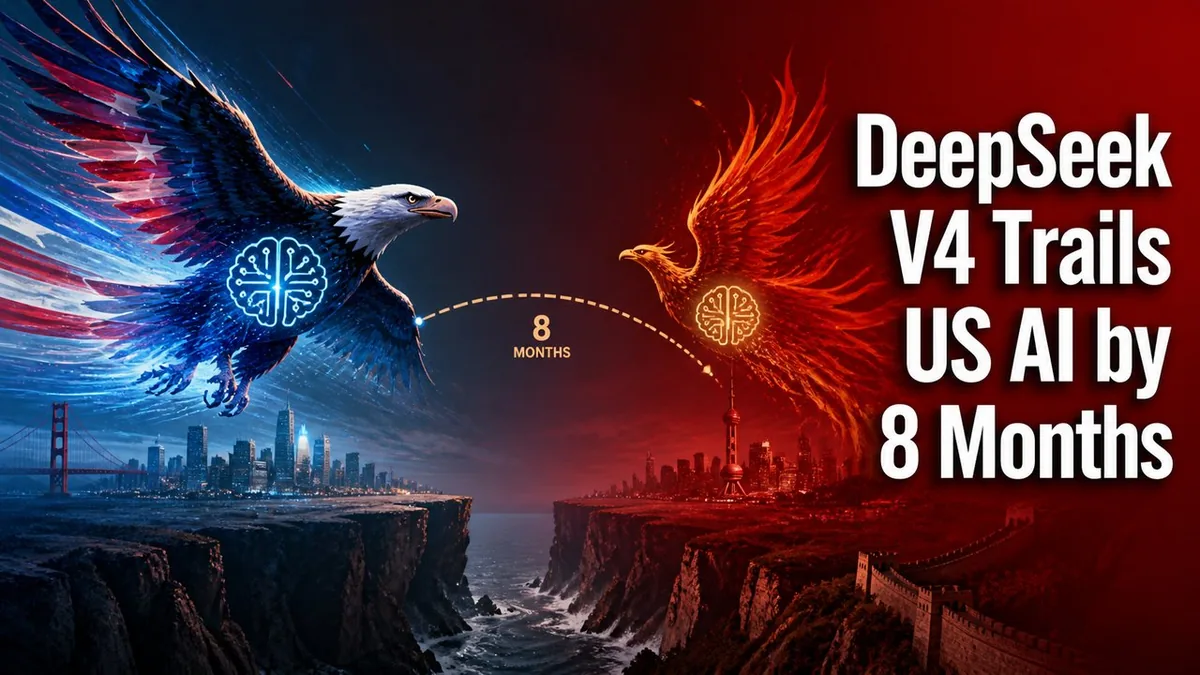
DeepSeek's V4 Pro model — China's most capable publicly-disclosed frontier AI system — trails comparable U.S. frontier models by approximately eight months in capability terms, according to a National Institute of Standards and Technology evaluation released this weekend. The benchmark report, conducted by NIST's Center for AI Standards and Innovation (CAISI), is the first official U.S. government evaluation of the leading Chinese model and provides a quantitative answer to the long-running question of how far behind Chinese AI capability actually is.
The eight-month figure is striking partly because it's the smallest gap NIST has ever measured between Chinese and U.S. frontier AI. In 2023, Chinese models lagged U.S. capability by roughly 18 months; in 2024, that compressed to 12 months; the V4 Pro evaluation now puts the gap at 8 months. The trajectory suggests the gap continues to narrow at roughly 4 months per year, which has significant implications for both U.S. AI export controls and broader competitive dynamics.
What the NIST evaluation actually measured
CAISI tested DeepSeek V4 Pro against three U.S. reference models — GPT-5 (released August 2025), Claude Opus 4.7, and Gemini 2.5 Ultra — across nine capability categories: general knowledge, mathematical reasoning, code generation, long-context comprehension, multimodal reasoning, scientific reasoning, instruction-following, safety alignment, and adversarial robustness. The eight-month lag is a weighted average across categories, with V4 Pro performing closest to GPT-5 on knowledge and code generation (within 2-3 months) and farthest behind on safety alignment and adversarial robustness (12-15 months).
The methodology matters because category-level performance is more strategically meaningful than aggregate scores. V4 Pro's near-parity on code generation means Chinese AI is substantively competitive for software development workloads. Its larger lag on safety and adversarial robustness means deployment risk profiles are still meaningfully different from U.S. frontier models, particularly for sensitive enterprise use cases.
The compute and data story behind the gap
NIST's analysis attributes V4 Pro's narrowing gap primarily to three factors: improved training methodology (particularly around mixture-of-experts and sparse attention architectures), expanded synthetic data pipelines that overcome some Chinese-specific data scarcity, and creative compute optimization that maximizes performance per FLOP under U.S. chip export restrictions. The report explicitly notes that DeepSeek has produced V4 Pro using meaningfully less aggregate compute than the U.S. reference models — likely 30-40% less — which is itself a notable engineering achievement.
The strategic question for U.S. export controls is whether DeepSeek's efficiency gains undermine the controls' intended effect. NIST's framing is that controls have slowed Chinese capability development but not stopped it, and that the marginal effect of additional control tightening is diminishing. That assessment will fuel ongoing debate in Washington about whether to extend, relax, or restructure the existing chip export framework.
My Take
The eight-month gap is closer than the U.S. AI policy community has been assuming, and the trajectory is concerning if you're betting on durable U.S. AI leadership. The U.S.'s structural advantages — compute access, talent concentration, capital — are real but not infinite. China's structural advantages — patient capital deployment, willingness to operate at lower margins, ability to coordinate state and private R&D — are also real and increasingly visible in the AI capability data.
The implication for U.S. AI policy is uncomfortable. The current export-controls regime is producing diminishing returns; the alternative of accepting Chinese AI parity within 12-18 months is politically and economically costly; and the third path — substantively investing in U.S. AI competitiveness through education, infrastructure, and workforce policy — is hard to execute under current political conditions. The most likely outcome over 2026-2027 is continued narrow Chinese capability ascent, with U.S. responses focused on incremental control tightening rather than structural reform.
For frontier AI vendors, the practical takeaway is that Chinese AI products are now realistically competitive on most enterprise use cases. DeepSeek V4 Pro is open-weight, available globally, and roughly comparable to GPT-5 for many workloads. That structurally undermines the pricing power of U.S. frontier vendors in non-U.S. markets — a meaningful headwind for Anthropic, OpenAI, and Google in their international growth plans.
What this means for AI competitive dynamics
Three implications. First, expect continued U.S. export-controls debate through 2026, with the NIST report fueling arguments on both sides — control-extension advocates citing the narrowing gap, control-skeptics citing diminishing efficacy. Second, expect Chinese AI deployment to accelerate in Asian and Middle Eastern markets where U.S. AI faces regulatory or political constraints; DeepSeek and Qwen are well-positioned. Third, expect U.S. frontier AI valuations to face pressure as international competition intensifies — particularly for companies with significant non-U.S. revenue exposure.
For broader investors, the read-through is that AI investment thesis based on durable U.S. capability leadership needs to be updated. The realistic frame is parity within 12-18 months across most use cases, with U.S. advantages preserved primarily in high-trust enterprise and government deployments where Chinese AI is structurally precluded.
Frequently Asked Questions
What is DeepSeek V4 Pro?
DeepSeek V4 Pro is the most recent flagship model from DeepSeek, a Chinese AI lab that has emerged as one of China's most prominent frontier AI developers. The model is open-weight, available for download and self-hosting, and competitive with U.S. frontier models on many benchmarks.
What does the 8-month lag actually mean?
NIST's measurement indicates that V4 Pro's average capability across nine evaluated categories is roughly equivalent to U.S. frontier models from approximately eight months earlier — i.e., V4 Pro in May 2026 performs similarly to GPT-5 in September 2025. The gap varies by category from ~2 months (code) to ~15 months (safety alignment).
Are U.S. chip export controls failing?
NIST's framing is that controls have slowed Chinese capability but not stopped it. DeepSeek has produced V4 Pro using meaningfully less aggregate compute than U.S. references, suggesting controls created friction but not insurmountable barriers. Policy debate over control efficacy is active.
Should enterprises use DeepSeek V4 Pro?
Depends on use case and jurisdiction. For non-sensitive workloads with code or general-knowledge requirements, V4 Pro is competitive. For workloads requiring strong safety alignment or operating under U.S. data-residency restrictions, U.S. frontier alternatives remain preferable. Enterprise legal review is recommended before deployment.
The Bottom Line
NIST's evaluation puts Chinese frontier AI within 8 months of U.S. capability — closer than the policy community has been assuming. The narrowing trajectory has significant implications for export controls, frontier-AI valuations, and international AI deployment dynamics. Expect intensifying policy debate over the next 12-18 months as the gap continues to compress.
Related Articles
- Nvidia Releases Nemotron-3 Nano Omni
- Anthropic Eyes $50B Round at $900B Valuation
- Poolside Breaks Silence With Open-Weight Models