Is ZeroGPT Accurate? A Practical Look at AI Detection, False Positives, and Alternatives
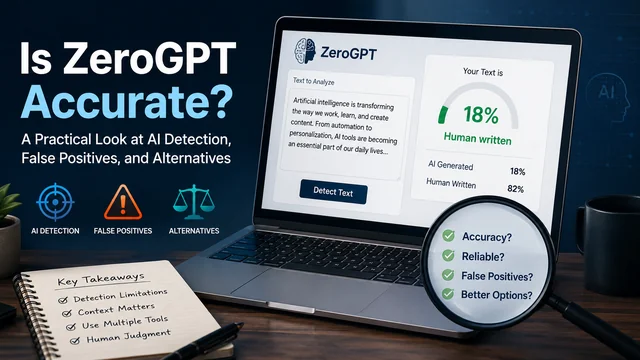
If you have ever pasted your own writing into ZeroGPT and watched it come back flagged as AI-generated, you already know the honest answer: ZeroGPT is accurate some of the time, and wrong some of the time.
It can pick up on patterns that often show up in AI-generated text, but a score from ZeroGPT is not proof that a specific person did or did not write something. Treat it as one data point, not a verdict.
What Is ZeroGPT?
ZeroGPT is a free online tool that scans text and returns a percentage meant to represent how likely that text is to have been generated by an AI model such as ChatGPT. You paste in the content, it runs the text through its own scoring model, and it hands back a number along with highlighted sentences it considers suspicious.
That number reflects a probability based on patterns the tool associates with machine generated writing. It is not a certificate of authorship, and it was never meant to function as courtroom style proof.
How Does ZeroGPT Detect AI Writing?
Most AI detectors, ZeroGPT included, work by measuring how predictable a piece of text is. Language models tend to choose common, statistically likely words in a fairly steady rhythm, an idea researchers call perplexity: low perplexity means the wording is easy to predict, and AI text usually scores lower on this scale than typical human writing.
Detectors also look at sentence structure, variation in sentence length, word choice, and how repetitive certain patterns are across a paragraph. When writing is unusually even in tone and sticks to conventional sentence construction, it can resemble the statistical fingerprint associated with generated content, even when a person wrote every word themselves.
Is ZeroGPT Accurate?
There is no single number that answers this honestly. Independent reviewers have published a wide range of results for ZeroGPT, and those results do not agree with each other, largely because they were not built the same way.
Some tests use a few dozen samples, others use a few hundred. Some focus only on raw, unedited AI text from one model, while others mix in paraphrased text, academic writing, or content from non native English speakers. Sample size, text length, which AI models were tested, and how "accuracy" was even defined all change the outcome.
What shows up consistently is a gap between ZeroGPT's own marketing claim of roughly 98 percent accuracy and what outside testers actually measure, which tends to land lower and swings depending on content type.
A widely cited academic evaluation by Weber-Wulff and colleagues tested a range of AI detection tools, ZeroGPT among them, and found that none of the fourteen tools reviewed reached 80 percent accuracy overall. That is a useful reference point, but it still describes one study under one set of conditions, not a permanent verdict on the tool.
Why Can ZeroGPT Flag Human Writing as AI?
Formal writing. Academic papers and business reports often follow rigid, predictable structures, which can resemble the low perplexity patterns detectors are trained to catch.
Short text. ZeroGPT needs enough words to identify a reliable pattern. Very short samples, often under a couple hundred words, do not give the model much to work with, so the score becomes less trustworthy.
Non native English writing. Writers who learned English as a second language sometimes use simpler sentence structures and more common vocabulary. A Stanford led study published in the journal Patterns found that detectors misclassified a significant share of essays written by non native English speakers as AI generated. This is a documented bias in the field, not a reflection of the writer's honesty.
AI assisted editing. Writing that started as a human draft but was later polished or restructured with an AI tool can carry mixed signals, since parts of the sentence pattern may now resemble machine phrasing.
Predictable writing styles. Some people naturally write in a clean, structured, repetitive way. That style can overlap with what a detector flags, even with zero AI involvement.
A false positive does not prove AI use. It proves that the text shared some statistical traits with AI writing, which is a different thing entirely.
How Should You Use an AI Detector?
-
Treat the result as a signal, not a verdict.
-
Read the confidence score carefully instead of reacting to a single number.
-
Never make a final decision about authorship based on one detector alone.
-
Factor in the length and type of the text before trusting the score.
-
When something important is at stake, such as a grade or a job application, run the text through more than one detector and compare.
-
Look at surrounding context: drafts, revision history, and other evidence matter more than a percentage.
AI Detector Alternatives
If you want a second opinion, running the same text through another detector can help you see whether a flag is consistent or a one off result. ChatGoat AI AI Detector is one option people use to check text for patterns associated with AI-generated writing, and it will not always agree with ZeroGPT, which is itself useful information.
Another option is the EaseDone AI AI Detector, which some writers and students use alongside ZeroGPT to compare results before concluding. Neither tool should be assumed to outperform ZeroGPT. The point of checking multiple detectors is to see where results agree and where they diverge, not to shop for the answer you were hoping for.
Final Verdict: Is ZeroGPT Accurate?
ZeroGPT can be a genuinely useful starting point for spotting writing patterns that often show up in AI-generated text, but it is not infallible. Independent testing consistently shows both false positives and false negatives, and the rates vary depending on the study. The most honest way to use it is as one piece of evidence among several, not as the final word on who actually wrote something.
FAQs
Is ZeroGPT 100% accurate?
No. No AI detector is 100 percent accurate. Independent tests report a range of outcomes depending on text type and testing conditions, with mistakes in both directions well documented.
Can ZeroGPT falsely detect human writing as AI?
Yes. This is a false positive, and it happens more with formal writing, short samples, and text from non native English speakers. A flag from ZeroGPT is not confirmation that AI was used.
How accurate are AI detectors?
It depends on the tool, the text, and the testing method. Published research shows wide variation, and none of the major tools reach consistent, near perfect accuracy across every type of writing.