The Best Glue for Ceramic in 2026: 10 Adhesives for Repairs, Mugs & Outdoor Pots
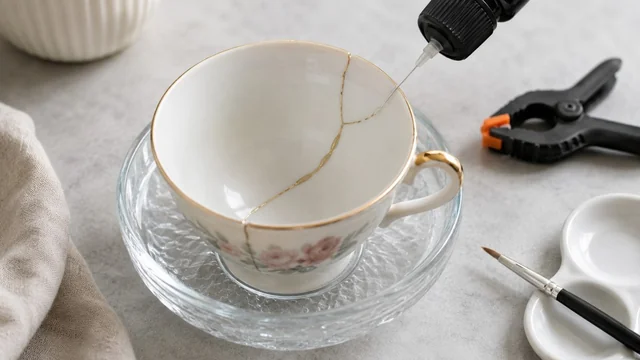
The best glue for ceramic depends on the break. A clean break on a figurine or vase needs a super glue gel that grabs in seconds. A mug you will wash again needs a flexible, dishwasher-rated adhesive. Missing chips, heavy planters and garden statues need a two-part epoxy. This guide compares ten glues for ceramic, porcelain and pottery, using each maker's own technical data sheet for set time, cure time, strength, heat limits and food-safety warnings.
As an Amazon Associate, SaveDelete earns from qualifying purchases made through links on this page.
Key takeaways:
- For a clean break on a decorative piece, use a super glue gel such as Loctite Super Glue Ultra Gel Control or Gorilla Super Glue Gel; for missing chips or heavy pieces, use a two-part epoxy.
- For a mug you will wash, Loctite's own pick is Extreme Glue No Drip Gel: its bond is dishwasher safe, but Loctite says it is not for food contact.
- None of the ten glues here is approved for food contact, so keep glue off rims and the inside of cups, bowls and plates.
- J-B Weld Original is the strongest pick at 6,220 PSI (older packs say 5,020 PSI) and handles 550°F once cured.
- Wash and dry the broken edges, dry-fit the pieces, and wait for the full cure (24 hours for most of these glues) before using the piece.
Which Glue for Which Ceramic Repair?
| Repair | Glue type | Our pick |
|---|---|---|
| Clean break on a figurine, vase or ornament | Cyanoacrylate (super glue) gel | Loctite Super Glue Ultra Gel Control |
| Mug handle or a piece that gets washed | Flexible hybrid polymer gel | Loctite Extreme Glue No Drip Gel |
| Missing chips or a gap to fill, clear finish | Two-part epoxy | J-B Weld ClearWeld |
| Heavy pots, statues, high heat | Steel-reinforced epoxy | J-B Weld Original |
| Outdoor pots and flexible joints | 100% silicone | GE Silicone 2 Glue |
| Mosaic, jewelry, ceramic to metal or glass | Flexible craft adhesive | E6000 Craft |
| Kids' crafts on unglazed bisque | PVA white glue | Aleene's Original Tacky Glue |
The 10 Best Glues for Ceramic at a Glance
| Glue | Type | Sets in | Full cure | Strength | Heat limit |
|---|---|---|---|---|---|
| Loctite Super Glue Ultra Gel Control | Cyanoacrylate gel | 15–30 seconds | 24 hours | 2,175–3,625 psi | 180°F |
| Loctite Extreme Glue No Drip Gel | Silane moisture-curing polymer | 3–5 min open time; leave 2 hours | About 24 hours | Not stated | 248°F |
| Gorilla Super Glue Gel | Cyanoacrylate gel | 10–45 seconds | 24 hours | Not stated | 220°F |
| Krazy Glue All Purpose | Ethyl cyanoacrylate | 10–60 seconds | Overnight | Over 1,000 psi | About 176°F |
| J-B Weld ClearWeld | Two-part epoxy | 5 minutes | 1 hour | 3,900 PSI | 250°F |
| J-B Weld Original | Steel-reinforced epoxy | 4–6 hours | 15–24 hours | 6,220 PSI | 550°F |
| Loctite Instant Mix 5 Minute Epoxy | Two-part epoxy | 5–7 minutes | 24 hours | 2,500 psi | 120°F |
| Aleene's Original Tacky Glue | PVA (water-based) | 30–40 min clamped | 37–47 min dry | Not stated | Not stated |
| GE Silicone 2 Glue | 100% silicone | Water-ready in 30 min* | 24 hours | Not stated | Not stated |
| E6000 Craft | Solvent-based, flexible | — | 24–72 hours | 380 PSI on ceramic | 180°F |
Figures come from each maker's product page or technical data sheet (TDS) and are typical values; temperature, humidity and bead size change them. *GE: water exposure after 30 minutes only for small beads in warm, humid conditions; otherwise wait 8 hours.
The 10 Best Glues for Ceramic, Reviewed
1. Loctite Super Glue Ultra Gel Control — Best for Clean Breaks
Cyanoacrylate gel · best for figurines, vases and vertical repairs
This is the rubber-toughened, side-squeeze gel that Loctite's own ceramic guide recommends for ceramic craft repairs. Loctite says the formula resists water, impact, shock and vibration, and lists china and ceramic among the surfaces it bonds. It fixes in 15 to 30 seconds and reaches full cure in 24 hours, with tensile shear strength of 2,175 to 3,625 psi depending on the material. The gel does not run, which helps on handles, spouts and figurine arms.
Limits: Loctite's data sheet says it is not suitable for gap filling, items that will hold hot liquids, continuous water exposure, or use in a dishwasher, oven or microwave, and it lists glazed surfaces as a limitation, so keep the glue on the broken edges and off the glaze. Service temperature tops out at 180°F. (It replaces the "Power Easy Gel" we listed before, which isn't sold on Loctite's US site.)
2. Loctite Extreme Glue No Drip Gel — Best for Mugs and Handles
Flexible silane moisture-curing polymer · best for pieces that get washed
For ceramic mugs, Loctite recommends Extreme Glue rather than its super glues. It is a gap-filling, clear-drying gel (Loctite calls the formula Flextec) that works indoors or outdoors and stays flexible, and its data sheet says the bond is dishwasher safe and resists moisture, impact and UV. It handles -58°F to 248°F. You get 3 to 5 minutes of open time to line up the pieces; leave the repair undisturbed for at least 2 hours and allow about 24 hours for a full cure.
Limits: Loctite says it should not be used for direct or indirect food contact and is not for prolonged water immersion. A dishwasher-safe bond on a handle is fine; glue on the rim or inside the cup is not.
3. Gorilla Super Glue Gel — Best All-Purpose Super Glue
Cyanoacrylate gel · best for indoor pieces that get bumped
Gorilla's gel dries in 10 to 45 seconds without clamping, cures clear, and has an anti-clog cap that keeps the tube usable between repairs. Gorilla describes a reinforced formula that handles bumps and drops, lists ceramic among the materials it bonds, and says super glue on ceramic reaches full strength within 24 hours. Its service range of -65° to 220°F is the widest of the super glues here.
Limits: Gorilla's spec sheet marks the gel as not for outdoor use and not gap filling, and Gorilla says super glue is not food-safe or dishwasher-safe. It also isn't recommended on polyethylene or polypropylene plastic.
4. Krazy Glue All Purpose — Best Budget Pick for a One-Off Fix
Ethyl cyanoacrylate · best for a single small repair
Krazy Glue lists ceramic among the surfaces its All Purpose formula works on. It starts bonding in 10 to 60 seconds, and Krazy Glue advises letting the bond cure overnight for maximum strength, when it can hold over 1,000 pounds per square inch. It handles heat up to about 176°F.
Limits: Krazy Glue says soaking in hot water around 140°F can weaken the bond, so a repaired mug should be hand-washed in cool water at most. Use an opened tube within a month, and don't expect it to bond polyethylene, polypropylene or Teflon.
5. J-B Weld ClearWeld — Best Clear Epoxy for Chips and Gaps
Two-part 1:1 epoxy · best for missing chips and structural repairs that should stay invisible
ClearWeld sets in 5 minutes and cures in 1 hour to a tensile strength of 3,900 PSI, and J-B Weld lists ceramic among the surfaces it bonds. Unlike super glue it fills gaps, so it can rebuild a small missing chip. The syringe comes with a static mixer and a mixing tray, and J-B Weld rates its heat resistance at 250°F.
Limits: J-B Weld says it cures clear only when applied thinner than 15 mil. J-B Weld claims only some water resistance, says it takes longer to set below 40°F, and says its products are not rated food-safe.
6. J-B Weld Original — Strongest Glue for Heavy Ceramic
Steel-reinforced two-part epoxy · best for planters, statues and high heat
The reformulated J-B Weld Original twin tube has a tensile strength of 6,220 PSI; J-B Weld says it now has 25% more strength and that older packages are labeled 5,020 PSI. It sets in 4 to 6 hours, fully cures in 15 to 24 hours, and withstands up to 550°F once cured. J-B Weld says it keeps its properties down to -67°F and resists water, chemicals and fuel, which makes it the right pick for terracotta urns, garden statues and pottery bases.
Limits: it dries dark gray, so hide the joint or paint over it, and like all J-B Weld products it is not rated food-safe.
7. Loctite Instant Mix 5 Minute Epoxy — Easiest Epoxy to Mix
Two-part epoxy · best for handles, lamp bases and china
Loctite recommends this epoxy for bonding ceramic and china. Its static mix nozzle mixes resin and hardener as you dispense, so there is no tray or stick. It sets in 5 to 7 minutes at room temperature, reaches handling strength in 1 hour and fully cures in 24 hours, with a tensile shear strength of 2,500 psi.
Limits: it dries translucent yellow, not water-clear. Loctite says not to use it where heat exceeds 120°F, in continuous water immersion or continuously wet areas, or in drinking-water systems.
8. Aleene's Original Tacky Glue — Best for Kids' Crafts on Bisque
PVA (water-based white glue) · best for decorative crafts, not repairs
Aleene's says Tacky Glue dries permanent and clear, cleans up with soap and water before it dries, and is nontoxic and safe for classroom use. For pottery, Aleene's says to clamp the joint and let the glue set for 30 to 40 minutes; its general dry time is 37 to 47 minutes. That makes it handy for gluing decorations onto unglazed bisque or terracotta craft pieces.
Limits: PVA glues work by soaking into the surfaces being glued, so they suit porous, unglazed pieces, and Aleene's recommends a solvent-based glue whenever water resistance is needed. Don't use it on anything that will be washed or left outdoors.
9. GE Silicone 2 Glue — Best for Outdoor Pots and Flexible Joints
100% silicone adhesive · best for outdoor ceramic that moves with the weather
GE's Silicone 2 Glue is a 100% silicone adhesive for household and craft jobs that GE says adheres to ceramic and porcelain. It dries clear, stays permanently flexible, and is freeze and sun proof, so it suits outdoor pots, garden ornaments and joints that expand and contract. Small beads can take water after 30 minutes in warm, humid conditions; otherwise GE says to keep it dry for 8 hours, and not to touch or clean it for 24 hours.
Limits: GE says it should not be used for structural repairs, in continuous contact with water, or in food contact applications, and it cannot be painted. For load-bearing outdoor repairs, use J-B Weld Original instead. (GE's Window & Door silicone, which we listed before, is a sealant: GE says it is not for structural repairs either, so use it to seal cracks, not to glue pieces.)
10. E6000 Craft — Best for Mosaic, Jewelry and Mixed Materials
Flexible solvent-based craft adhesive · best for ceramic on metal, glass or wood
E6000 hardens as its solvent evaporates and dries to a rubber-like consistency that stays flexible, which suits mosaic tiles, ceramic beads and ceramic glued to other materials. Its data sheet lists 380 PSI adhesion on ceramic, and cured E6000 withstands -40°F to 180°F. A full cure takes 24 to 72 hours. Work with good ventilation.
Limits: Eclectic Products, the maker, does not recommend E6000 for items that touch food, drinking water or animals, and gives no dishwasher rating; its washer/dryer claim is about fabric, not dishes. Clear E6000 is not formulated for sunlight, and it won't hold on polystyrene, polyethylene, polypropylene, Styrofoam or paper.
Ceramic Glue vs Super Glue vs Epoxy: What Bonds Ceramic Best?
There is no single "ceramic glue" chemistry. Products sold for ceramic repair are one of four types, and the right one depends on the break:
- Super glue (cyanoacrylate) grabs in seconds and dries clear, so it is the quickest fix for a clean, tight break. It does not fill gaps, and Loctite and Gorilla both say their super glues are not for dishwashers or hot liquids.
- Two-part epoxy fills gaps and missing chips and gives the strongest bonds here (3,900 PSI for ClearWeld, 6,220 PSI for J-B Weld Original). It takes minutes to hours to set, so you need tape or clamps.
- Flexible polymers and silicone (Loctite Extreme Glue, GE Silicone 2 Glue, E6000) stay rubbery after curing, which helps with washing, outdoor temperature swings and mixed materials, but they are not for heavy, load-bearing joints.
- PVA white glue soaks into porous surfaces. It is fine for crafts on unglazed bisque and poor on glazed or wet ceramic.
We dropped Loctite Super Glue Liquid from this list: its own data sheet says not to use it on glazed surfaces, glass or pure bone china, outdoors, or on items that hold hot liquids, which rules out most ceramic repairs.
Is Any Ceramic Glue Food-Safe or Dishwasher-Safe?
Not among these ten. Every maker here either says its glue is not for food contact or makes no food-contact claim. Two federal rules are often quoted on glue packaging, and neither is a "food-safe certification" for repaired dishes:
- 21 CFR 175.105 covers adhesives in food packaging. The adhesive must be separated from food by a functional barrier or limited to small amounts (only trace amounts at seams for fatty and watery foods), and the container label must say "food-packaging adhesive".
- 21 CFR 175.300 covers resin and polymer coatings applied as a continuous film that acts as a barrier between food and the surface. It lists epoxy resins among permitted substances and caps extractable residue from small single-use container coatings at 0.5 milligram per square inch.
A few industrial epoxies are made to these rules: Permabond says its food-grade epoxies (such as ET5145 and ET5147) comply with CFR 175.105 or 175.300 and bond ceramics. Permabond also points out that the CFR does not list cyanoacrylate ingredients, so no super glue can be confirmed food-safe.
Dishwasher-safe is a separate question from food-safe. Loctite says the Extreme Glue No Drip Gel bond is dishwasher safe, yet also says it is not for direct or indirect food contact. Loctite's ceramic guide advises choosing a food-safe glue for anything that will hold food or drink. The practical rule: glue handles and outer breaks only, keep adhesive off rims and inner surfaces, and hand-wash repaired pieces.
How to Glue Ceramic Back Together
- Clean the edges. Loctite says to wash glass and ceramic surfaces with soap and water before bonding; J-B Weld recommends acetone or lacquer thinner and warns against using alcohol before its epoxies. Let everything dry fully.
- Dry-fit first. Line up every piece without glue so you know the order and where tape will go.
- Protect your hands. Loctite recommends nitrile gloves, not PVC, nylon or cotton, when using super glue.
- Apply a thin layer to one edge and press the pieces together. For epoxy, mix only what you can use in its working time.
- Hold or tape the joint. Painter's tape across the break keeps pieces aligned while epoxy or silicone sets.
- Wait for the full cure before washing or loading the piece: 24 hours for most glues here, 15 to 24 hours for J-B Weld Original, and up to 72 hours for E6000.
What About Kintsugi?
Kintsugi is a traditional Japanese way of repairing chipped or broken ceramics in which the mended joins are covered with gold; LACMA notes it was popular in Japan in the 16th century. Traditional kintsugi uses urushi, a lacquer made from tree sap. LACMA says urushi comes from the poison ivy family and irritates sensitive skin, and the V&A calls it an allergen that hardens by polymerising in a damp environment rather than by drying. If you use an epoxy-based kit instead, you get the look with a different material, and none of the epoxies in this guide is rated food-safe, so treat the piece as decorative.
Sources & Further Reading
Frequently Asked Questions
Can you glue ceramic back together?
Yes. Clean breaks bond well with a super glue gel, and breaks with missing chips or gaps bond better with a two-part epoxy that fills the space. Clean and dry the edges, dry-fit the pieces, tape the joint, and wait for the full cure (24 hours for most glues) before using the piece.
What is the strongest glue for ceramic?
Of the glues here, J-B Weld Original is the strongest at 6,220 PSI tensile strength (older packages say 5,020 PSI), and it withstands 550°F once cured. It dries dark gray, so for a clear joint use J-B Weld ClearWeld at 3,900 PSI.
What is the best epoxy for ceramics?
For a clear two-part epoxy, J-B Weld ClearWeld sets in 5 minutes, cures in 1 hour and reaches 3,900 PSI. For heavy or hot pieces, J-B Weld Original is the strongest two-part epoxy here at 6,220 PSI and 550°F. For the easiest mixing, Loctite Instant Mix 5 Minute Epoxy dispenses through a mixing nozzle and is recommended by Loctite for ceramic and china, but tops out at 120°F. None of these epoxies is rated food-safe.
What kind of glue will stick to ceramic?
Cyanoacrylate super glues, two-part epoxies, flexible polymers such as Loctite Extreme Glue, 100% silicone adhesives and E6000 all list ceramic among the surfaces they bond. PVA white glue is best kept for porous, unglazed ceramic.
Is super glue or ceramic glue better for a broken mug?
For a mug you will wash, Loctite recommends its Extreme Glue No Drip Gel, whose bond is dishwasher safe, over its super glues, which Loctite says are not for dishwashers or items that hold hot liquids. No glue here is approved for food contact, so keep it off the rim and inside of the mug.
Is PVA glue good for ceramics?
Only for crafts on porous, unglazed ceramic. PVA is a water-based white glue that works by soaking into the surfaces being glued, and Aleene's recommends a solvent-based glue when water resistance is needed.
Is E6000 good for ceramics, and is it dishwasher safe?
E6000 bonds ceramic (its data sheet lists 380 PSI adhesion on ceramic) and stays flexible, which makes it good for mosaic and jewelry. The maker gives no dishwasher rating and does not recommend it for items that touch food or drinking water, so hand-wash and keep it off eating surfaces.
What will E6000 not stick to?
Eclectic Products does not recommend E6000 on polystyrene, polyethylene, polypropylene, Styrofoam or paper products, and says clear E6000 is not formulated for sunlight exposure.
Is any ceramic glue food-safe?
None of the consumer glues in this guide is approved for food contact. A few industrial epoxies, such as Permabond's food-grade grades, are formulated to FDA rules 21 CFR 175.105 or 175.300, but these rules set conditions for packaging adhesives and coatings rather than certifying repaired dishes.
How long does ceramic glue need to cure?
Super glues grab in seconds but need about 24 hours (Krazy Glue: overnight) for full strength. Five-minute epoxies are handleable in about an hour and fully cure in 24 hours, J-B Weld ClearWeld cures in 1 hour, J-B Weld Original needs 15 to 24 hours, and E6000 needs 24 to 72 hours.
What is the best glue for outdoor ceramic pots?
For a flexible, weatherproof joint, GE Silicone 2 Glue is freeze and sun proof and bonds ceramic, though GE says it is not for structural repairs or continuous water contact. For heavy or load-bearing outdoor pieces, use J-B Weld Original, which resists water and keeps its properties down to -67°F.
Fixing something that gets hot, or bonding ceramic to another material? See our guides to the best heat-resistant glue and the best glue for glass to plastic.
Specifications come from each maker's product pages and technical data sheets, checked in November 2026. Formulas and labels change, so check the package before you buy. SaveDelete may earn a small commission on purchases made through some links on this page, at no extra cost to you.