Fox Owns Roku: What the DOJ's Commitments Mean for Your TV
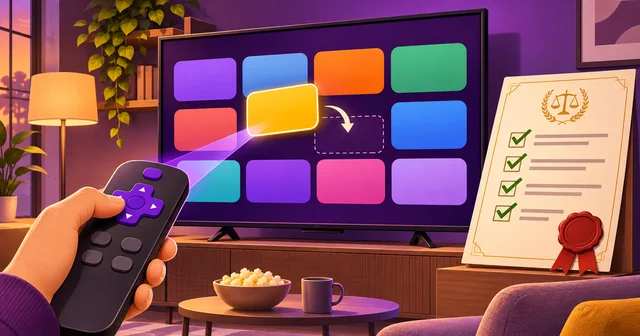
Fox now owns Roku, but your apps stay where they are for now. The Justice Department closed its review on November 6 after Fox promised to keep carrying rival services for at least three years, not to bias search results, and to let users rearrange their home screens. Promotional placement, ads and prices are not covered.
What Happened
Fox Corporation said on November 6, 2026 that it had completed its roughly $22 billion purchase of Roku, and Roku shares stopped trading on Nasdaq the same day. According to Fox's closing release, filed with the SEC, each Roku share was exchanged for $95.30 in cash plus 0.9799 of a Fox Class A share. Former Roku stockholders now hold about 26% of Fox, and existing Fox stockholders about 74%.
The deal was announced on June 15 and was expected to close in the first half of 2027, so it finished months early. TechCrunch noted the gap between that forecast and the actual close. The Justice Department had asked both companies for more documents in September through what antitrust law calls a second request, the step that usually signals a longer review.
That review ended the day the deal closed. In its closing statement, the Antitrust Division said the deal "is not likely to result in harm to competition," and it listed four commitments Fox had made.
Roku now sits in a new division called Fox Digital Platforms, alongside Tubi, Fox One and the creator business Red Seat Ventures. Roku founder Anthony Wood joins Fox's board and becomes co-chair of the division. Paul Cheesbrough is its other co-chair and its chief executive.
Why It Matters
Roku is not just another streaming app. It is the software that decides what you see when you turn on the TV, and Fox says it reaches more than 100 million households worldwide. Parks Associates, as cited in a National Law Review analysis, puts Roku at 28% of US broadband homes' primary connected-TV platform, ahead of Samsung's Tizen at 23%.
Fox also makes things people watch: Fox News, Fox Sports, its local stations and Tubi. So one company now owns both a gateway and some of the programming competing to get through it. That is the central worry behind a July 17 letter from Senator Elizabeth Warren, Representative Becca Balint and six other Democrats. They warned that Fox could steer Roku households toward its own news, sports and entertainment, and that it could use detailed viewing data to raise prices.
The free-streaming overlap matters too. Nielsen's August 2026 Gauge, reported by PPC Land, gave The Roku Channel 2.9% of US TV viewing and Tubi 1.9%, against 15.8% for YouTube and 7.7% for Netflix. That is 4.8% of TV time under one owner, in the category where viewers pay nothing and ads fund everything. Nielsen adjusted how it measures Tubi in June, so treat that figure with some caution. Madison and Wall, a media research firm, estimated the two services together would hold about 16% of US streaming ad revenue.
The first visible change has nothing to do with antitrust. Roku is ending its Aquatic Life screensaver on December 1 and moving affected users to Roku City, which carries advertising. Its creator, artist Jim Sachs, told Ars Technica he would not renew the license after learning of the sale, saying "I can't be part of the Fox world." He put the license at $80,000 a year. Roku has not publicly linked the removal to the deal.
How It Works
The fine print is more useful than the headline, because the four commitments have different lengths and leave clear gaps.
- Carriage, at least three years. Fox will keep carrying non-Fox content on Roku, in line with Roku's past practice. Netflix, YouTube and Disney+ should not disappear because of this deal during that window.
- Search and home screen, no stated period. Fox will not discriminate against non-Fox content in search results, and users can keep rearranging apps on the home screen.
- Data products, no stated period. Fox will keep selling data products to third parties on commercially reasonable terms, consistent with Roku's standard distribution agreement.
- Data firewalls, at least three years. Fox will maintain existing contractual firewalls that protect competitively sensitive data about other companies' content, including aggregated and inferable data.
That last item is easy to misread. The firewall protects content partners, not viewers. A platform can see which services do well, and a rival would not want that information reaching the people programming Fox or Tubi. The statement never mentions consumer privacy, so it gives you no new protection over your own viewing data.
The bigger gap is promotion. The statement covers search results and where you place your apps, but it says nothing about featured tiles, ad slots or sponsored recommendations on the home screen. It also does not address remote buttons, subscription prices or the fees Roku charges app developers. Fox can honor every commitment and still give its own programming more attention in those spaces. Nothing announced says it will. Nothing listed in the statement rules it out either.
The Division explained why it did not seek more. Roku depends on a broad range of content to attract viewers, it reasoned, so hurting Fox's rivals would cost the merged company money and reputation. Viewers could also leave for another TV platform, and new free streaming services could enter the market if Tubi and The Roku Channel used their position badly.
If you own a Roku, the one protection you can use today is the rearranging itself. Highlight an app, press the star button on the remote and choose the move option, as Roku's support page describes. The layout is set per device, so you repeat it on each Roku you own. Putting the services you actually use in the top row reduces how much any promoted tile can steer you.
What's Still Unknown
The largest open question is enforcement. The statement says Fox "has committed" but mentions no consent decree or settlement, and Global Competition Review reported that the Division imposed no conditions. The Division says only that it "may take appropriate action" if circumstances change. The statement does not explain how anyone would monitor search neutrality, which is hard to audit from the outside.
Nobody has said what happens after three years, or what the home-screen and search promises mean without a stated period. Fox executives said in June, according to TheWrap, that the two free services' audiences overlap by about a third and that the brands would stay separate, but that is a plan and not one of the listed commitments.
The timing of any product changes is also unclear. Fox expects Roku's audience to improve its ad targeting and reduce its reliance on traditional TV distribution, and it expects about $400 million in annual cost savings within two years of closing. Its closing release does not say where those cuts will land or what they will mean for The Roku Channel's library or for Roku's software. Fox's own release lists integration and the company's significant combined debt among its risks.
Frequently Asked Questions
Will Fox remove Netflix or YouTube from Roku?
Nothing announced points that way. Fox has committed to the Justice Department to keep carrying non-Fox content on Roku for at least three years, consistent with how Roku has operated. Roku also depends on those services to attract viewers, which is part of why regulators did not expect Fox to block them. Individual contract disputes between Roku and a service can still happen, as they could before.
Do I need to do anything if I own a Roku device?
No. Nothing in the closing announcements asks owners to act, and your device, account and installed apps are not described as changing. If you want more control, you can reorder your apps with the star button on the remote. If you use the Aquatic Life screensaver, pick a replacement before December 1, or your device will switch to Roku City automatically.
Can Fox put its own shows first on the Roku home screen?
Possibly. The Justice Department statement bars discrimination against non-Fox content in search results and protects your ability to move apps, but it does not mention featured tiles, ad slots or recommendations. Fox says Roku will stay open to every content partner. Neither its release nor the statement sets out how promoted space will be allocated, so this is the area to watch.
Are the commitments Fox made legally binding?
That is unclear. The statement does not mention a consent decree or a settlement, and Global Competition Review reported that no conditions were imposed on the deal. The firewall commitment refers to existing contracts with content partners, which those partners could presumably rely on. The Antitrust Division says it will keep evaluating competition and may act if the facts change.
Will Tubi and The Roku Channel merge?
Not according to anything announced so far. Fox executives said in June, according to TheWrap, that they intend to keep the two brands separate, and the Justice Department statement describes them as distinct services. Both now sit under the same corporate group. Nielsen's August figures gave The Roku Channel 2.9% of US TV viewing and Tubi 1.9%, so together they form a sizable free-streaming business.
Why is the Aquatic Life screensaver leaving Roku?
Artist Jim Sachs, who created the aquarium scene, told Ars Technica he declined to renew Roku's license after learning Fox planned to buy the company. Roku's on-screen notice says only that the screensaver ends on December 1 and that devices will switch to Roku City. The aquarium remains available from Sachs for Windows, macOS, iOS and Android, but not for Roku.
Does the deal change what data Roku collects about me?
The closing announcements do not describe a change. The firewall commitment protects sensitive data belonging to content partners, and it is not a consumer privacy rule, so it does not limit what happens to your own viewing history. Fox has said it expects Roku's audience to improve its ad targeting. Lawmakers raised viewer data as a concern in July, and the statement does not answer it.
Related Reading
For a sense of how large Roku had grown before the sale, see our report on Roku passing 100 million homes. Tubi has been pushing into new places too, as our piece on Tubi's native app inside ChatGPT shows. If you are weighing your options, our guide to video streaming services and our roundup of free alternatives to Netflix are good places to start. Owners who need a quick fix can also read how to sync a Roku remote without a pairing button.